





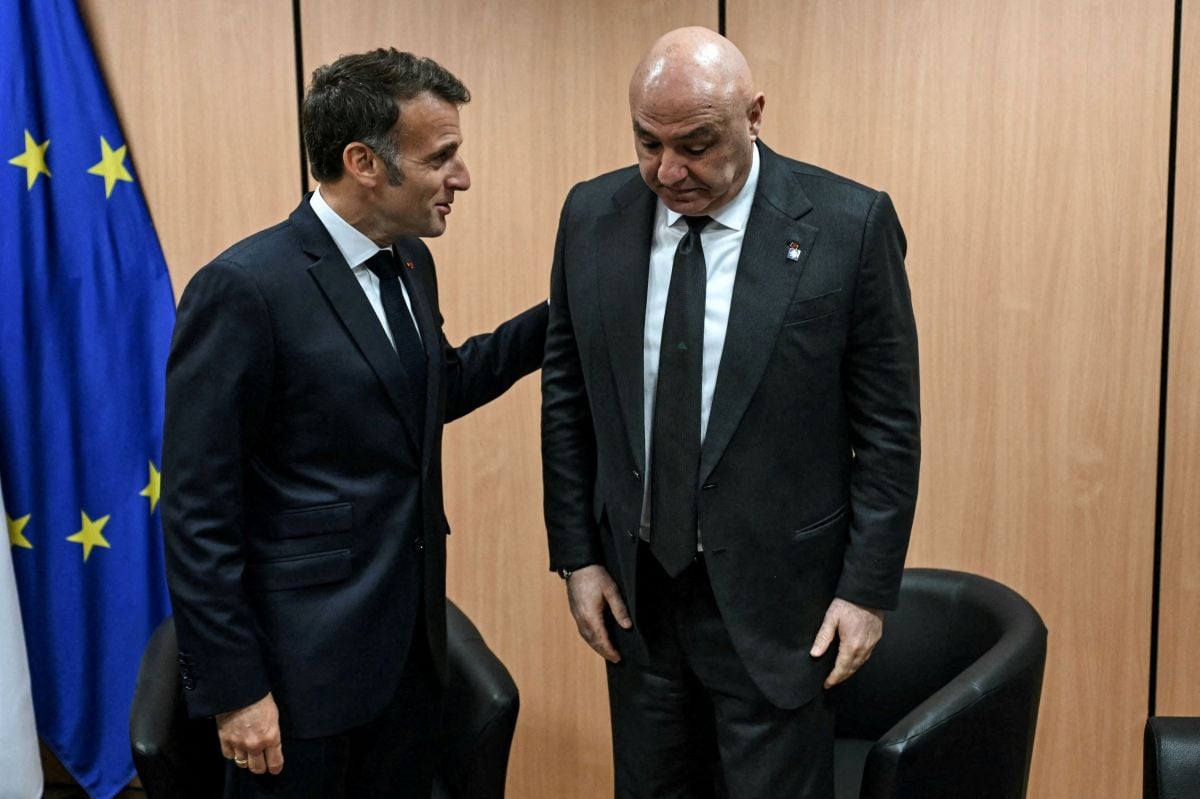
French President Emmanuel Macron meets with Lebanese President Joseph Aoun in Nicosia, Cyprus, on April 24, 2026, on the sidelines of a European summit. (Credit: Nicolas Tucat/Reuters)






BEIRUT — On Tuesday, French President Emmanuel Macron contacted his Lebanese counterpart Joseph Aoun, as well as Lebanese Prime Minister Nawaf Salam and Speaker of Parliament Nabih Berri. These discussions follow on from the U.S.-Iranian negotiations held in Switzerland and the conclusions of the latest G7 summit in France.
According to a statement from the presidency, Macron said he "would hold consultations with several countries to determine their position on the initiative" to deploy an international military force in southern Lebanon after the departure of the United Nations Interim Force in Lebanon, or UNIFIL, whose withdrawal is set to begin at the start of 2027.
The initiative has been supported by several European Union countries, including France, Italy, and Spain.
French Foreign Minister Jean-Noel Barrot said June 19 on Franceinfo that Paris is prepared to keep troops in Lebanon after UNIFIL leaves, in coordination with local authorities.
The two presidents also discussed Lebanese-Syrian relations and coordination between the two countries. On that occasion, Aoun welcomed comments made by Syrian President Ahmad al-Sharaa during a televised interview Sunday on Al Mashhad.
The Syrian president denied any intention to intervene militarily in Lebanon and raised the possibility of engaging in dialogue with Hezbollah "if this serves Lebanon's interests and preserves those of Syria."
Aoun and Macron also agreed to "maintain regular contact in order to monitor developments and ongoing efforts to consolidate the cease-fire in Lebanon and strengthen the authority of the state across its entire territory."
Macron also contacted Lebanese Prime Minister Nawaf Salam to discuss the follow-up to their meeting in Paris.
He also addressed the negotiations between Iran and the United States, as well as their implications for the region and Lebanon, according to a statement published on the Élysée’s X account.
Discussions also centered on the need to create the right conditions for organizing conferences in support of the Lebanese Army and security forces, as well as on reconstruction, a topic already raised in Paris last week.
Macron also called Speaker of Parliament Nabih Berri. According to the National News Agency (NNA), Macron emphasized “Lebanon’s role and the importance attached to its stability and sovereignty, as well as the willingness of France and friendly nations to support it in overcoming the difficult phase it is currently going through, whether through international conferences to support the Lebanese Army or through reconstruction."
Berri thanked “the French President and France for their constant support for Lebanon,” emphasizing “the importance of consolidating the "cease-fire" and securing Israel’s withdrawal from the territories it occupies back to the international borders, as well as the deployment of the Lebanese Army and the return of residents to their towns and villages, as a prelude to the launch of the reconstruction program.”
He also emphasized that “the November 2024 agreement is an existing opportunity, particularly in terms of the mechanism it provides for consolidating the "cease-fire" and verifying any violations or threats, should it be adopted in the ongoing negotiations in Switzerland.”
French Ambassador to Lebanon Hervé Magro met Tuesday with Lebanese Army Commander Rodolph Haykal to reiterate France's continued support for the Lebanese Army.

 Evening recap: Netanyahu announces West Bank offensive; 7 killed in Jordan church shooting; tents burned in south Lebanon
 US strike on Iran this weekend? ‘Absolutely,’ says Barrack; ‘I have no idea,’ says Trump