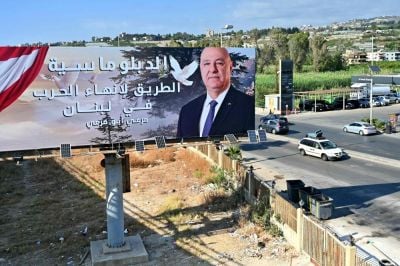


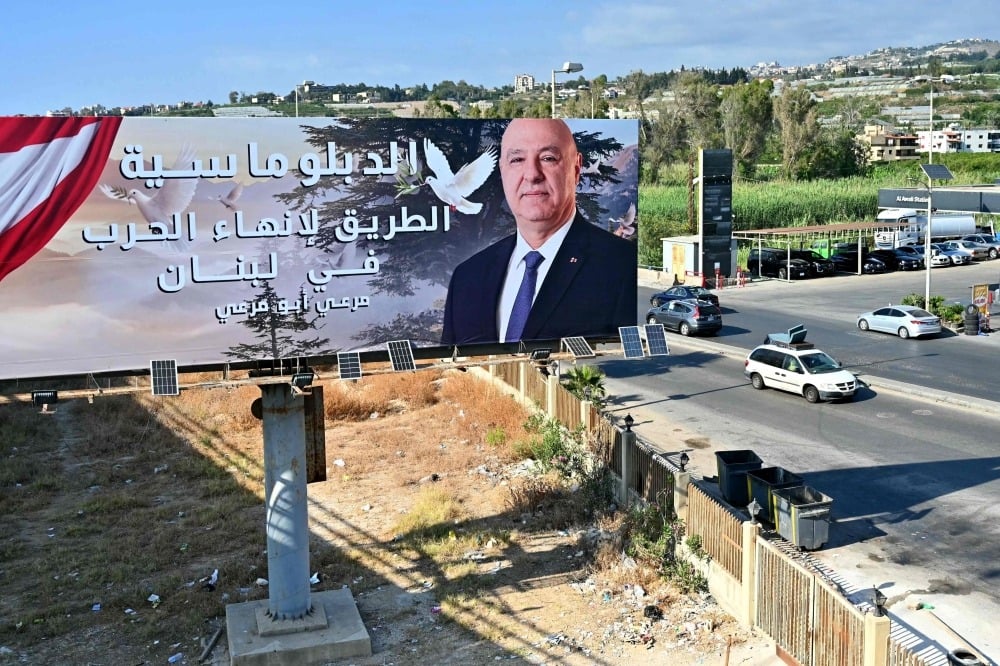
A sign in support of the diplomatic efforts of the President of the Republic, in Saida, southern Lebanon, on June 15, 2026. (Credit: Fadel Itani/ AFP)






Albert Kostanian, journalist, economist, and one of the signatories of the petition, responded Monday to questions from L’Orient-Le Jour.
The petition stresses the need to implement government decisions regarding the monopoly on arms. Can this issue be addressed without resorting to force, at a time when the army categorically refuses to act against Hezbollah and its commander insists that "civil peace" is the priority?
First, I would like to say that the 'Call to Save Lebanon' expresses a strong position in favor of Lebanon, with no concessions either to Iran or to Israel. It is a call to return to national constants and national discourse, which today is embodied by the state. Especially since we know all too well the Lebanese experience of 15 to 20 years of war driven by narratives that went against the national constants.
Therefore, today we must stand behind the state and its negotiations (in Washington). We also support the government and its decisions, especially the one regarding the monopoly on arms. We are not saying that Hezbollah will be disarmed tomorrow morning. In any case, this will not happen under bombardment. It is up to the government, not to us, to decide the timing and the process. However, a favorable climate must be ensured so that this issue is addressed without violence.
The petition was signed by many independent activists, including Shiites. Is it truly possible to propose a political alternative to the Shiite community while an armed militia like Hezbollah exists?
The text reflects a cross-community effort. Many anti-Hezbollah Shiites are among the signatories. They were carefully selected. There are members of parliament, intellectuals, journalists, and university professors. This proves that there is still an active Shiite civil society in Lebanon.
That being said, the petition does not constitute a full-fledged political alternative to the Shiite alliance. It is, however, proof that the foundations of a serious alternative exist. It should be clarified in this context that the petition is not addressed to Hezbollah, but to all Lebanese and all Shiites — including the popular base of the duo — to say that all Lebanese condemn wars and Israel’s actions, and are confident that the state is everyone’s ultimate shield.
The document also refers to the implementation and modernization of the Taif Agreement. This process requires a national dialogue, which could once again become another way for Lebanese leaders to avoid real progress. In your opinion, how can we ensure that this dialogue leads to genuine progress?
One of the points in the text emphasizes the refusal of any trade-off between the implementation of the Taif Agreement and the handover of arms. In exchange for its arsenal, Hezbollah would gain a genuine state.
Regarding the mechanism for implementing Taif, we are absolutely not talking about national dialogue. We are pushing for the building of a proper state. This would allow for the implementation of Taif, whose provisions specify implementation mechanisms, such as recourse to Article 95 of the Constitution (on the abolition of political sectarianism), to name just one example.
Do you intend to transform this initiative into a political organization? Do you have allies at this level?
The June 22 text is an inclusive petition aimed at gathering as many people and entities as possible around the aforementioned principles. Among these entities are, of course, the traditional political parties. It is therefore not a separate political party but an inclusive initiative centered on support for the state.