







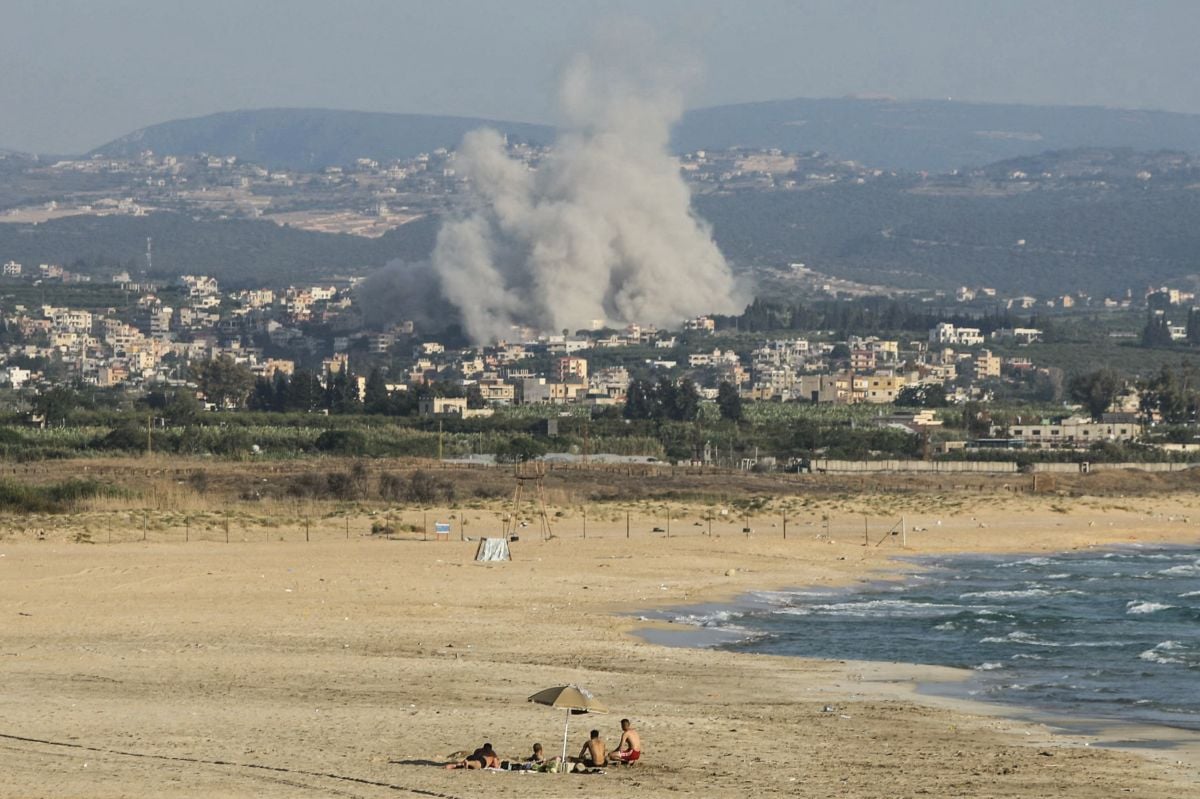
Smoke rises over Deir Qanoun al-Nahr, on the outskirts of Sour, after an Israeli strike on the village on June 8, 2026. (Credit: Kawnat Haju/AFP)






SOUTH LEBANON — Although Israel issued an evacuation order on Tuesday morning for the city of Sour and its suburbs — extending for the first time to the city's Christian quarter, which had until now been spared—its air force did not wait before carrying out deadly strikes on the area.
Beginning in the morning, Israeli forces carried out a series of strikes on Abbasieh and Ramadieh, north of Sour, as well as on the city’s “popular neighborhoods,” killing at least eight people and injuring 32 others, according to the Health Ministry.
In a post on his Arabic-language X account, Israeli military spokesperson Avichay Adraee then ordered residents of the city and its outskirts—including Shabriha, Hamdieh, Jal al-Bahr, Zoqaq al-Mafdi, Buss, Maashouk, Burj al-Shemali, Nabaa, Hosh, Rashidieh and Ain Baal — to evacuate north of the Zahrani River, which empties into the sea more than 25 kilometers north of Sour.
Adaree accused Hezbollah of being present in the Christian quarter, repeating claims made days earlier while warning of imminent strikes against the group.
Strike near UNESCO-listed archaeological site
After these warnings — which covered an area of around 20 square kilometers — the Israeli military continued its strikes, some of which resulted in casualties. The first strike, around midday, struck the area around the Rifai mosque in Sour, roughly three hours after the initial evacuation orders, according to our correspondent.
The targeted building is located less than 200 meters from the entrance to one of the city’s archaeological sites listed as a UNESCO World Heritage site. Two young men, Mohammad Abou Sahyoun and Khodr Atwi, were killed in the strike.
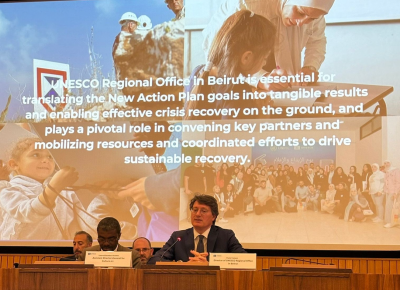
Israeli forces later carried out several bombings near the Buss Palestinian refugee camp, killing at least four people. Additional air strikes were also reported in Mansouri and Srifa.
The three archbishops of Sour — Georges Iskandar (Greek Melkite Catholic), Elias Kfoury (Greek Orthodox) and Charbel Abdallah (Maronite) — issued an urgent appeal to Lebanese authorities, calling for the protection of the Old City of Sour from destruction.
They said the area is “not a simple residential space, but the historical and human heart” of the city, home to thousands of civilians and centuries of cultural and religious heritage. Any damage, they warned, would constitute a “human and national catastrophe with irreversible consequences.”
Clashes and rocket fire in the south
Meanwhile, as an Israeli force attempted to advance in the Sour district toward Byout al-Siyad — just north of the “buffer zone” — Hezbollah said it forced the troops to withdraw toward Bayyada with a salvo of rockets. The group also claimed attacks against Israeli forces in Kantara and other areas linked to operations in Wadi Hojeir and Ghandourieh, with overnight exchanges of fire reported in the region.
Drone strikes intensify in south Lebanon
Elsewhere in south Lebanon, Israeli strikes continued without warning across multiple areas, with drones causing repeated casualties on roads and in villages.
In the Saida district, two people were killed in drone strikes, including in Ansarieh — which was hit at least six times since Tuesday morning — and Msayleh.
In the Nabatieh region, a drone strike in Kfar Roummane killed two people, while in Sharqieh, two Civil Defense rescuers were injured in a double strike after a team was targeted following an initial hit, according to a statement from the organization. Other drone strikes targeted Habboush and the road between Qseibeh and Adsheet.
In its daily update, the Health Ministry said Israeli strikes on Lebanon have killed 29 people and injured 133 in the past 24 hours. Since the resumption of hostilities on 2 March, Israeli strikes have killed 3,666 people and injured 11,321, the ministry added.
Infiltration in northern Israel
After an emergency meeting, Israel’s security cabinet reportedly authorized the army to launch strikes on the southern suburbs of Beirut “without political approval” in response to any rocket fire from Lebanon hitting Israeli territory, according to Channel 14.
Israel has repeatedly signaled its intention to enforce this new “equation,” which was already implemented on Sunday following a rocket launch attributed to Hezbollah that crossed the border. That strike triggered Israeli air strikes on Beirut’s southern suburbs for the first time since 17 April, followed by a brief escalation involving Iran and Israel.
No new rocket or drone attacks from Lebanon into northern Israel have been claimed by Hezbollah since then.
The Israeli army also reported an infiltration attempt from Lebanon, saying an armed individual crossed the Blue Line before being killed on the Israeli side near the Ramim Ridge, close to Manara opposite the Lebanese village of Houla.
In a statement, the army said troops had come under fire in the area and “neutralized a terrorist,” adding that the incident was still ongoing. Residents of nearby Israeli communities — including Misgav Am, Margaliot and Manara — were instructed to remain indoors and follow military guidance.
Reporting contributed by our regional correspondent, Muntasser Abdallah.
