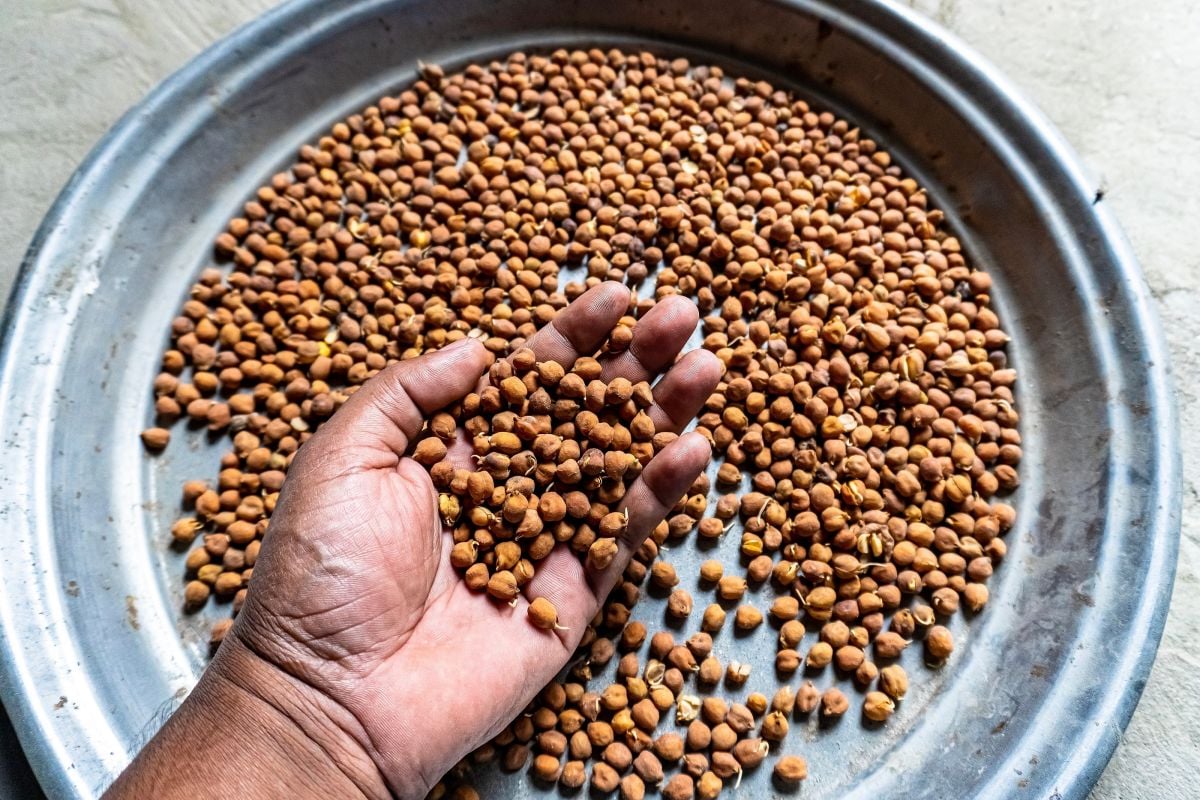
Chickpeas soon on the Moon? (Credit: Illustration photo bigstock)






This has nothing to do with the exploits of Tintin — this is very real! Two researchers from the University of Texas at Austin, Sara Oliveira Santos and Jessica Atkin, have pulled off the feat of growing chickpeas on lunar soil inspired by samples collected during NASA’s Apollo missions more than half a century ago.
The aim: to improve the diet of astronauts (increasingly working in space), who for a long time survived on dehydrated foods squeezed from aluminum tubes.
The process developed by these researchers was published in the ''Scientific Reports'' journal. They explained: "We will need to learn how to grow food on the moon, as it won’t be possible to regularly transport it by spacecraft. What’s more, sending shipments to space remains very expensive, and the survival of astronauts on the moon can’t depend on occasional deliveries of supplies."

Adapting
Hence the need to produce food on site, as astronauts are expected to spend long stays on the moon in the near future. In this context, the researchers’ goal is to maximize in-situ resources and use local substrate to provide sustainable support for horticulture.
As for why hummus will be a lunar first... First, the chickpea was chosen as a model plant because of its nutritional value. In addition, it has a great ability to host a symbiosis with other materials conducive to its growth.
Finally, the chickpea is rich in proteins, carbohydrates, iron, phosphorus, calcium, vitamin B and other nutrients, and it requires only minimal amounts of water and nitrogen. It is consumed worldwide as a nutritious protein substitute for meat and has been used in studies evaluating its ability to help restore soils contaminated by radioactivity and metals.
Of course, this new research marks a major advance in understanding the conditions required for growing food on the lunar surface. However, no one has yet tasted these lunar chickpeas. The team is currently working to determine whether the chickpeas contain too much metal to be eaten. "We want to assess their potential as a food source. Are they healthy? Do they contain the nutrients astronauts need? If they’re not edible yet, how long will it take until they are?" the team said.

On tables across Earth for millennia
In the meantime, as we know, chickpea-based dishes have found their way onto tables all over planet Earth for ages. Originating in Turkey and the Near East, the chickpea was domesticated around 5,000 B.C., before spreading to southern Europe, North Africa, Asia, and later to the rest of the world.
However, it is especially popular in southern countries. In fact, the south of France has its own "chickpea capital." It is called Rougiers, a town in the Provence-Alpes-Côte d’Azur region, which celebrates this regional staple every Sept. 13. The event includes parades, a market for producers and various activities.

This year, the highlight will be the restaurant Saint-Maximin-la-Sainte-Baume, which has developed a special "Chickpea menu," featuring three specialties based on the same ingredient: "Starter, chickpea trilogy: hummus, panisse and creamy chickpea soup, and carrots." Main course: "Chicken curry with chickpeas and coconut milk." Dessert: "Chickpea chocolate cake. Quarter bottle of wine and coffee"…
A toast to the good health of hummus — on earth, and at the University of Texas laboratory, which has now put down roots in the cosmos. Finally, note that this project, initially funded by the researcher duo Santos and Atkin, is now subsidized by NASA.