





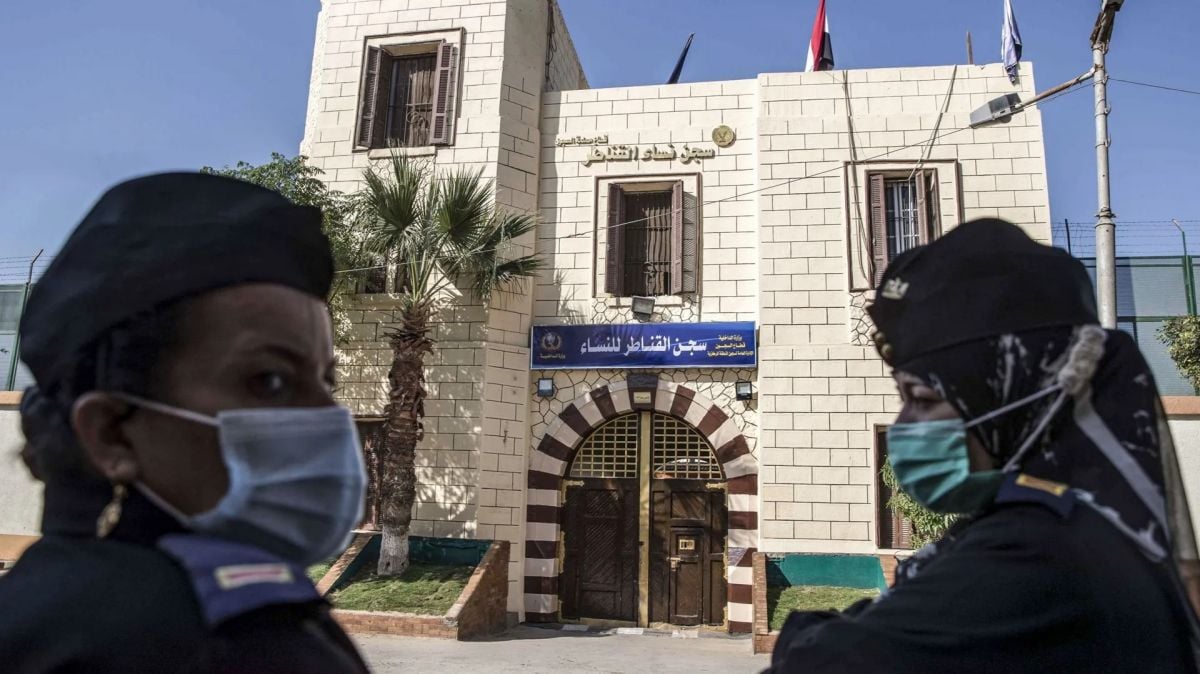
Egyptian policewomen stand in front of the entrance to Al-Qanatir women’s prison in Qalyubia province. (Credit: AFP)

Egyptian writer and researcher Ahmad Abdelhalim focuses on political sociology and body studies. He is the author of six works spanning literature and research, exploring themes of the body, prison, society, politics, and exile.
The structural shifts sweeping through the Egyptian state since the summer of 2013 mark a profound sociological and philosophical turning point. With authoritarian rule under Abdel Fattah al-Sisi evolving from traditional sovereignty into Foucault’s ''biopolitics'' and Achille Mbembe’s ''necropolitics.''
These authoritarian strategies did not stop at reshaping the public sphere through outright oppression, rather they pierced the very depth of the Egyptian body, treating it as a laboratory to produce submissive subjects, forcing an entire generation's consciousness into a forced existential trinity of prison, exile, and death.
The sociology of the suppressed body
In the contemporary Egyptian experience, and throughout the history of punishment, the prison represents something far beyond mere walls and fences. It serves as the ultimate expression of the state's power to suspend the law and enforce a ''state of exception,'' as theorized by Giorgio Agamben. Within this space, prison is no longer just a temporary punishment ; it becomes a machine that produces the ''homo sacer'', an individual entirely stripped of political and legal rights. Over recent decades, this system has left tens of thousands of Egyptians with exhausted and broken bodies, whether they remain behind bars or left them behind still carrying the wreckage in their bones, nerves, and memories, as these punitive practices have evolved into tools designed to physically reshape the body and dismantle its psychological and existential being.
The real prison, as the novelist Abdelrahman Munif calls it, begins long before crossing into the cell ; it takes shape in a person's terror and anticipation of fear. This is precisely what the carceral authorities seeks: to guarantee an individual's permanent submission, even within their own private spaces.
In parallel, the detained body becomes a battleground where the will to resist clashes with the machinery of repression. In his novel East of the Mediterranean, Munif portrays the body as an instrument of resistance when ''Rajab'' decides to return home, fully aware of the torture that awaits him, insisting that true helplessness does not reside in the body but takes root in the soul. However, the regime seeks to turn that very body into a testament of defeat through torture, neglect, starvation, and isolation, so that even after release, the detainee remains a being who carries the prison within ; a permanent scar that does not fade when the sentence ends.
Moreover, Egyptian prison literature has shifted from a realistic, documentary style to postmodern forms that use autofiction to record the vulnerability of the incarcerated body. As a result, the prison is no longer a mere documentary testimony, it has become a site where political identity is dismantled and reshaped through pain, a space where torture is deployed as a ''disciplinary'' technique designed to strip the individual of self-sovereignty and tame the ''soul'' by brutalizing the body. Therefore, in the Egyptian experience, the body emerges as a canvas upon which the state writes its violent marks, to the point where physical wreckage becomes an enduring extension of the sentence, outlasting the moment of imprisonment to overshadow life in its entirety.
Drawing upon Foucault's framework, Egypt's carceral spaces can be viewed as biopolitical tools that seek to manage the population through pervasive surveillance. Therefore, these philosophical concepts intersect to form a holistic view of the prison within the Egyptian context. While Foucault's biopolitics reflects the meticulous regulation of bodily movement and the control of food as punitive tools to produce subjects stripped of autonomy, Munif’s concept of the body as a testament of pain emerges to transform this body into a battleground that deepens the sense of helplessness and fractures the will for change, while Agamben’s state of exception steps in to legitimize prolonged detention through the practice of ''recycling'', suspending constitutional safeguards and stripping the detainee down to bare life, entirely devoid of any legal or sovereign protection.
The wilderness of exile and estrangement
With no glimmer of political hope and the constant threat of imprisonment or physical annihilation, tens of thousands of young Egyptians were forced to choose ''estrangement and withdrawal'' by escaping into exile. Yet, exile here cannot be reduced to a mere geographical relocation, instead, it transforms into an existential state that the late Syrian thinker Halim Barakat termed ''political alienation'' where the individual feels entirely powerless to impact their homeland, living through an internal fracture and a gradual loss of meaning, so the exile remains suspended between a nation that drove them away and a new society unable to fully embrace them.
This concept of alienation in Arab culture also emphasizes that these societies exist in a state of suffocation, trapped by an inability to transcend their current reality and accepting it as their ultimate fate. Therefore, the alienation of the exiled Egyptian takes on a dual nature: they are severed from their homeland while remaining a stranger within a new society that often views them as the ''Other''. From the heart of this rupture, a sense of ''political helplessness'' is born, driving many young people to take refuge in digital activism as a substitute for real-world action, thus widening the chasm between the dream and the possibility of its realization.
Consequently, exile becomes a form of ''social death'', as described by Mbembe, where the exile loses sovereignty over their own body and the right to belong. Living instead within a ''gray zone'' between life and death, denied the right to return, stripped even of the right to renew their Egyptian documents, and left unable to experience true stability abroad, as the very concept of ''sanctuary'' collapses, since the homeland has ceased to be a space of protection, transforming instead into a hostile environment that echoes the exact slogan thrown by supporters of Sisi's authoritarian regime: ''If you don't like the country, pack up and leave.''
This alienation is reflected in a persistent sense of helplessness, combined with political and existential depression, the direct result of losing any capacity to influence the nation’s future from abroad. On the other hand, this total lack of purpose drives many to withdraw from politics altogether or seek refuge in professional careers to escape the surrounding absurdity. Besides, social alienation remains a barrier to full integration within their new societies, which often leads to the creation of closed political ''ghettos'' that reproduce their traumas within exile itself.
Sisi’s necro-authoritarianism, or the management of death
After 2013, Egyptian authoritarianism surpassed the boundaries of the biopolitical regulation to reach what Mbembe terms ''Necropolitics.'' Sovereignty here is defined not by the protection of life, but by the power to decide ''who should live and who must die.''
Within this framework, the Egyptian public sphere has been transformed into a series of ''death-worlds'', where individuals are forced to exist under brutal conditions that reduce them to the status of the ''living dead.''
The manifestations of death under the current authoritarianism are diverse, serving as an expression of ''necro-power'' in population management. Death in public squares, as witnessed in Rabaa, al-Nahda, and elsewhere, revealed the direct exercise of the sovereign right to kill through a spectacle of violence aimed at deterring opposition.
Meanwhile, a slower form of mortality has emerged inside prisons through medical neglect and systematic torture, a process akin to ''killing in small doses'' that stretches across time. Furthermore, the phenomenon of suicide emerged as a reflection of the collapse of the public horizon, while forced exile and the deprivation of political rights remained a form of ''civil death'' that transforms a human being into a socially isolated creature before their biological death.
Drawing upon Mbembe’s philosophical framework, authoritarian regimes produce a ''surplus population'' that can no longer be integrated politically or economically. As a result, their very existence is managed by permanently exposing them to lethal risks. In the Egyptian context, entire segments of youth and activists have been treated as ''surplus population'' or as ''threats to public order,'' a classification used to justify prolonged imprisonment while forcing people into exile and dangerous migration paths. In this manner, the regime redefines its sovereignty through ''The right to kill'' and ''The right to expose others to a slow death.''
The deepest impacts of authoritarianism do not only manifest in prisons and bodies, but rather appear in the mental and existential collapse of the collective identity. The generation of the January Revolution is living through what can be called the ''trauma of political activism.'' This is a state of total paralysis caused by a continuous series of shocks aimed to wipe out collective memory and rebuild society through fear, violating sacred boundaries, and demonizing the opposition.
As a result, a state of ''forced indifference'' emerged, and huge numbers of young people became alienated from politics, and eventually from life itself, when painful memories turned from drivers of change into tools of deterrence. Hence, there emerges what can be described as the ''collapse of the concept of homeland,'' where the homeland is no longer a safe shelter, but a space of permanent emergency, while the phrase ''if you don't like the country, pack up and leave,'' becomes a tool of stripping away citizenship, turning the opponent into an ''internal refugee'' before they eventually become an exile abroad.
In the end, the triad of prison, exile, and death reveals how the ''necro-authoritarian'' system is completely put together, ruling society through fear, pain, and a continuous cycle of helplessness.
Even so, collective memory cannot be completely wiped out. The harsh experiences that thousands of young people lived through could turn into a hidden reservoir, bringing political action back to life in the future. And as Abdelrahman Munif says: ''If it were not for forgetfulness, human beings would die from the weight of what they know.'' Yet in the political world, forgetting can become just another form of death, while memory remains the final fortress against the ''politics of death.''
This article was originally published in French by L'Orient-le Jour and translated to English by Mira El-Hayek.






