








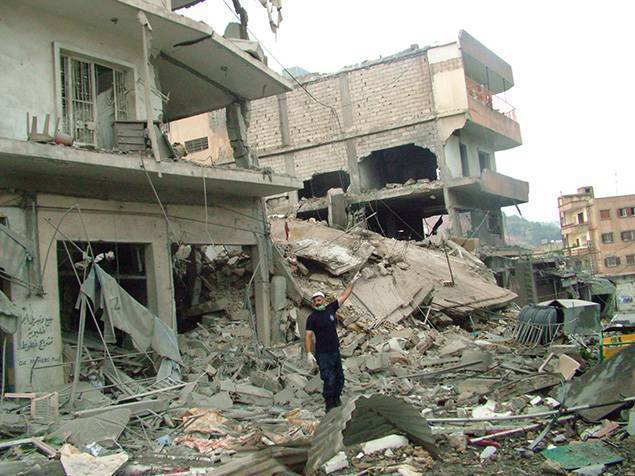
A man stands amid the destruction in Nabatieh, southern Lebanon, in the aftermath of the July 2006 war. (Credit: Photo taken from the archives of L'Orient-Le Jour newspaper)






Twenty years after the 2006 July War, the most important question is no longer who won and who lost, but rather: What did the war do to Lebanon, to southern Lebanon, to the Shiite community, and to the very idea of the state?
Wars are measured not only by their outcomes, but also by the imprint they leave on collective consciousness, on power structures and on the relationship between the state, and the communities that compose it.
The July War became a defining moment in Lebanon’s contemporary political memory. It ended with a cessation of hostilities and was codified internationally through United Nations Security Council Resolution 1701, which called for an end to attacks, the deployment of the Lebanese Army and UNIFIL in the southern Lebanon, the withdrawal of Israeli forces, and a ban on the transfer of weapons into Lebanon without the approval of the Lebanese government.
Twenty years later, however, the question remains: Did the U.N. Resolution 1701 truly end the war, or did it merely institutionalize a fragile truce between two wars?
The first thing that changed is that the 2006 war is no longer viewed solely through the lens of the "miraculous victory of steadfastness." Instead, it has become the benchmark against which subsequent wars — and the risk of renewed conflict in southern Lebanon — are measured.
At the time, a dominant narrative centered on deterrence and Hezbollah’s ability to prevent Israel from imposing its will by force.
Twenty years on, however, the very notion of deterrence has become far more problematic. Deterrence that does not evolve into lasting stability, and that is not translated into state sovereignty, can shift from being a source of protection to a mechanism for managing permanent risk. It may, at times, prevent all-out war, but it cannot prevent a society from living under the constant shadow of another conflict — one increasingly tied to interests that extend beyond Lebanon’s borders.
Here, one enduring reality stands out: Lebanon has remained a country whose state does not hold a monopoly over the decision to go to war or make peace.
In 2006, the central question was: Who decides when the country goes to war? The government? Hezbollah? Regional powers? The balance of power?
Twenty years later, the essence of that question has changed very little. Southern Lebanon remains a space where the local and the regional, the Lebanese and the Iranian, the border issue and the Palestinian question, the defensive and the strategic, all intersect.
This does not mean absolving Israel of responsibility for its repeated attacks. Instead, it means recognizing that condemning Israeli aggression does not preclude criticism of the Lebanese political structure that allows an entire community to be turned into a permanent front line.
The position of the Lebanese state has also changed. In 2006, the state was weak and divided, but it had not yet collapsed as it did after the economic and financial crisis of 2019.
Back then, it was unable to prevent the war. After the collapse, it became unable even to deal with its consequences.
A state that cannot control security decisions, protect the economy, guarantee compensation or manage displacement is reduced to receiving disasters and counting the dead rather than preventing them. People in southern Lebanon are therefore caught between an Israeli force that attacks and destroys, an internal force that holds strategic decision-making power outside the state, and a government that often appears only after the destruction, to make promises, negotiate or appeal for aid.
The deepest transformation, however, has been social and psychological.
In the aftermath of the 2006 war, a narrative of steadfastness and victory took root across broad segments of society. That narrative was understandable: a community that had endured bombardment and destruction needed a meaning that would help it bear the loss. Societies do not live by numbers alone. They need a story that transforms suffering into dignity.
But twenty years on, it is no longer enough to ask: Did we stand firm?
Another question has become unavoidable: What did that steadfastness cost us? Who paid the price? And can the communities that bore the brunt of the war discuss that cost without being accused of betrayal or weakness?
This reality confronts Lebanon with a dichotomy that cannot be ignored.
Yes, there was a large-scale Israeli assault whose civilian toll was measured in bombardment, displacement and destruction. And yes, there was also a society expected to display an almost superhuman capacity for endurance.
That is why public consciousness has changed.
The generation of 2006 experienced the war as an extraordinary event, after which life could eventually resume. But the generations that followed — having lived through the financial collapse, the Beirut port explosion, repeated waves of displacement and recurring border tensions — have come to see war as a permanent possibility.
For those living on the brink of displacement, sovereignty is not an abstract concept to be invoked in political speeches. Their questions are far more immediate: Should I keep a bag packed in the car? Should I rebuild my home or wait for the next war? Should I raise my children to stay, or to pack their bags and leave?
The deepest constant, however, is that Lebanon has remained an arena rather than becoming a fully sovereign state. Twenty years on, it has yet to move beyond serving as a battleground for competing interests and assume the role of a state with full authority over its own affairs.
In that sense, U.N. Security Resolution 1701 has functioned more as a framework for managing tensions than as a lasting solution.
The key questions are not merely technical: Has the Lebanese Army deployed? Has UNIFIL increased its presence? Have there been violations?
They are political and sociological. Why does southern Lebanon remain suspended between the authority of the state, Hezbollah, the United Nations, and Israel? And why have the Lebanese been unable to forge a political compact that makes the defense of the country’s territory a shared national responsibility rather than the responsibility of a single community?
What has remained constant, then, is a structure of fear: fear of Israel, fear of internal divisions and fear of speaking the whole truth. What has changed is that society is no longer as willing to embrace the old rhetoric. There is a deep fatigue with wars, slogans and the repeated treatment of ordinary people as testing grounds for competing theories of deterrence, resistance and diminished sovereignty.
Even within the communities that have traditionally embraced the discourse of resistance, speaking only of Israeli aggression is no longer enough. The question has become: How do we protect people not only from external aggression, but also from the consequences of unilateral decisions?
Twenty years on, Lebanon has changed profoundly — and yet, in many ways, it remains the same.
It has changed because the state is weaker, the economy has collapsed, society is more exhausted and people are far more conscious of the cost of war. Yet it remains the same because the core of the crisis has never been resolved: incomplete sovereignty, a fragmented security decision-making process, a South suspended in uncertainty and an Israeli adversary that remains a permanent threat.
For that reason, commemorating the July War should not simply be an occasion to revive narratives of either victory or suffering. It should instead prompt a different question: How can Lebanon move beyond celebrating survival and begin creating the conditions for a normal life?
Steadfastness is a virtue in moments of danger. But it becomes a tragedy when it turns into a way of life. Perhaps the time has come to recognize that protecting southern Lebanon means not only preventing Israel from advancing, but also preventing Lebanon from remaining captive to a postponed war, a postponed state and a postponed future.


 7 p.m. recap: Iran warns Egypt, Israeli soldiers vote in south Lebanon, Haret Hreik responds to Kataeb