






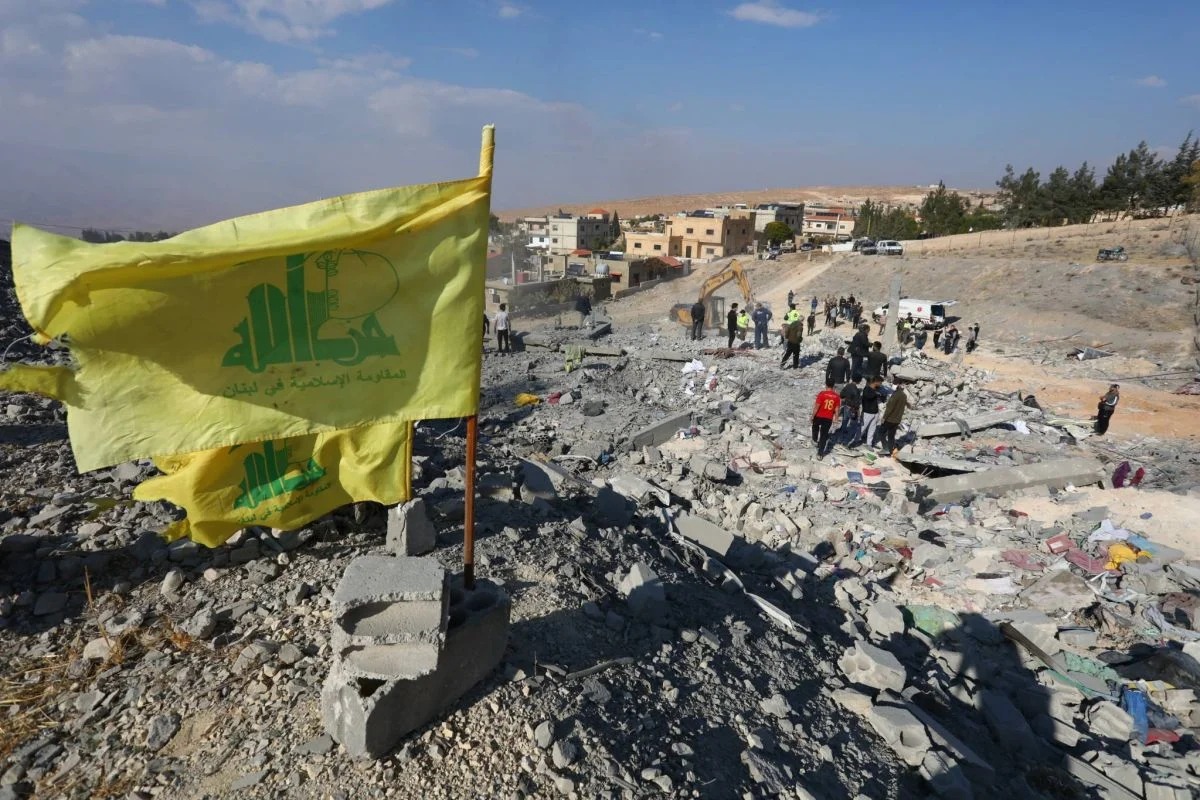
A Hezbollah flag planted on the ruins of a building bombed by Israel in Hermel, in the Bekaa, in November 2024. (Credit: Mohammad Yassine/AFP)






BEIRUT — Several figures close to Hezbollah and other Shiite personalities spoke on Monday on the occasion of the 26th anniversary of May 25, 2000, the date of the unilateral withdrawal of the Israeli army from south Lebanon after 18 years of occupation, despite Israel’s current presence in large parts of Lebanese territory.
Senior member of Hezbollah’s political council and its former chief of the Coordination and Liaison Unit, Wafic Safa said that "the resistance gave the state a chance for 15 months, without the diplomatic option succeeding" adding that "the authorities' resort to direct negotiations constituted a gain for Israel and the United States and a failure for [Lebanon because they did not] take advantage of the strength of the resistance against Israel," according to a statement to the al-Nour party radio rebroadcast by the al-Nashra site.
He added that "the leadership of the Lebanese Army — led by General Rodolf Haykal — has sufficient political and social awareness, taking Lebanon’s interests into account," stressing that "there will never come a day when the resistance opposes the army," which has a "national conscience."
These remarks come as the war between Israel and Hezbollah resumed on March 2, following the war triggered by the United States and Israel against Iran, after the failure of a first cease-fire agreed at the end of November 2024. Since then, Israel has carried out heavy strikes in southern Lebanon and the Bekaa Valley, with a toll exceeding 3,100 killed and damages estimated at tens of billions of dollars, despite a new truce agreed on April 16 and extended several times.
Hezbollah rejects handing over its weapons to the Lebanese Army as requested by the government citing Israel's continued occupation of more than 600 square kilometers of south Lebanon and daily strikes since March 2. It also criticizes the government’s decision to enter negotiations with Israel to achieve a lasting cease-fire.
Shiite-Iran relations
The next Lebanon-Israel meeting is scheduled for May 29 at the Pentagon to discuss security and military issues, as Hezbollah lawmaker Hussein Hajj Hassan warned that "the government's trajectory is leading the country toward a difficult phase" and that "the government's poor security approach could lead to clashes in the streets," noting that "the fall of the government in the streets was discussed as a possibility and not as a decision," referring to a threat made the previous day by the Hezbollah leader.
Washington and Israel are seeking, together with the Lebanese Army, to implement a plan to disarm Hezbollah and dismantle its military structure. Hezbollah Secretary-General Naim Qassem on Sunday rejected any scenario in which the group would surrender its heavy weapons.
Ali Fayad, another Hezbollah MP, called on the Lebanese authorities to "review their policies, reconsider their mistaken decisions with regard to their relations with Iran," accusing the authorities of having "thrown the doors wide open to regional and international interference." He also said that "the Lebanese authorities did not take into account ... the specific nature of the relations between the Shiite community and the Islamic Republic." According to him, the Lebanese crisis "has gone beyond the question of weapons" to affect "domestic stability, the political identity of the country, and its future."
While U.S.-Iran negotiations continue, Fayad said any "Iranian success in imposing a comprehensive cease-fire including the Lebanese front, as a main element of the outcomes of the negotiations, reveals the scale of the error committed by the Lebanese authorities, which have adopted a hostile line toward Iran."
Among other Shiite figures to speak out, cleric Ali Fadlallah said this date "reminds the Lebanese of the achievement accomplished when they united their efforts and pooled their forces, succeeding in driving the enemy out of their land." He stressed that "national unity remains one of the main pillars of the Lebanese people's strength in the face of the enemy's project," calling to avoid "divisions" and "provocative rhetoric."
Mufti Kabalan, also seen as close to Hezbollah, said the current situation of the Muslim world was "catastrophic" due to division among states, calling for the creation of "an Islamic union able to face international challenges, protect the interests of Muslim peoples and counter projects of division and foreign influence in the region."