


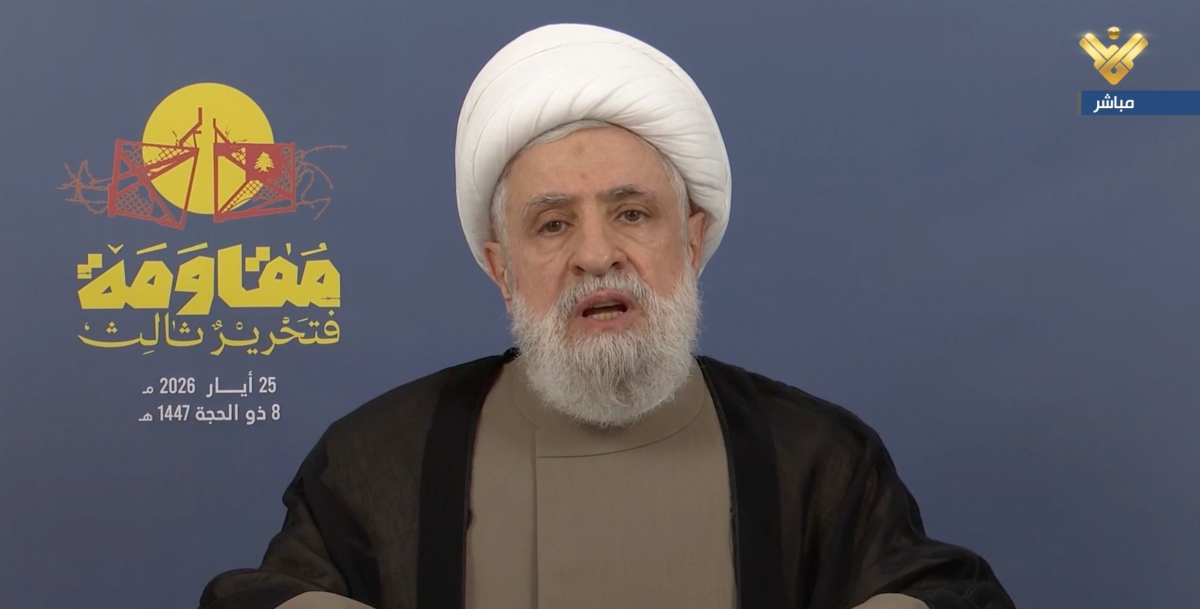
The Secretary General of Hezbollah, NaIm Qassem, during a speech on Sunday, May 24, 2026. (Credit: Screenshot of the broadcast of the speech by Hezbollah's channel, Al-Manar)






BEIRUT — Hezbollah Secretary-General Naim Qassem on Sunday struck a defiant tone against mounting domestic and international pressure on party-militia, rejecting calls for disarmament, warning the Lebanese government against confronting Hezbollah. He delivered those remarks during a speech commemorating May 25, 2000 — the day Israel unilaterally withdrew from southern Lebanon after 18 years of occupation — against the backdrop of daily Israeli bombardment and continued occupation despite the cease-fire in place since April 16.
Qassem warned the government that Hezbollah "will confront with all [its] strength all those who confront it," and "without hesitation," claiming that the Lebanese authorities "do not have the right to act as they please." He added: "The people have the right to take to the streets to topple the government."
His speech comes in the context of ongoing U.S.-Iran negotiations that, until now, had appeared to be moving toward an agreement potentially favorable to Tehran, Hezbollah’s main backer. "God willing, the agreement sponsored by Pakistan will be concluded, and it includes Lebanon with a total cease-fire" on all fronts, Qassem said.
'To hand over our weapons is to be annihilated!'
The Hezbollah leader went on to say, "If this government is unable to ensure sovereignty, it should go," adding, "The people have the right to take to the streets to bring it down and confront the Israeli-American project targeting the country's institutions."
Such rhetoric is reminiscent of Hezbollah's takeover of western Beirut and the Druze Mountain on May 7, 2008, when its militia moved against the government of Fouad Siniora after authorities decided to dismantle the group’s parallel telecommunications network and dismiss security officials close to it. Many observers fear that an agreement favorable to Iran could embolden Hezbollah and raise the prospect of a similar confrontation with Prime Minister Nawaf Salam's government.
Qassem also renewed calls on the Lebanese state to "abandon direct negotiations with the Israeli enemy" and instead "pursue a national consensus."
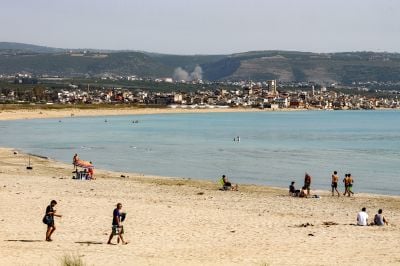
The next meeting between Lebanon and Israel is scheduled for May 29 at the Pentagon to discuss security and military matters. Washington and Israel are seeking to jointly implement a plan with the Lebanese Army aimed at disarming Hezbollah and dismantling its military infrastructure. In August 2025, the Lebanese government tasked the army with drafting a plan to disarm the party-militia. According to authorities, the process was completed south of the Litani River in January 2026 in coordination with Hezbollah, which continues to reject handing over its weapons beyond that area. And following the resumption of the latest war with Israel, the government declared Hezbollah's military and security apparatuses illegal.
"Lebanese authorities tell us: Help us disarm you so Israel can then come in, kill you and displace your people as well as the Lebanese," Qassem said. "To hand over our weapons is to be annihilated!" the Hezbollah leader declared, saying the group was facing an "existential war." "Disarming the Resistance means depriving Lebanon of its defensive capability, its strength in negotiations and in protecting its wealth and existence," he added, two months after Hezbollah’s decision to involve Lebanon in the regional war to "avenge" the assassination of the Iranian Supreme Leader.
Qassem argued that "what is happening is not someone else's war, but a war that targets our existence," responding to criticism from the overwhelming majority of Lebanese officials. He also vowed that Hezbollah "will not surrender, even if the whole world unites against [it]," and said its "drones will continue to track enemy Israeli soldiers" in southern Lebanon.
"We will confront with all our strength and without hesitation Israel as well as all those who fight us at its side," he added, in an apparent warning to the Lebanese authorities. "Tell me what you have done over a year and a half [the period of initial cease-fire between Hezbollah and Israel from 2024 until 2026]; and if you are incapable, then leave."
American sanctions 'will not weaken the Resistance'
Qassem also said that "the attack on al-Qard al-Hassan [the financial institution linked to Hezbollah] is an attack on hundreds of thousands of poor and low-income people," describing efforts to shut down the institution as "an Israeli-American project" that Hezbollah would oppose. As early as July 2025, Hezbollah voiced concern over a decision by the Banque du Liban (BDL, central bank) prohibiting banks, financial institutions, brokerage firms, collective investment funds and other entities from dealing with the institution. Several of its branches have been bombed by Israel since 2024.
He also insisted that U.S. sanctions "will not weaken the Resistance," days after unprecedented measures were announced against Hezbollah officials, members of the Amal Movement and security officials accused of colluding with the militia. On that point, Hassan Fadlallah, one of the Hezbollah MPs targeted by the measures, reiterated Sunday that Iran’s condition for an agreement with the United States is "an end to the war in Lebanon."
Meanwhile, Israeli Prime Minister Benjamin Netanyahu said U.S. President Donald Trump, during a phone call on Saturday, had reiterated "Israel's right" to fight Hezbollah in Lebanon. Israeli Chief of Staff Eyal Zamir also said the army had prepared "attack plans for the coming weeks," during which it would deliver "a decisive blow" to Hezbollah.
 2 p.m. recap: Flydubai investigation points to 'terrorist act'; calls grow for Hassan Diab’s extradition to France