








A female soldier stands among the graves during the funeral of Sergeant Major Alexander Glovanyov, killed the previous day in combat near the Lebanese border, in Petah Tikva, on May 11, 2026. (Credit: Ilia Yefimovich/AFP)






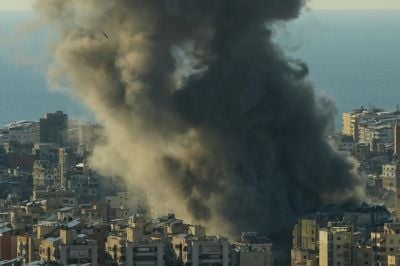
BEIRUT — As the war between Hezbollah and Israel approaches its third month, Israeli forces that invaded southern Lebanon continue extensive destruction of villages while struggling to counter waves of rudimentary Hezbollah drones. In recent days, sections of the Israeli press have expressed growing confusion over a conflict that continues despite the declared cease-fire, while also amplifying the frustration of military personnel, with more than 20 soldiers reportedly killed in Lebanon.
"There is no point in staying in Lebanon," "senior commanders on the ground" told the right-leaning media outlet Israel Hayom early on in the campaign. "The armed forces continue to destroy buildings in southern Lebanon, but in reality, the army is achieving no concrete results in these battles as they are currently fought," one of the officers said.
"Brigade commanders do not understand what is expected of them: they do not know whether there is a cease-fire, whether we really want one, or whether we want it to fail. On the ground, there is no cease-fire, but it is impossible to mobilize all our capabilities," military sources said.
"On the news, they say 'cease-fire, cease-fire' — what are you talking about? Do you know how many drones they [Hezbollah] are sending at us? This circus never ends. Is that what a cease-fire is?" a reservist quoted by the left-wing newspaper Haaretz asked.
'Permanent war'
These concerns are also reflected in commentary by Doron Kodosh, the military affairs correspondent for Israeli army radio (GLZ), who has criticized in recent weeks the army’s lack of transparency regarding operations in southern Lebanon. He also questioned Defense Minister Israel Katz on Wednesday, accusing him of avoiding "major" security issues, including how to counter explosive drones that have killed several fighters.
"How are the security services, under his leadership, working to better handle the explosive drones that killed five fighters last month?" he asked. "How, as defense minister, does he intend to ensure the safety of residents in the north of the country, who continue to endure bombardment, live through a permanent war and see no prospect for its end?"
That bleak outlook is also reflected in public opinion. A poll published in late April by Israeli public broadcaster KAN found that 57% of respondents believe Israel has not achieved victory on any front since Oct. 7. Only 14% of respondents expressed confidence in a victory against Hezbollah.
The Hezbollah drones threat
Beyond uncertainty over political and military objectives in Lebanon, Hezbollah's suicide drones — operated via fiber optics and therefore difficult to intercept — remain a central concern. "The situation is extremely difficult for Israeli forces," senior Israeli army officers told the website Walla News.
Unlike the military personnel interviewed by Israel Hayom, these officers believe that instead of withdrawing from southern Lebanon, Israel should "expand the area controlled" by its forces. "A targeted ground maneuver, allowing the area controlled by the Israeli army to be expanded and Hezbollah to be pushed back toward Beirut, could reduce the number of casualties caused by suicide drones," they argue.
From a technical standpoint, several solutions to the threat of drones have been suggested, but none have yet been implemented. Israeli forces are relying on improvised countermeasures such as nets stretched between buildings or over vehicles, while awaiting more advanced systems.
Haaretz has also reported on proposals for drone-catching systems using nets, while Maariv reported that other solutions are under study.
Israel Aerospace Industries, a company owned by Israel and other defense companies "have presented the Defense Ministry and the army with solutions, including a quantum interception system, energy-powered systems, including one based on electromagnetic force that is supposed to capture the drone and prevent it from moving," Maariv explains.
In a broader investigation into the Israeli army's "moral decay" in southern Lebanon, Haaretz, published chilling testimonies from several soldiers, one of whom is reported to have said "on the other side of the border, you can be a little crazy."
Haaretz published testimonies from soldiers and allegations of looting on Lebanese territory, which the Israeli army turns a blind eye to. Several Israeli outlets have also urged authorities to draw lessons from Israel’s previous occupation of southern Lebanon, which ended with the 2000 withdrawal.