






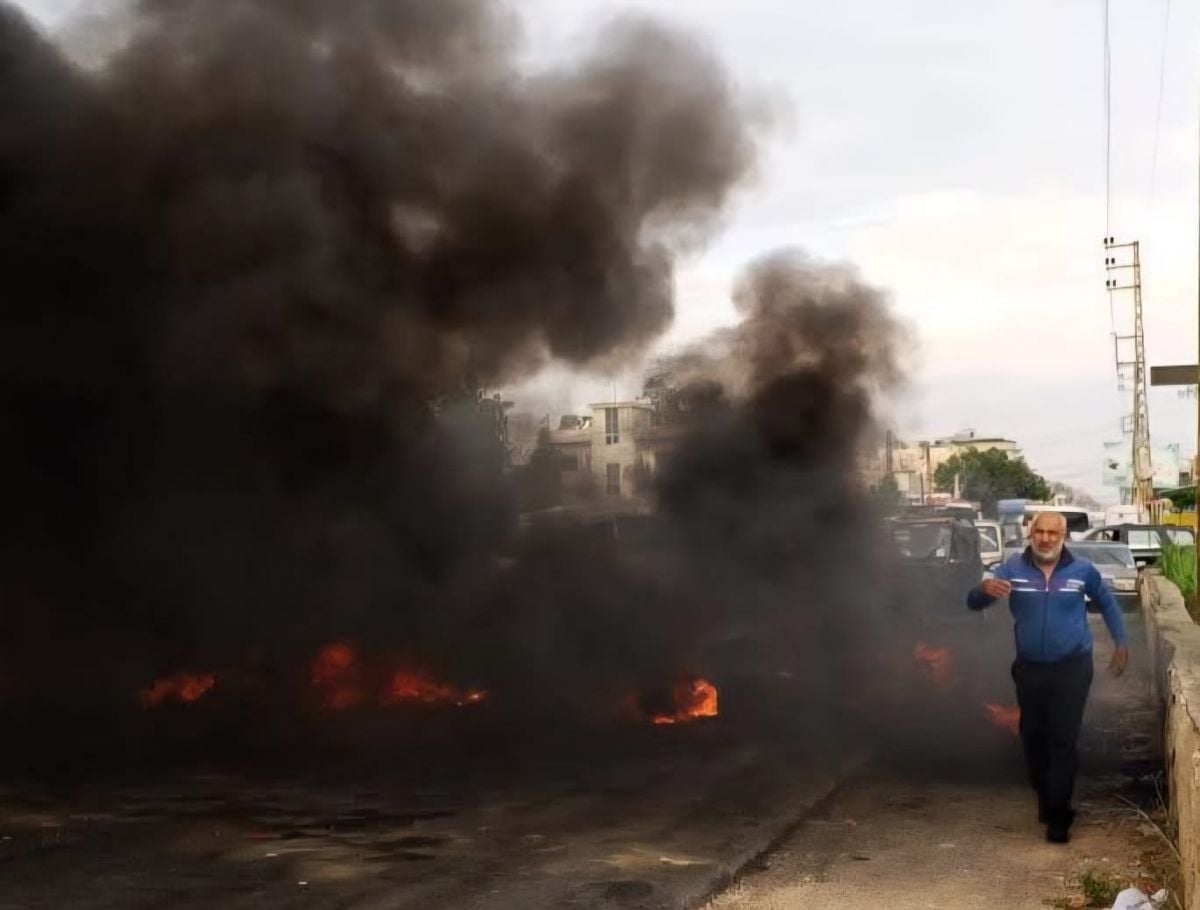
Tires set on fire during a protest on the road linking Abdeh to Halba in northern Lebanon, on May 20, 2026. (Credit: Michel Hallak)






BEIRUT — What had appeared to be a breakthrough was not one after all.
As MPs seemed poised Thursday to adopt a draft law on general amnesty approved Tuesday by joint parliamentary committees, Parliament Speaker Nabih Berri changed course. On Wednesday, he announced that Parliament’s plenary session had been postponed “to a later date under the banner of consensus.”
Behind the decision was mounting rejection of the proposed law within Lebanon’s Sunni community, which critics have described as “unjust.”
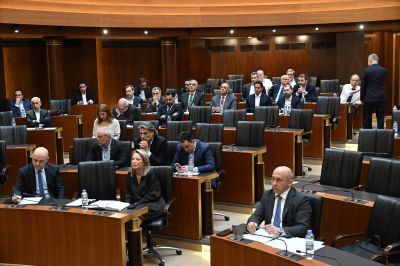
The draft law was negotiated as part of a broader political bargain among parties representing Lebanon’s various sects. Sunni leaders have pushed for the release of Islamist detainees, many accused of shooting at or killing Lebanese soldiers. Shiite parties want the release of certain drug traffickers, while Christian parties are seeking to include Lebanese exiles living in Israel.
On Tuesday, the deal appeared to be moving forward after joint committees approved what was described as a “consensual” version of the text. But protests quickly erupted.
Several sit-ins were organized in predominantly Sunni areas, including Tripoli and Akkar in northern Lebanon, Saida in the south, Ersal in the Bekaa near the Syrian border and Khaldeh south of Beirut, to denounce the proposal. The demonstrations were soon backed by Sunni political representatives, many of whom had initially welcomed the law.
Families of soldiers also object
According to information obtained by L’Orient-Le Jour, Berri did not coordinate his decision to postpone the parliamentary session with the presidency in the Baabda Presidential Palace.
In a statement, the speaker condemned the “sectarian and confessional incitement” reported during protests against the draft law “in several regions.” He said the proposal aimed to “restore the principle of justice” and address chronic judicial delays, adding that Lebanon “more than ever needs solidarity and consensus.”
Imad Hout, an MP from al-Jamaa al-Islamiya, told L’Orient-Le Jour that several provisions in the current draft had raised concerns within the Sunni community.
“One issue is the clause stipulating that the law will not apply if relatives of murder victims refuse to waive their personal claims,” the Beirut MP said, warning that “many detainees therefore risk not being released.”
According to Hout, contacts are underway “to try to find a solution.”
“We cannot accept seeing others benefit from the amnesty while being prevented from doing the same,” Tripoli MP Ashraf Rifi told L’Orient-Le Jour.
He said the amendments demanded to the text approved Tuesday “would give Sheikh Ahmad al-Assir a chance to leave prison.”
The reference was to the Salafist cleric involved in the 2013 clashes in Abra, near Saida, between his supporters and the Lebanese Army. Assir’s supporters deny he targeted soldiers, accusing the military tribunal of aligning with Hezbollah and claiming they were firing at Hezbollah fighters, not army troops.
Still, not all Sunni politicians oppose the current draft.
Beirut MP Nabil Badr said some MPs were attempting to exploit Sunni anger for populist purposes, even if it meant obstructing the law’s passage.
“I repeat for the hundredth time: We proposed this law to end injustice. But we did not tailor it to Sheikh Assir,” he said.
But opposition to the law extends beyond Islamist detainees’ families.
Bilal Abdallah, a Progressive Socialist Party MP from Chouf, told L’Orient-Le Jour that the proposal “faced reservations from Defense Minister Michel Menassa,” who is close to President Joseph Aoun, “particularly regarding detainees accused of killing soldiers.”
Families of fallen soldiers have also protested the draft.
On Wednesday, the family of Bilal Ali Saleh — a soldier killed during the 2013 Abra clashes and originally from Brital in the Bekaa — expressed its “absolute rejection of any amnesty or sentence reduction” for Assir or anyone implicated in the events.
“The blood of the martyrs cannot be subject to political bargaining,” the family said, calling on the judiciary to ensure full accountability.
Bekaa clans voice anger
L’Orient-Le Jour also learned that another point of contention was the decision, announced Tuesday by Deputy Parliament Speaker Elias Bou Saab, to vote on the amnesty bill as a whole rather than article by article.
That move reportedly angered several political factions and contributed to Berri’s decision to postpone Thursday’s session indefinitely.
“Some MPs were counting on parliamentary debates to introduce further amendments to the text approved Tuesday. Voting on it all at once would prevent that,” an anti-Hezbollah MP told L’Orient-Le Jour.
Earlier, members of prominent Bekaa clans — most of them Shiite — also criticized what they described as an “incomplete and unjust law that does not do justice to the Bekaa.”
In a statement, they referred to tens of thousands of arrest warrants targeting residents of the region and “thousands of young people behind bars for drug use and trafficking cases, in a context marked by decades of underdevelopment and lack of economic alternatives.”
“We do not want a partial amnesty that entrenches injustice and abandonment,” the representatives said.
Later Wednesday, mokhtars, local dignitaries and clan representatives from the Bekaa organized a sit-in in Douris, at the entrance to Baalbeck, demanding a “comprehensive and nonselective general amnesty.”
Meanwhile, Lebanon’s Higher Judicial Council pushed back against criticism directed at the judiciary during the amnesty debate, particularly over trial delays and prison overcrowding.
In a statement, the council said the situation “cannot be reduced solely to prison overcrowding,” arguing it also stemmed from “multiple social and political factors.”
The council highlighted efforts to speed up case processing, citing figures from the six months following recent judicial appointments: 63,412 cases handled by appellate public prosecutors, 7,332 by investigative judges and 31,076 by criminal courts.
As for procedural delays, the council attributed them mainly to external causes, including delays in notifications and “logistical, administrative or security-related reasons” linked to transferring detainees, independent of the judiciary’s will.
The draft law, which MP had been expected to examine Thursday, notably concerns detainees sentenced to death, a penalty Lebanon has not carried out since 2004. Under the proposal, death sentences would be commuted to 28 prison years, calculated at nine months each.
Prisoners serving life sentences would see their terms reduced to 17 prison years.
Several Islamist detainees could benefit from the new provisions, as demanded by some Sunni leaders. However, the draft specifies that the law would not apply if relatives of murder victims refuse to waive personal claims.
Speaking to reporters Tuesday, Bou Saab declined to clarify the fate of Ahmad al-Assir, one of the main figures concerned by the proposed amnesty and accused of killing Lebanese soldiers during the June 2013 Abra battle near Saida.
A parliamentary source, however, ruled out Assir’s imminent release, despite years of demands from detainees’ families.

 8 p.m. recap: Israel again threatens Beirut’s south suburbs; 2 ships hit near Hormuz; Riyadh football matches canceled