





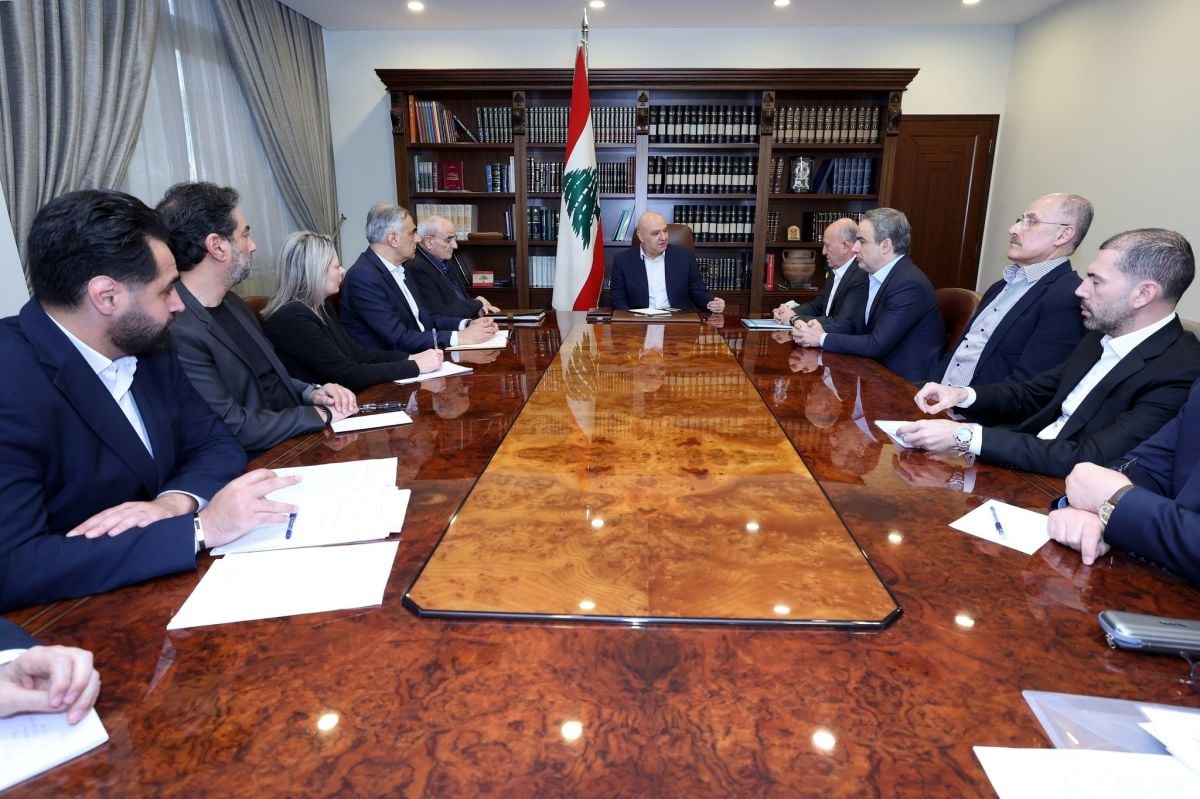
President Joseph Aoun surrounded by several MPs during a meeting at the Baabda Presidential Palace, on May 10, 2026. (Credit: @lbpresidency/X)






While MPs debated last week the imminent adoption of a general amnesty law, the bill now appears unlikely to pass before several more days of negotiations.
The goal is to find a formula capable of reconciling each party’s demands. Sunni parties are demanding amnesty for Islamist detainees, Shiite factions for drug traffickers, and Christian leaders for Lebanese citizens living in Israel.
This seems a difficult task in an increasingly tense political and sectarian climate.
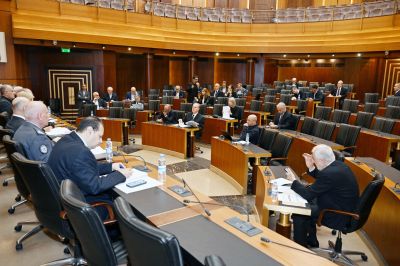
A few days after last Wednesday’s brief parliamentary session, Deputy Speaker Elias Bou Saab unexpectedly postponed the joint parliamentary committee meeting that had been scheduled for Monday indefinitely, in a bid to finalize discussions before sending the bill to the full chamber.
This decision came after MP Michel Moawad, a strong opponent of Hezbollah, brought together on Sunday President Joseph Aoun and several MPs from different political blocs — except the Amal-Hezbollah alliance — to discuss the amnesty law. Defense Minister Michel Menassah, who is close to the president, also attended.
Menassah, a former army general, firmly opposed any amnesty law that would release “Islamists” accused of killing Lebanese Army soldiers or members of other security agencies.
According to information obtained by L’Orient-Le Jour, the discussions held on Sunday at Baabda Presidential Palace were aimed primarily at allowing Aoun, who is himself a former army commander, to try and mediate the dispute between Menassah and Sunni MPs backing the amnesty law.
“On this issue, the president was masterful,” one of those MPs said, suggesting that Aoun could help remove the remaining obstacles blocking the bill’s adoption.
According to converging sources, meeting participants agreed to commute death sentences to 20 years in prison, and reduce life sentences to 20 years behind bars. They also agreed to lower the maximum cumulative sentence threshold from 10 years to seven.
Those still detained without trial would not be released automatically. Instead, they would be granted fair trials so that final verdicts can be issued in their cases.
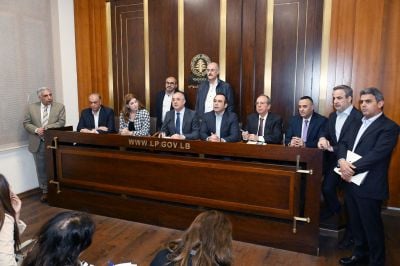
Bou Saab in the crosshairs?
But despite Aoun’s apparently constructive role, obstacles remain. “Some simply do not want to see the law passed,” a Hezbollah-opposing MP told L’Orient-Le Jour on condition of anonymity.
Several MPs are now pointing fingers at Bou Saab.
“I think he took the fact that he was absent from the Baabda meeting badly,” one of the MPs who attended the meeting said.
Another MP blamed Parliament Speaker Nabih Berri, who he claims “did not appreciate discussions over a bill still under negotiation taking place in Baabda rather than in Parliament.”
It is in this context that Moawad published a message on Tuesday on X: “The campaign portraying the Baabda meeting as a violation of the separation of powers and presidential interference in legislative affairs is an attempt to torpedo the adoption of the amnesty law.”
“This law is not ordinary legislation,” he added, “but rather the embodiment of a delicate compromise that preserves the prestige of the state and the dignity of the military and security institutions, while putting an end to the injustice suffered by Lebanese citizens who are paying the price for decisions taken during the eras of Syrian tutelage and later Hezbollah’s dominance.”
“It was therefore natural to seek the president’s intervention given his role, especially since he has the constitutional right to return a law to Parliament for further review,” the MP continued, criticizing “those who blocked the Constitution and covered for illegal weapons” who now “are lecturing others about the separation of powers.”
However, MP Ali Hassan Khalil, also Berri’s close aide, contacted Aoun on Saturday, on the eve of the Baabda meeting, to assure him of the Hezbollah-Amal alliance’s green light for the talks.
“I hope they are being sincere,” Tripoli MP Ashraf Rifi said, suggesting that Berri may not be particularly enthusiastic about the new bill but also does not want to be seen as obstructing the process.
Berri appears to be Bou Saab’s last line of support as pressure mounts to finalize the file. It is in this context that Bou Saab met Berri on Tuesday at his residence in Ain al-Tineh.
“Berri is expected to work on softening the Amal-Hezbollah alliance's position to facilitate the passage of the bill after a new joint committee meeting next week,” a source familiar with the negotiations said.
Meanwhile, Sunni MPs are continuing efforts to draft a final version of the bill that would “take into account the concerns of all parties involved,” according to Beirut MP Nabil Bader.
By “all parties,” he was likely referring not only to political factions, but also to Salafist cleric Ahmad al-Assir — one of the figures most directly concerned by the amnesty debate — who recently received MP Ahmad Khair in Roumieh prison and shared his “remarks” on the draft law.
“He is directly concerned by the matter,” Bader said.
“We want to avoid a Sunni-Shiite confrontation,” another MP added. “This is especially true since Sheikh Assir himself will not be released under the future law.”
He added, “He is effectively making a sacrifice by remaining behind bars while many other detainees regain their freedom.”
This article was originally published in French in L'Orient-Le Jour and translated by Sahar Ghossoub.

 7 p.m. recap: Iran warns Egypt, Israeli soldiers vote in south Lebanon, Haret Hreik responds to Kataeb