







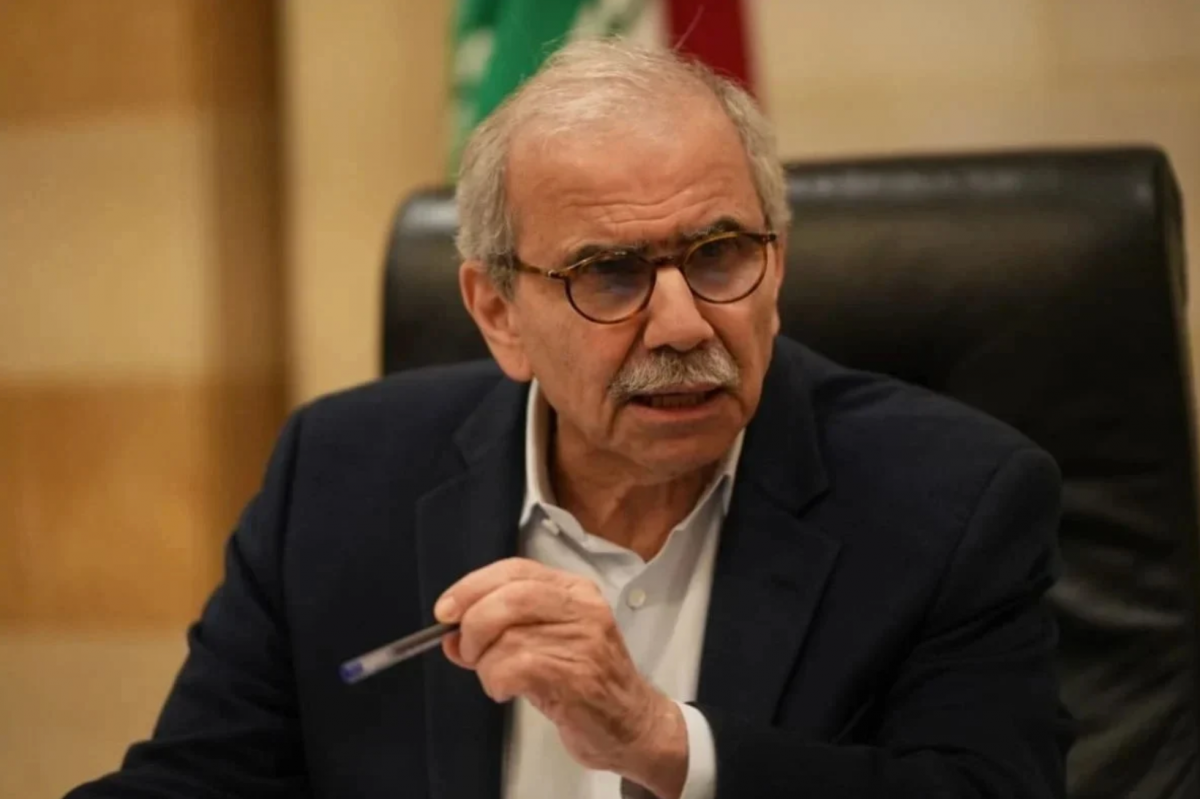
The Lebanese Prime Minister, Nawaf Salam, during an interview given to L'Orient-Le Jour on March 8, 2026. Photo Mohammad Yassine/L’Orient-Le Jour






BEIRUT — Lebanese Prime Minister Nawaf Salam lamented in an interview with Saudi channel Al Arabiya that "Lebanon was dragged" into the Israel-Iran war by Hezbollah on March 2, which led to Israel's occupation of 68 villages and a devastation in the South reminiscent of that in Gaza.
'68 villages controlled by Israel'
"We had five points still occupied before the war, and we were trying to obtain an Israeli withdrawal with Arab and international support ... Israel now occupies 68 village," Salam lamented.
Despite the cease-fire agreement that took effect at the end of November 2024 — which called for the full withdrawal of the Israeli army from southern Lebanon within two months — Israeli forces remained positioned on at least five hills near the border. In March 2026, following the resumption of the war, Israel launched a new ground invasion that has continued despite another cease-fire that took effect on April 17.
"Israel today occupies nearly half of the area south of the Litani," a river located 30 km from the border, the prime minister lamented, at a time when the Israeli army does not hide its intent to establish a "buffer zone" 8 to 10 kilometers deep inside Lebanon. He added that "cities like Bint Jbeil are destroyed, and based on drone footage, it's impossible to tell if they were taken in Bint Jbeil or Gaza!"
Salam reiterated the need for direct negotiations with Israel, led by Prsident Joesph Aoun, in order to end the war and result in a meaningful cease-fire. He added that such negotiations would be conducted "in accordance with the Constitution."
On Sunday, Mahmoud Qomati, a member of Hezbollah's Political Council, launched a harsh attack on Aoun, questioning how he could "bypass an essential pillar of the state, Parliament Speaker Nabih Berri, and by what right he alone decides the fate of Lebanon."
The prime minister also said that "the majority of Lebanese support negotiations," and stressed that the government "is currently focused on stopping hostilities and ending the war," asserting its commitment to "the return of displaced persons to their villages and towns." Salam declared himself "committed to the need for a full Israeli withdrawal from all Lebanese territories," and the return of the Lebanese detainees from Israeli prisons.
He again affirmed that Lebanon was open to discussing a peace agreement, but only within the broader context of the 2002 Arab Peace Initiative, which conditions the normalization by Arab countries with Israel on the establishment of a Palestinian state within the 1967 borders.
'Consolidation of relations' with Syria
Salam made the remarks upon returning from a visit to Damascus, where he traveled Saturday with a senior ministerial delegation in a bid to open a new chapter in relations between Lebanon and Syria. "We have turned the page on disputes with Syria," he said. "We are moving toward a consolidation of relations."
He added that "significant progress has been made with the Syrian side and its results will appear soon." To illustrate, he announced plans to "create a Higher Council for Cooperation with Syria," specifying that "the Council's first meeting will take place ... in June." He also spoke of "an agreement with Syria to facilitate the movement of people and goods as well as electrical interconnection."
The Lebanese delegation included Deputy Prime Minister Tarek Mitri, Economy and Trade Minister Amer Bsat, Public Works and Transportation Minister Fayez Rasamny, Energy and Water Minister Joe Saddi, as well as the prime minister's adviser, Ambassador Claude Hajal.
The visit came against the backdrop of Damascus' repeatedly accusations of Hezbollah of involvement in planned attacks on Syrian territory, allegations the party denies, and while the Israeli army continues to occupy Syrian and Lebanese territories.

 8 p.m. recap: Israel again threatens Beirut’s south suburbs; 2 ships hit near Hormuz; Riyadh football matches canceled