







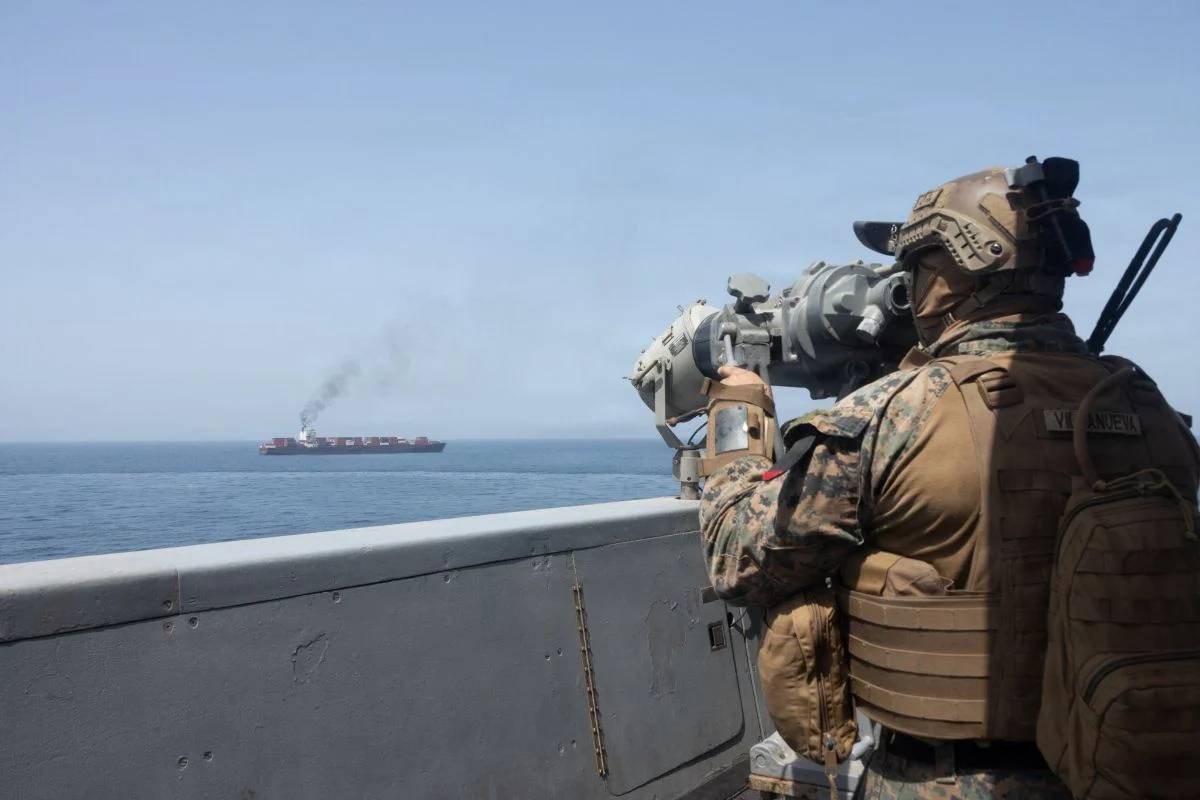
American forces patrolling the Arabian Sea near the Touska, an Iranian-flagged cargo ship, on April 20, 2026. (Credit: Photo released by the press service of the U.S./ Navy Central Command/via AFP)






BEIRUT — As negotiations between Washington and Tehran aimed at bringing a lasting end to the war in the Middle East stall, Donald Trump is to be briefed Thursday during the day on new military options against Iran by Centcom, which has also reportedly requested the deployment of a hypersonic missile to the region, according to Axios and Bloomberg.
The U.S. president is set to receive a briefing from Admiral Brad Cooper, head of Centcom (the U.S. military command for the Middle East), regarding potential new military actions against Iran, two sources familiar with the matter told Axios.
Centcom is said to have prepared a plan for a "short but powerful" wave of strikes against Iran, likely targeting infrastructure, "in hopes of breaking the deadlock in the negotiations," the American outlet reported, citing three sources with knowledge of the matter.
The aim would then be to push Tehran to return to the negotiating table with "more flexibility on the nuclear issue." Another plan expected to be presented to the White House occupant would involve a "takeover of part of the Strait of Hormuz" in order to reopen this maritime route to commercial traffic, an operation that could "include ground forces," according to one of the sources.
A third option, previously mentioned and which could also be discussed during the briefing, would involve an operation by special forces to secure Iran’s stockpiles of highly enriched uranium.
For its part, Bloomberg reports on its website that Centcom has requested the deployment of the U.S. Army’s Dark Eagle hypersonic missile to the Middle East. According to the outlet, this long-range missile would allow the U.S. to "strike" ballistic missile launchers deep within the country, and would mark the first deployment by the U.S. of this type of weapon, which has suffered development delays.
A source familiar with the process told Bloomberg that no decision had yet been made. The Dark Eagle would have a range exceeding 2,775 km and is designed to glide toward its target at five times the speed of sound, the outlet stated. Fewer than eight are said to exist, and each unit would cost around $15 million, according to the same source.
Even though weapons have been silent since a cease-fire went into effect on April 8, the Strait of Hormuz — through which about a fifth of the world’s oil supply usually passes — remains subjected to a double blockade by Iran and the United States. The American administration has also reportedly asked its embassies to try to convince its allies to join an international coalition tasked with securing the Strait of Hormuz.
Citing a cable from the U.S. State Department, the Wall Street Journal revealed the existence of a project called the "Maritime Freedom Mechanism," in which a U.S.-led coalition would share information, coordinate diplomatic action, and enforce sanctions. "Your participation will strengthen our collective ability to restore freedom of navigation and protect the global economy," the cable cited by the newspaper states, calling collective action "essential" particularly "to impose significant costs on Iranian obstruction of transit through the strait."
