



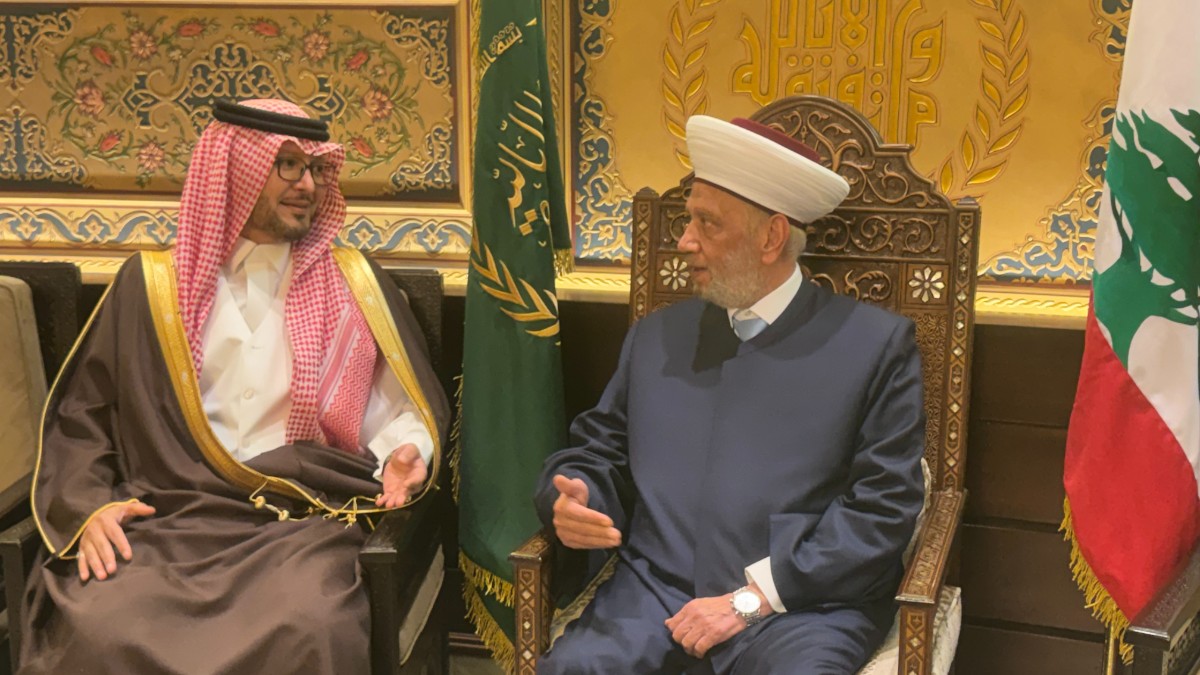
The Saudi ambassador, Walid Boukhari (on the left), and the mufti of the Republic, Abdellatif Derian, on April 28, 2026 at Dar al-Fatwa. (Credit: National News Agency)






The Saudi ambassador to Lebanon, Walid Bukhari, emphasized Tuesday, before the vice president of the Higher Shiite Islamic Council, Ali Khatib, and the Grand Mufti of the Republic, Abdellatif Derian, "the need to consolidate civil peace in Lebanon."
During his meeting with Mufti Derian at Dar al-Fatwa, Bukhari reaffirmed "his country’s commitment to the unity of the Lebanese people in the face of the challenges it faces."
"Saudi Arabia is making diplomatic efforts to help Lebanon in this ordeal and stands firmly alongside the Lebanese state and its institutions in order to find solutions that contribute to strengthening security, stability, and prosperity," he stressed.
He added that the kingdom maintains constant coordination and cooperation with the state and called for "favoring wisdom and reason in the face of challenges and crises in order to preserve civil peace," saluting the positions of the Grand Mufti "and his wise and measured role in ensuring the unity of Lebanon and its people."
Derian, for his part, expressed his "deep gratitude for the role Saudi Arabia plays in the region, especially in Lebanon, by supporting and contributing to preserving the country’s stability, security and unity, particularly in the exceptional circumstances it is experiencing."
He emphasized that "the reconstruction of the state is the only way to save Lebanon, to restore its prestige, to extend its authority over the whole territory, to monopolize arms in the hands of the Lebanese Army, to respect the Taif Agreement and to strengthen the unity of the Lebanese people."
He also said he was "satisfied with the diplomatic steps taken by the president and government to end the war in Lebanon and find a solution that would guarantee stability."
At Sheikh Ali Khatib’s residence in Hazmieh, Ambassador Bukhari said he was "optimistic about the future," once again stressing the need to consolidate civil peace in Lebanon.
He stated that "returning to the Taif Agreement constitutes the essential starting point to agree on general principles and to ensure that no Lebanese group is wronged and that no party is excluded."
Bukhari also called on President Joseph Aoun, Prime Minister Nawaf Salam, and Parliament Speaker Nabih Berri to "agree on a common path to preserve civil peace," while expressing confidence in "Mr. Berri’s wisdom and experience."
"We do not have a separate political project. We believe in the nation and cannot be a separate part of it; we will not deviate from this principle," stated the vice president of the Council.
He also highlighted the role played by Riyadh "in containing Israeli and Western expansionism." That is why we call for cooperation between the main Arab and Islamic countries of the region to confront the Zionist project. The Arab-Islamic world needs a united front to protect it, and Saudi Arabia is fundamental in this regard," he continued.
Saudi Arabia has recently brought its full weight to bear on the Lebanese scene ahead of direct negotiations between Lebanon and Israel, by outlining a series of fundamentals.
First, according to information obtained by L'Orient-Le Jour, the full preservation of the Taif Agreement; second, the maintenance of the government and the guarantee of all necessary support and protection; third, the consolidation of understanding between the three presidents (of the republic, the government, and the Parliament) and coordination on key issues, notably negotiations with Israel; fourth, priority should be given to the protection of Lebanon as an entity (society and demography) in the context of negotiations; fifth, the preservation of internal stability and the prevention of any internal confrontation; sixth, the implementation of government decisions regarding the monopoly of arms by the state.
Lebanon has held two direct preparatory meetings with Israel ahead of the direct negotiations scheduled under Washington’s auspices, which allowed the cease-fire with Israel to be extended for three weeks, after more than a month and a half of war in Lebanon.

 7 p.m. recap: Netanyahu seeks mastermind behind Flydubai incident; Washington sanctions 2 French nationals; Ben Gvir's 'I want to kill you' threat