
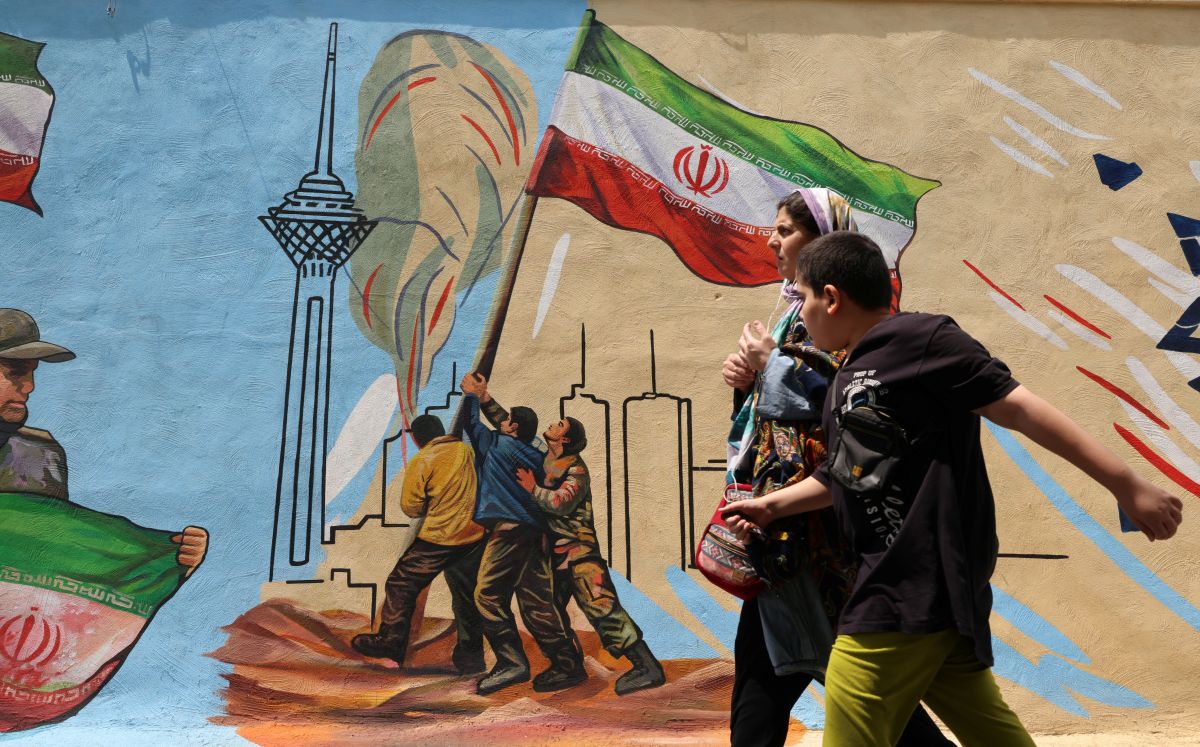
A woman and a boy walk past a nationalist mural in Tehran on April 21, 2026, against the backdrop of a cease-fire in the region. (Credit: Atta Kenare/AFP)






The war that pitted the United States and Israel against Iran for nearly six weeks has left a heavy toll, both materially and in human lives.
At least 7,645 buildings were damaged or destroyed throughout the Islamic Republic between the outbreak of hostilities on Feb. 28 and the start of a two-week truce on April 8 — including 60 educational facilities and 12 health structures — according to Bloomberg, citing a study by Conflict Ecology researchers at Oregon State University based on radar images.
Despite the indefinite extension of the fragile two-week truce, unilaterally announced by U.S. President Donald Trump, the human toll continues to climb.
The Martyrs Foundation in Iran reported Saturday that 3,468 people have died, including 1,701 civilians — at least 254 of whom were children — according to the U.S.-based Human Rights Activists News Agency.
Diplomatically, the situation remains uncertain. Talks between Washington and Tehran, which were scheduled to resume early in the week in Islamabad after a first session on April 11, have yet to start again, with Iran making the resumption of talks conditional on the lifting of the U.S. naval blockade.
In the Iranian capital, a sprawling metropolis of nine million, the scars of the bombings are visible: apartment buildings gutted, piles of rubble, and partially devastated neighborhoods, Bloomberg reports. An analysis by the American agency, focused on Tehran, estimates that 2,816 buildings there were hit: About 32% were linked to military activities, 25% to industry, 21% to civilian use, while 19% pertained to the commercial sector, and 2% to government infrastructure.
Although strikes were reported in several regions of Iran, including Isfahan — the country's historic cultural capital and a major industrial hub — Tehran appears to be one of the hardest-hit cities, according to the media outlet.
Still, the destruction is unevenly distributed: Large areas were spared, while others show significant concentrations of damage, Bloomberg points out. An analysis of the damaged zones shows that military or government targets are often located in close proximity to civilian and commercial infrastructure, illustrating the interconnection of urban functions.
The Tehran municipality also claims that over 39,000 residential units have been severely damaged since the bombings began.
In the Vanak neighborhood, at the heart of the capital, where homes, offices, businesses, and public infrastructure intermingle, residents report entire city blocks being razed, particularly in residential zones. Further south, Gandhi Hospital was struck, suffering serious damage, according to images broadcast by state media.
Beyond the capital, some strikes have caused particularly high civilian casualties. In the city of Minab in the south of the country, an attack on a school on the very first day of the war reportedly killed at least 150 children, according to Iranian authorities and state media.