






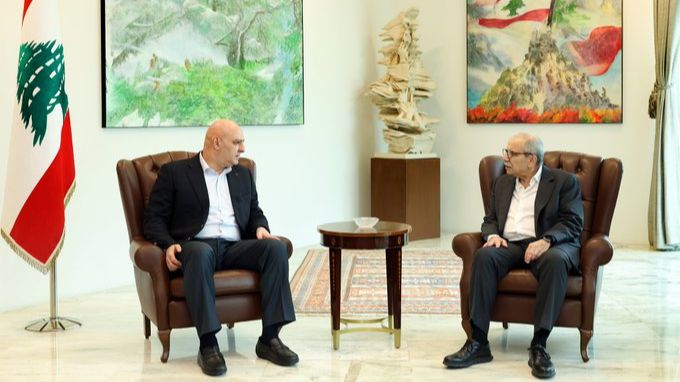
The President of the Republic Joseph Aoun (left) and Prime Minister Nawaf Salam, meeting in Baabda on Saturday, April 18, 2026. (Credit: NNA Photo)






President Joseph Aoun and Prime Minister Nawaf Salam met Saturday to discuss upcoming negotiations between Lebanon and Israel, as the rift with Hezbollah widens. Hezbollah rejects any disarmament logic and denounces what it calls authorities’ turn toward "projects against the interest of the country."
On Saturday morning, Joseph Aoun received Salam at the Baabda Palace for a "review of the latest security and diplomatic developments," according to a message from the presidency posted on X. The two "assessed the period following the entry into force of the April 16 cease-fire, as well as ongoing efforts to consolidate it, particularly Aoun’s contacts with U.S. President Donald Trump, Secretary of State Marco Rubio, and several Arab leaders," the statement continued.
Aoun and Salam also discussed Lebanon’s preparations for the scheduled negotiations with Israel, as well as the implementation of Cabinet decisions, notably the move to extend state sovereignty over the entire territory, a process that, it is noted, implies a monopoly on arms for state institutions and, consequently, Hezbollah’s disarmament.
The Lebanese government decided to disarm militias starting August 2025, but the Lebanese Army’s efforts to extend its control south of the Litani River were neutralized when Hezbollah, on March 2, opened a support front with Iran. This reintroduced Lebanon into a spiral of violence, death, and population displacement. From the start of the conflict, President Aoun proposed direct negotiations with Israel to end the cycle of wars, but the idea only materialized last Tuesday, at a meeting of the two countries’ ambassadors in Washington. Hezbollah continues to refuse to give up its weapons, and its circles categorically reject direct talks with Tel Aviv, preferring to leave the matter to their Iranian sponsor in its talks with the Americans.
On Friday night, the president addressed the nation, expressing his commitment to negotiations to save the country and free it from foreign influence, referencing Iran without naming it. "I am ready to go anywhere necessary to liberate my land, protect my people and save my country," he said. U.S. President Donald Trump has expressed willingness to host a meeting between Joseph Aoun and Israeli Prime Minister Benjamin Netanyahu, but no decision has been made regarding the next round of negotiations.
‘Authorities engage in projects against the country’s interests’
Reactions to President Aoun’s message came swiftly. Hezbollah’s vice president of the political council, Mahmoud Qomati, known for his outspoken positions, stated: "Contacts have been cut off with the president since his last speech." He also said that "following the (Hezbollah-labeled) victory, the state faces two possibilities: apologize to the people and retract its decisions against Hezbollah, or face a 'peaceful' popular anger that could lead to its downfall."
Qomati, speaking to local channel al-Jadeed, was referring to the cease-fire announced by Washington, which his party sees as its fighters’ victory on the ground and the result of Iran’s own talks with Washington. This, even though the Israeli army did not withdraw from southern Lebanon after the cease-fire and continues its strikes and destruction.
For his part, Hezbollah MP Hassan Fadlallah told the same channel that "the Lebanese authorities are working on projects against the country's interests." "We have informed Iranian leaders of Israeli violations" since the cease-fire, he added.
Geagea: The cease-fire must serve as a test for the state
Information Minister Paul Morcos said that "Lebanon faces a unique diplomatic opportunity given ongoing U.S. and Arab efforts and should not miss it." In an interview with ABC News, he explained that "the Lebanese state wants to conduct its own negotiation process, separate from broader regional discussions," referencing U.S.-Iran talks.
On the side of the sovereignist parties, which support the president’s position, several expressed their views. Lebanese Forces leader Samir Geagea said the country faces a decisive moment in its history "that cannot suffer delays." He added that the ten-day cease-fire "should be used as a test for the Lebanese state’s ability to extend its sovereignty over its territory." According to him, "the top priority must be the disarmament of illegal militias, because no state can control the decision for war and peace without it."
Finally, Beirut MP Ibrahim Mneimneh said Hezbollah "does not want to recognize that the balance of power has changed, which leads it to insult and threaten others because it is powerless to keep up with the changes."
Aoun also spoke by telephone Saturday evening with Egyptian President Abdel Fattah al-Sisi. The latter affirmed his support for measures taken to de-escalate tensions with Israel, including direct bilateral negotiations aimed at ending hostilities, securing the withdrawal of Israeli forces from the occupied southern areas, and deploying the Lebanese army to the border, according to a statement from the Lebanese presidency.
Aoun thanked his Egyptian counterpart for his support for Lebanon, as well as for the humanitarian aid sent by Egypt to Lebanon in recent days.

 8 p.m. recap: Israel again threatens Beirut’s south suburbs; 2 ships hit near Hormuz; Riyadh football matches canceled