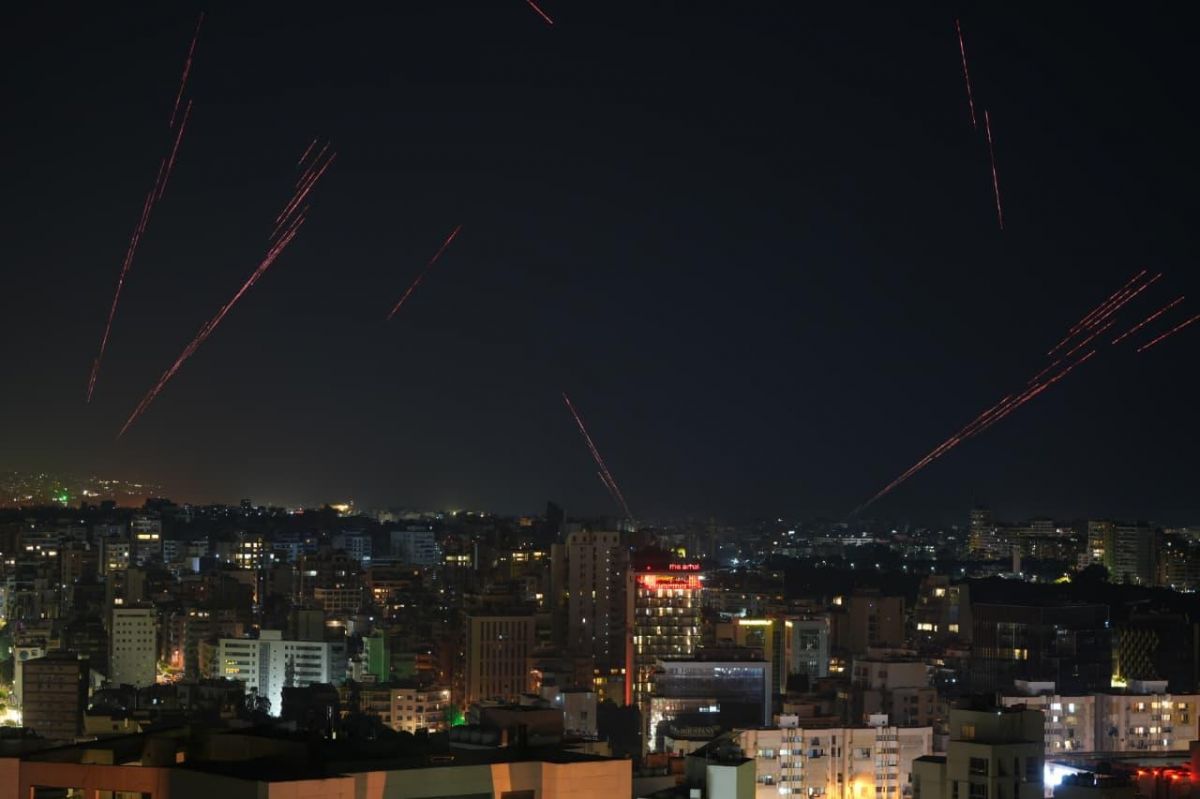
Celebratory gunfire in the sky over Beirut, at the moment the ceasefire with Israel came into effect, on April 17, 2026. (Credit: Mohammad Yassine/L'OLJ)






There is something profoundly indecent about the scene that unfolded at the very moment the truce came into effect. It goes beyond simple provocation or the clumsy expression of misplaced joy; it smacks of a desire to impose, through noise and force, a reading of reality that the reality itself contradicts. As if this country, already ravaged by weeks of war, should now be forced to applaud its own destruction.
Because reality is not up for debate, and cannot be skirted or distorted: a war that leaves thousands killed, thousands wounded, more than a million displaced, entire villages wiped from the map, a once-again occupied south, and a ruined economy cannot in any way be transformed into a victory without it being a deliberate fabrication.
It is within the gap between what is and what some want us to believe that the scene in Beirut took shape — on that night when gunfire erupted above an exhausted population, and for a few seconds, which are more telling than all the speeches, the real question arose: was what tore through the sky coming from the Israeli enemy or from the "enemy" within?

This confusion is neither accidental nor fleeting, but the product of a balance of power that has taken hold to the point of redefining the very perception of threat. These shots are neither an overflow nor an uncontrollable spontaneity, much less a simple manifestation of joy. They constitute a fully political act, a way of reminding everyone that, for that camp, the cease-fire does not in any way alter the real hierarchy of decision-making, that the end of fighting does not mean the restoration of sovereignty, and that the state can be asked to negotiate without ever being able to fully decide for itself. Meanwhile, violence remains available, mobilizable, ready to be used not only against external foes but also as a tool for internal regulation and for pressuring any attempt at regaining control.
It is precisely because this violence must now serve to sustain a narrative that it takes this form. The “victory” in question rests neither on facts, nor on the toll, nor even on a minimal reading of the situation. It exists only in the need to assert it — to make it heard, to impose it — because what it conceals is of an entirely different nature.
Hezbollah did not impose the truce; it was led into it. Its insistence on securing a cease-fire does not reflect a triumphant strategy, but rather a limit reached — a point at which continuing the war becomes riskier than stopping it, and where its ability to sustain the same level of confrontation begins to erode. This, however, cannot be acknowledged publicly without undermining a narrative built over years. The same, naturally, applies to Iran, without which Hezbollah, as it is, would simply not exist.

Paradoxically — or perhaps not — this limit has opened a breach, an opening closed up by years of stalemate. If it is to be credited with any outcome, it would be this: forcing the Lebanese state out of its lethargy, pushing it to regain initiative, not to proclaim false victories, but to attempt escaping a logic where it enters war without having chosen to and suffers its outcome without having negotiated it for itself. It is in this context that Joseph Aoun's decision, supported by Nawaf Salam as well as, discreetly, by Nabih Berri, comes: to embark on a process that Hezbollah's war has made inevitable.
The irony in all this? Those who made these negotiations unavoidable are now the first to denounce them, and those who once criticized the state's "resignation" in the face of an unfavorable deal for Lebanon are now the only ones celebrating it. And while Lebanon pays the price for this logic, Iran negotiates — on its own behalf — with those it still publicly calls its enemies.
Does Hezbollah need to be reminded that if Lebanon today must struggle to get out of this dead-end, it is first and foremost because of Hezbollah's own failures? To end a renewed occupation brought on by its suicidal gambit, to keep the south from becoming a Lebanese Golan or sinking into a Gaza-style cycle of endless destruction and war without resolution? In that case, who really ought to be accused of "treason"?

This rhetoric, in reality, comes as no surprise. It is not a matter of contradiction or incoherence, but of a logic intended to maintain, at all costs, an order in which decision-making remains confiscated. Except that this logic is no longer irreversible. What is at stake is not in the agreement itself, nor in its terms, still less in the illusion of any gain, but in what it makes possible — or even necessary. For to negotiate an exit from the war while leaving intact that (or those) which led to it is only to postpone the next conflict, and this is precisely where the line is drawn. And this is exactly why we can no longer stop halfway.
As long as the power to decide on war lies outside the state, any attempt to move beyond it will remain provisional, suspended. It is time for the question of Hezbollah’s disarmament to be recognized for what it has always been, yet never fully acknowledged as such: the minimal condition for Lebanon to cease being a battleground and finally become a country again.
But this logic must be carried through to its conclusion. Regaining the initiative is not just about negotiating — it means openly accepting what such negotiations entail: that the state can no longer coexist with the militia.
To support the state's courageous move today is neither to embrace its terms nor to ignore its limits. It's to recognize that, despite everything, it is the only serious attempt to break the vicious cycle that has destroyed Lebanon. And that, in the face of their suicidal logic, there is no comfortable third way. All the rest is mere illusion. Or denial.
Their victory lies in those gunshots; ours will begin when they fall silent.