






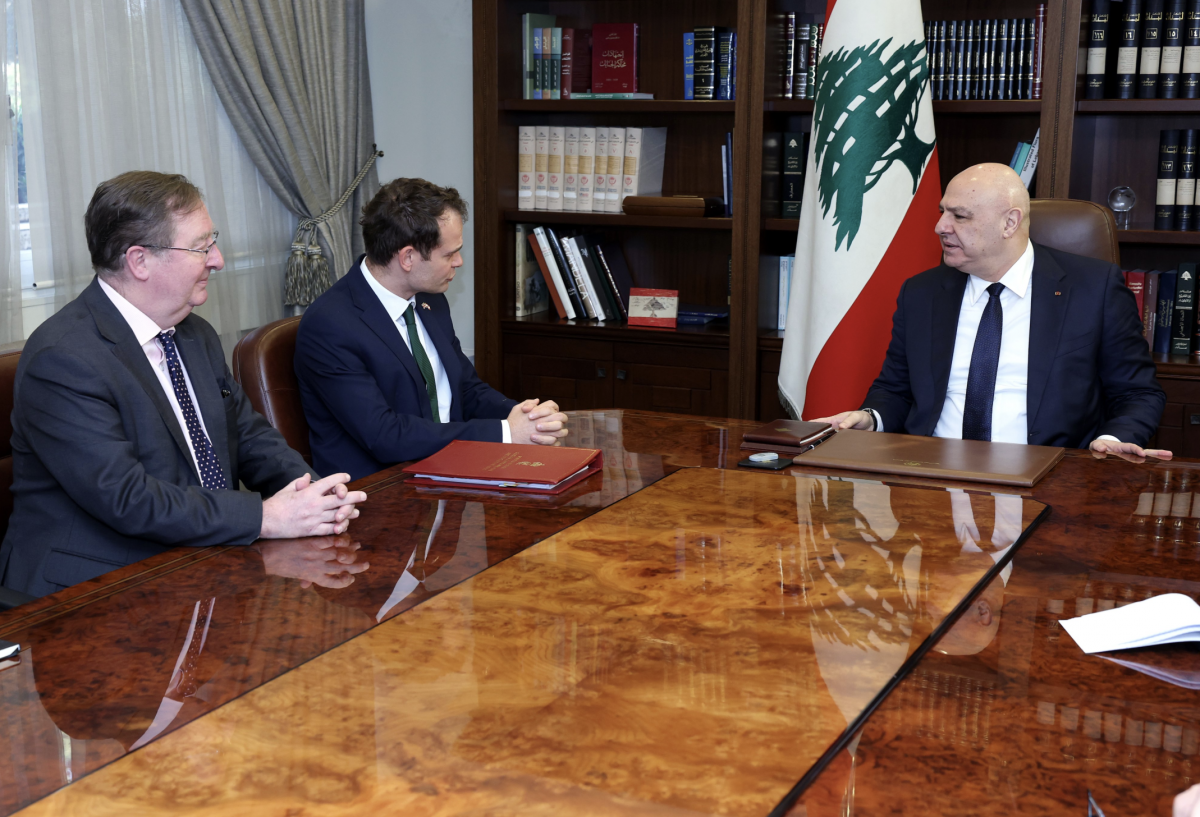
The President of the Republic, Joseph Aoun, receives the British Minister of State for Middle Eastern Affairs, Hamish Nicholas Falconer, in Baabda on April 16, 2026. (Credit: Baabda Presidential Palace)






BEIRUT — This was their first direct contact. On Thursday, Lebanese President Joseph Aoun received a phone call from his American counterpart Donald Trump, amid intensified efforts to secure a cease-fire in Lebanon.
A few hours earlier, Aoun had also spoken with U.S. Secretary of State Marco Rubio. The discussions followed controversy triggered by a U.S.-Israeli announcement of an imminent call between Aoun and Israeli Prime Minister Benjamin Netanyahu — a possibility the Lebanese president rejected.
The move came despite a Tuesday meeting in Washington between Lebanese and Israeli ambassadors aimed at preparing for indirect negotiations, in which Lebanon would be represented by Ambassador Simon Karam, a step strongly criticized by Hezbollah-aligned factions.
According to a statement from the presidential palace, Aoun “renewed his thanks for the efforts made by Trump to secure a cease-fire in Lebanon and ensure lasting peace and stability, as a prelude to a peace process in the region.” He expressed hope that U.S. efforts would continue “to secure a cease-fire as soon as possible.” Trump, in response, reaffirmed his support for Aoun and Lebanon and his commitment to responding to the Lebanese request for a swift cease-fire.
The conversation between the two leaders could accelerate efforts toward a truce in Lebanon, which some Israeli and U.S. media reports say may be imminent. Israeli Channel 12 also reported that Trump spoke with Netanyahu before his call with Aoun.
A carefully considered step
Earlier, Trump had said that the “leaders of Israel and Lebanon” were expected to speak on Thursday. The announcement followed a meeting between the U.S. president, U.S. Ambassador to Beirut Michel Issa, and Marco Rubio, according to the U.S. Embassy in Beirut on X.
Shortly afterward, Israeli Minister of Science and Technology Gila Gamliel-Demri also said Netanyahu would speak with the Lebanese president, expressing hope it could lead to “Lebanon’s prosperity and development,” and describing it as “a step that has been carefully considered over time.”
The announcement quickly sparked controversy in Lebanon. Parliamentary Speaker Nabih Berri and Druze leader Walid Joumblatt reportedly contacted Baabda to advise the president against direct contact with Netanyahu. Figures close to Hezbollah, who reject direct negotiations with Israel, also sharply criticized the prospect on social media, with some warning it would mark “the end of the Aoun era.”

But the head of state — who conditions any direct negotiations on a cease-fire — quickly moved to contain the situation. Two official sources told Reuters that Baabda informed the U.S. Embassy that President Joseph Aoun had rejected the possibility.
Three officials also told the same agency that no contact was planned with Israeli Prime Minister Benjamin Netanyahu.
A 'natural gateway'
Joseph Aoun first spoke with Marco Rubio, who appears to have paved the way for contact with Donald Trump.
According to a statement from the presidential palace, Aoun thanked the head of U.S. diplomacy “for the efforts made by Washington to secure a cease-fire in Lebanon.” Rubio, for his part, expressed “his support and appreciation for the positions of President Aoun.”
Similarly, Lebanon’s ambassador to Washington, Nada Hamadeh Mouawad, said that “the call was an exclusively bilateral exchange between Mr. Rubio and Mr. Aoun.” She added: “The call went very well. It was a strong sign of the significant interest the secretary takes in the Lebanese issue.”
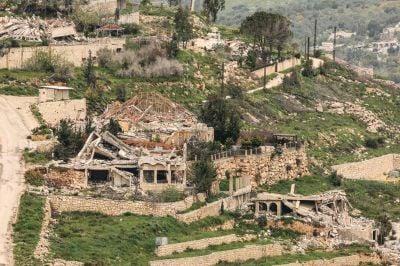
In addition, President Joseph Aoun received UK Minister of State for the Middle East Hamish Nicholas Falconer, telling him that a cease-fire should serve as the “natural gateway to direct negotiations” with Israel.
Aoun reiterated that such a preliminary cease-fire is a prerequisite for talks under what he described as a “presidential negotiation initiative,” according to statements published on X by the presidency. “Negotiations will be conducted exclusively by Lebanese authorities, as this is a matter of sovereignty in which no other actor can be involved,” he insisted, as Iran on Wednesday welcomed having pushed for a cease-fire that has yet to be approved by Israel.
“The withdrawal of Israeli forces from Lebanese territory is an essential step to consolidate the cease-fire, enable the redeployment of the Lebanese Army to the international border, strengthen state authority, and end any armed presence,” the head of state added, calling for “an end to attacks on civilians and the destruction of homes in Lebanese villages.”
He also reiterated that decisions taken by the government, particularly regarding the state’s monopoly on arms, “will be implemented in the interest of Lebanon and to ensure the protection of all Lebanese who want the state alone to guarantee the country’s security and stability.”

 8 p.m. recap: Israel again threatens Beirut’s south suburbs; 2 ships hit near Hormuz; Riyadh football matches canceled