







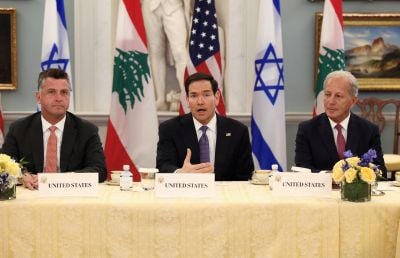
U.S. Secretary of State Marco Rubio (C) speaks during a meeting with Lebanon’s Ambassador to the United States, Nada Hamadeh Mouawad (2nd from right), and Israel’s Ambassador to the United States, Yechiel Leiter (2nd from left), at the State Department in Washington on April 14, 2026. (Credit: Oliver Contreras/AFP)






The now-iconic photo of the meeting in the office of U.S. Secretary of State Marco Rubio in Washington on April 14 was prominently featured, unsurprisingly, on the front pages of nearly all Lebanese newspapers on April 15. “Historic,” “a disgrace,” “a broken taboo,” a “promising opportunity” — there was no shortage of descriptions for these first direct talks between Lebanon and Israel since 1983. The meeting comes as war between Hezbollah and the Israeli army continues to rage in the South, with Israeli airstrikes regularly targeting multiple regions since March 2.
As expected, opinions were deeply polarized, with pro-Hezbollah outlets and media from the opposing end of the political spectrum offering sharply divergent views. Some newspapers also highlighted the inherent challenges of conducting such negotiations in the midst of an ongoing war.
Al-Akhbar, a newspaper close to Hezbollah, ran the headline: “The power of shame, on its knees in Washington.” Its front page was split in two, featuring a photo of Prime Minister Nawaf Salam on the left and President Joseph Aoun on the right, placing them in the same camp—although Aoun had largely been spared until now from pro-Hezbollah criticism, which typically targets the occupant of the Grand Serail, often labeled a “Zionist” in protests from this pro-Iranian camp.
In its subheadings, the paper noted that Israel had rejected Lebanon’s main demands — namely a cease-fire and withdrawal — and stressed that the “resistance” had vowed to continue fighting “until liberation,” echoing recent statements by Hezbollah Secretary-General Naim Qassem. Addressing parallel negotiations initiated by Hezbollah’s Iranian ally in Pakistan with the United States, the paper wrote: “Iran in Islamabad: protecting Lebanon is an essential condition for agreement, and there can be no debate [on this issue].” This reflects the camp’s position that separating the Lebanese and Iranian tracks would harm Lebanon’s interests.
On the other side of the political spectrum, Nidaa al-Watan, a daily close to the Lebanese Forces — a party firmly opposed to Hezbollah and the war — ran the headline: “A taboo … broken.” The paper described the Washington talks as “historic,” asserting that Lebanon and Israel had entered “the era of negotiations.”
In its editorial, the daily argued that the move was driven “on the one hand, by the Lebanese people’s aspiration for peace and a normal life, and on the other, by the need to keep pace with regional shifts in the aftermath of October 7” — the Hamas attack on Israel in 2023 that triggered the war in Gaza and opened a front in Lebanon. “Yesterday [Tuesday], the country chose to defend its supreme national interests, positioning itself solely in accordance with its sovereignty agenda,” the paper wrote, suggesting that Lebanon had “finally freed itself from Iranian dependence.”
“Lebanon: An opportunity for U.S. diplomacy to succeed — limiting Israeli operations alongside Hezbollah’s disarmament,” headlined the major daily an-Nahar. According to the paper, “the Lebanese-Israeli talks under Washington’s sponsorship produced an agreement — not a cease-fire formula, but one that could lead to negotiations aimed at disarming Hezbollah and establishing bilateral peace.”
The government 'faces an unprecedented existential challenge'
The daily al-Joumhouria also focused on the “historic meeting between Lebanon and Israel.” In its editorial, the newspaper — owned by politician Elias Murr — said the Lebanese government faces “an unprecedented existential challenge,” as Benjamin Netanyahu’s government refuses a cease-fire alongside the talks.
For al-Liwa', there is no doubt: "the negotiations restore the state's role." Its editorial reads: “In a rare moment in contemporary Lebanese history, one of the most enduring political taboos has fallen: that of direct talks with Israel. What happened on April 14, 2026, is no minor development, nor merely a technical step in managing the border conflict, but a sovereign decision as weighty as a declaration of war and as significant as the signing of a peace agreement.”
In a more factual tone, the newspaper al-Sharq highlighted Marco Rubio's statement: "The road is long," while the pan-Arab daily al-Sharq al-Awsat pointed to “European support for the negotiation process” between Lebanon and Israel.

 8 p.m. recap: Israel again threatens Beirut’s south suburbs; 2 ships hit near Hormuz; Riyadh football matches canceled