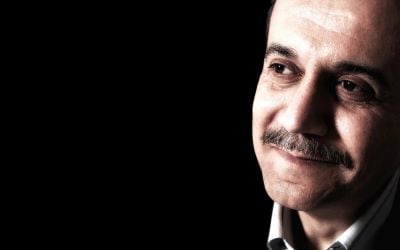
Ahmad Kaabour, Lebanese musician, composer, and actor, passed away on March 26, 2026, at the age of 71. Photo taken from the artist's website.






Ahmad Kaabour, Lebanese musician, composer and actor whose protest song "Ounadikom" (I call to you) became an enduring anthem, died Thursday at the age of 71.
Born in Beirut in 1955, Kaabour grew up in a musical home. His father, violinist Mahmoud al-Rashidi, was among Lebanon's first instrumentalists of his generation. Kaabour's childhood unfolded between the Basta and Horsh neighborhoods of Beirut, a city already divided by deep fault lines.
As a teenager, he began composing music. Then the Civil War broke out in 1975. He was 19. "I already felt like an adult man," he later said.
He did not take up arms. Instead, he wrote, sang and organized civilian support committees. In this context, he composed "Ounadikom" to lyrics by Palestinian poet Tawfiq Ziad. The song spread widely, becoming indispensable and crossing borders. Sung at protests and passed down through generations, it became both a rallying cry and shared memory.
Trained in theater at Lebanese University, Kaabour moved fluidly between forms. He performed, wrote and composed for stage and screen. In the 1980s, he worked with Ziad Rahbani, Fayek Hmaysi, Yaacoub Shedrawi and Rabih Mroueh.

Later, he appeared as Palestinian militant Wadih Haddad in director Olivier Assayas' Cannes-premiered film "Carlos." He became a fixture of Lebanese television on Future TV with musical series and music videos.
Kaabour's career centered on live performances: hundreds of concerts from south to north Lebanon, Europe and the Arab world. Some venues overflowed, others stayed modest. His presence remained steady.
In 2016, he briefly entered civic engagement, joining the Beirut Madinati list for Beirut municipal elections, marking a detour, not a turning point, reflecting his aversion to conventional career paths.
Reducing Kaabour to "Ounadikom" overlooks his quieter loyalty to children. Away from spotlights, he worked with the Firkat al-Sanabel troupe and Lebanese Puppet Theater. He wrote, composed and directed shows for young audiences that avoided simplification, weaving in stories, rhythms and unflinching views of the world.
For Kaabour, no divide existed between protest songs and children's works. A single thread ran through: to speak, connect and transmit.
When asked his favorite song, he replied: the one he had not yet written. As if to say, despite everything, more remained to come.