







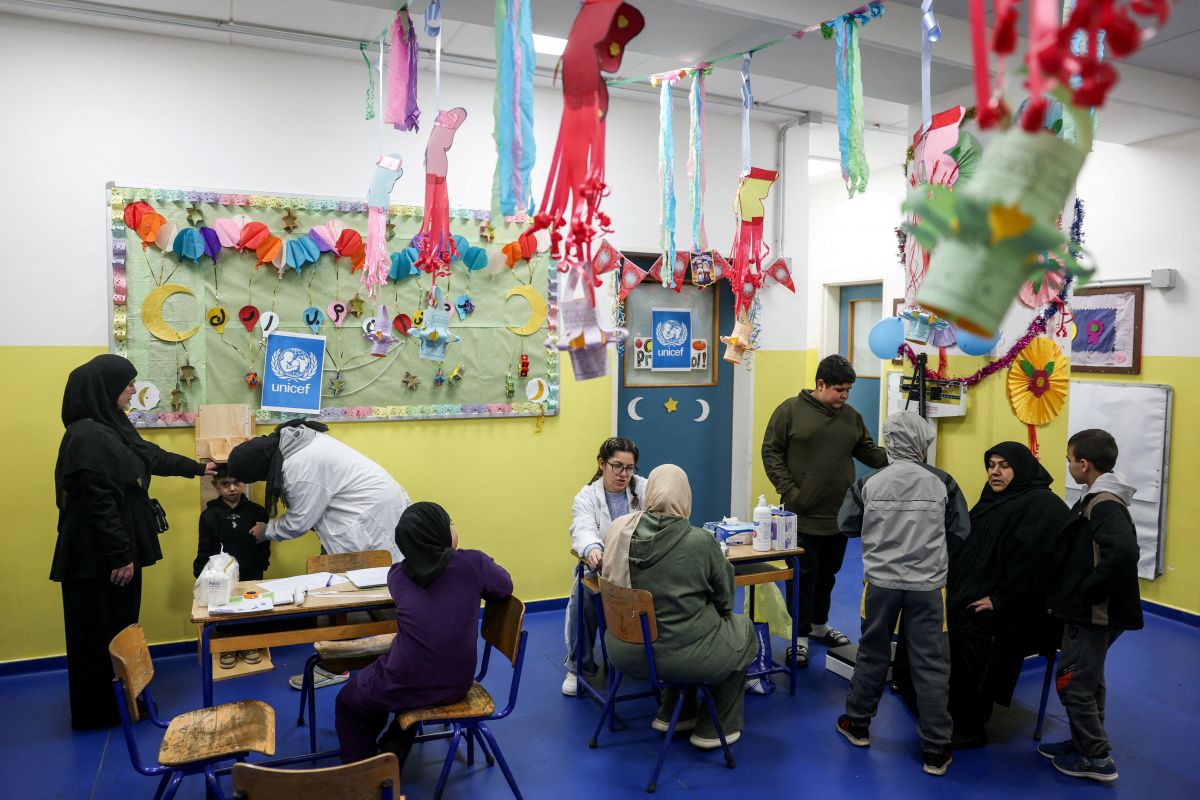
Ramadan decorations are displayed inside a classroom, as displaced people receive medical assistance inside a public school turned shelter, following an escalation between Hezbollah and Israel amid the U.S.-Israeli conflict with Iran, in Beirut, Lebanon, March 7, 2026. (Credit: Claudia Greco)






BEIRUT — Education Minister Rima Karameh on Monday called on public and private educational institutions to resume classes “as of this Tuesday, March 10, as much as possible,” either in person or remotely, “in order to complete the school curriculum.”
The decision comes as tensions escalate on the Lebanese front between Israel and Hezbollah, amid the wider conflict involving Israel and the United States against Iran.
On the eighth day of the conflict in Lebanon, with Israel continuing heavy bombing in South Lebanon, the Bekaa, and the southern suburbs of Beirut — displacing over half a million people — the education ministry issued a circular aimed at "guaranteeing the continuity of education in exceptional circumstances."
The circular highlights the "humanitarian, social, and educational consequences" of the war, including the displacement of many families and students, the use of some public schools as shelters, the closure of several educational institutions, and the inability to maintain regular teaching in certain areas. It also notes the stark differences among students: some are following rigid programs tied to educational curricula abroad, others are displaced or affected by the fighting, while some continue their studies in more stable regions.
Maintaining the connection
For private educational and technical institutions, the ministry asked them to "continuously assess the security situation in their areas and adopt a flexible educational plan from March 10, which would allow for the determination of the most appropriate teaching method — in-person, remote, or hybrid — after consultation with parents, to ensure everyone's safety."
Schools choosing in-person teaching are also asked to provide remote options for students unable to attend, until conditions return to normal and new ministry guidelines are issued.
In public schools and technical institutes, many of which are being used as shelters for the displaced, teaching will be conducted "mainly remotely."
In areas heavily affected by war and displacement, "classes are temporarily suspended." Authorities promise to monitor students and staff, provide educational resources to maintain engagement, and compensate for lost learning.
The ministry assures it will "monitor daily the evolution of the educational and security situation and take new measures as the situation develops in order to guarantee the right to education." It calls on all schools "to fully cooperate with the competent educational authorities" and says it is "studying solutions to preserve the rights of teachers, especially contract teachers, during this crisis."

 8 p.m. recap: Israel again threatens Beirut’s south suburbs; 2 ships hit near Hormuz; Riyadh football matches canceled