






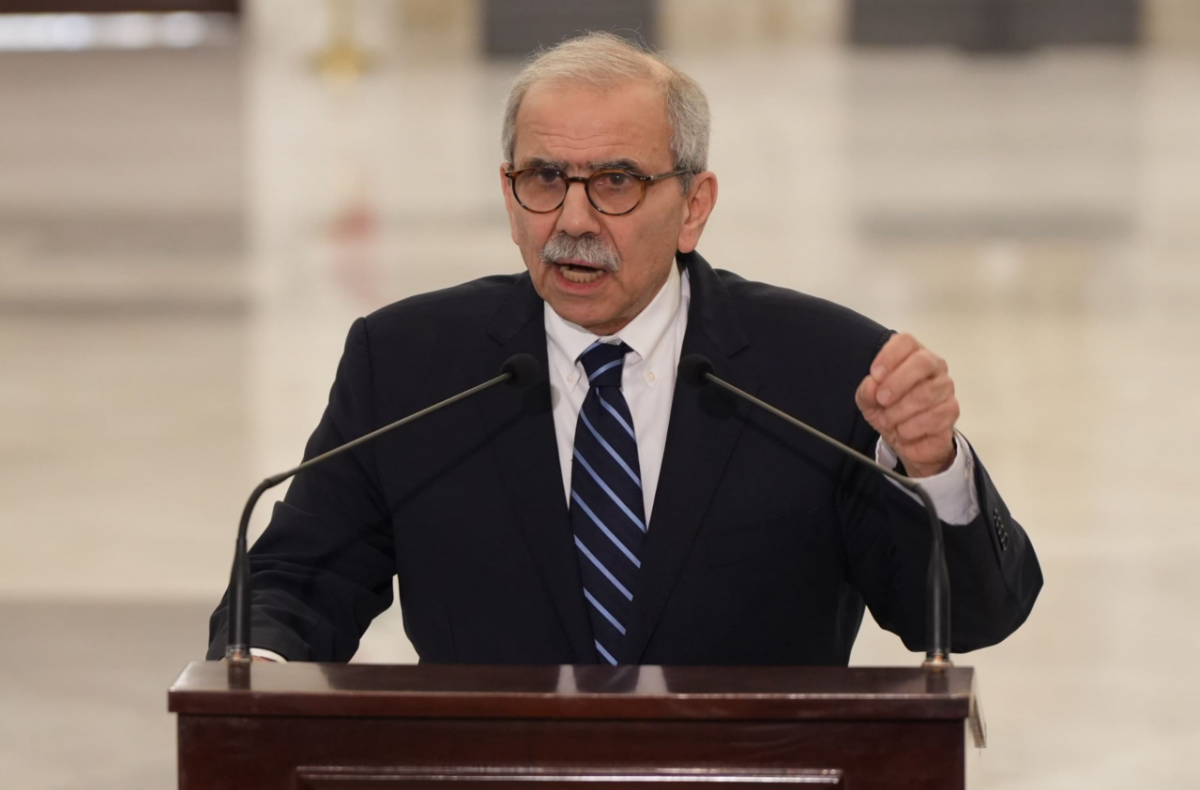
PM Nawaf Salam, at the Baabda Palace, Jan. 14, 2026. (Credit: Mohammad Yassine/L'Orient-Le Jour)






BEIRUT — Prime Minister Nawaf Salam warned Friday of a "humanitarian catastrophe" in Lebanon as tens of thousands of people have been displaced, fleeing Israeli strikes on southern Lebanon, Bekaa and Beirut's southern suburbs.
Speaking before ambassadors, Salam called on the international community to pressure Israel to spare Lebanon’s civilian infrastructure from its strikes.
“Our country has been dragged into a devastating war that we neither sought nor chose. It is a war that was imposed on us,” Salam said, as the escalation in Lebanon began Sunday night after Hezbollah launched rockets toward Israel.
Israel then launched an exteremly aggressive counter attack.
Israel continues to relentlessly bomb the south, the Bekaa, and southern Beirut suburbs, and has issued threats and evacuation orders that have forced hundreds of thousands of people to flee, mainly from the entire area south of the Litani River and the southern suburbs.
“The Lebanese government’s priority is to bring an end to this war, and our duty is to protect our country and our people,” the prime minister stated, while “Lebanon is being further dragged toward the abyss.”
Facing this situation, and before the country sinks into “more violence and chaos,” he called for “unity and a sense of responsibility,” as tensions in recent days have erupted around the reception of the displaced.
“Those who have been forced to leave their homes are not, and must not be, held responsible for the suffering inflicted upon them. They are victims of the Israeli war on Lebanon, but also of those who provided a pretext for Israeli aggression,” he added, in a clear reference to Hezbollah.
Commenting on the Israeli call to evacuate entire neighborhoods of the southern suburb, the prime minister described a “grave situation.”
“The consequences of these displacements, both humanitarian and political, could be unprecedented. A humanitarian catastrophe is looming,” he said, expressing concern. He went on to affirm that his government was making every effort to alleviate the “burden” of population displacement and called on “friendly countries” to support Beirut.
“We did not choose this war, but we will remain steadfast in defending the integrity of our country and the unity of its people,” he insisted, recalling the authorities’ “unequivocal” position that “decisions of war and peace must rest exclusively with the State’s legitimate institutions,” as well Cabinet’s resolutions to prohibit military activity by Hezbollah and “all non-state actors, Lebanese or foreign.”
“In the interest of all Lebanese, we will continue to assert the state’s sovereignty over its territory and its monopoly on arms,” he stressed.
He again called for solidarity from the international community “to demand loudly and clearly that Israel end its military attacks and the displacement of civilians. It is equally crucial that Lebanon’s infrastructure is spared.”

 8 p.m. recap: Israel again threatens Beirut’s south suburbs; 2 ships hit near Hormuz; Riyadh football matches canceled