


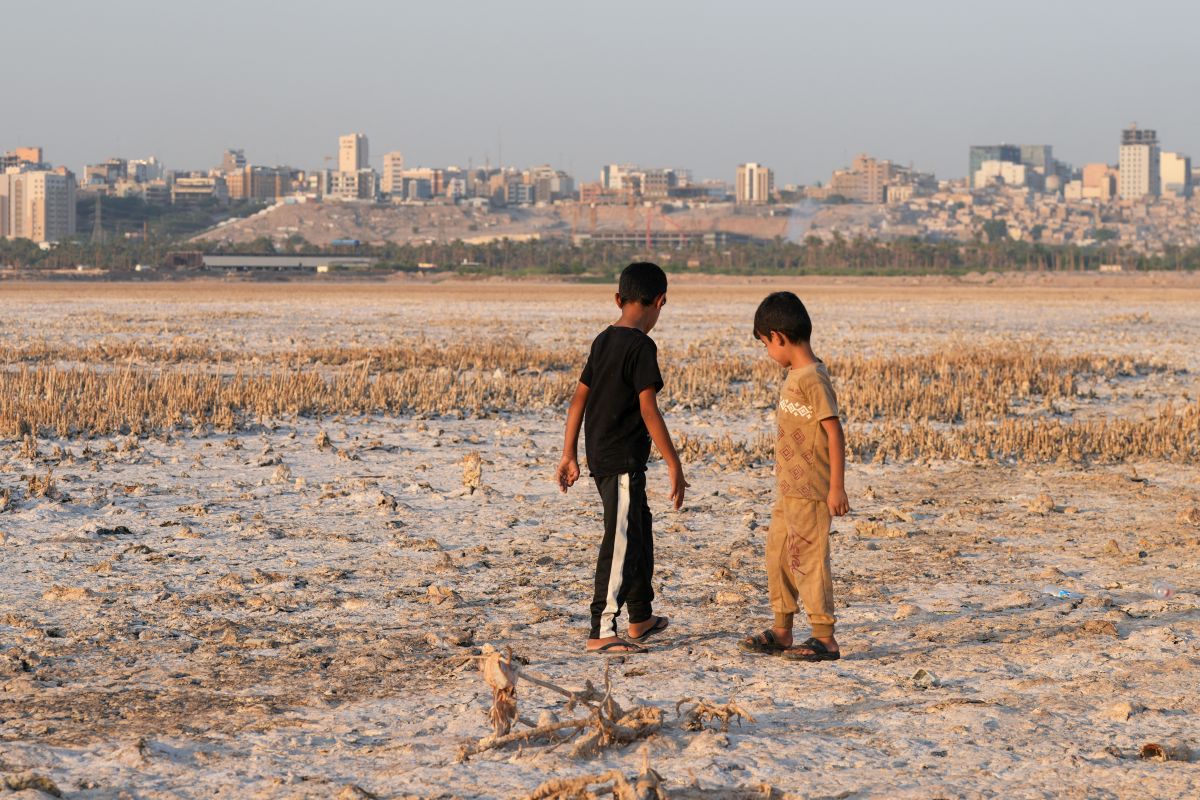
Boys play in a drought-striken expanse, locally known as the Najaf 'sea', once a lush lake fed with tributaries of the Euphrates river, east of the central Iraqi city of Najaf on September 9, 2025. (Credit : by Qassem al-KAABI / AFP)






Across the Middle East and North Africa, solar panels and wind turbines are rising faster than ever. According to the 2026 MENA Energy Outlook, renewable capacity in the region surged by an unprecedented 44% last year. On the surface, this looks like a triumph: a fossil-fuel heartland embracing the global call to limit warming to 1.5°C and phase out the hydrocarbons that have driven the climate crisis. But this transition is taking place in a vacuum of equity. The MENA region consistently ranks as one of the most unequal in the world; according to recent data, the richest 10% of the population capture nearly 58% of total national income, according to the World Inequality Database. Beneath the slick branding of "green" mega-projects, the risk remains that the same entrenched elites who controlled the fossil-fuel era are simply rebranding to maintain their grip on the region’s wealth. Climate science leaves little room for delay: a rapid global phase-out of fossil fuels is essential to limit warming and protect livelihoods. For the MENA region, which is warming at twice the global average, this is a matter of basic liveability. However, for decades, oil and gas extraction has been more than an energy source; it has been a tool for concentrating political power and sustaining corruption. Simply swapping oil rigs for solar parks won't solve the underlying problem if the governing logic remains the same, and if people and justice are not placed at the centre of the transition.
When "green" means state capture
We are already seeing the warning signs of how "green" narratives are being used to bypass accountability. In Morocco, while the Noor Ouarzazate solar complex is hailed as a global success, it has faced criticism for "green grabbing", where ancestral lands were acquired through opaque processes involving the ruling elite, effectively socialising the costs for local communities while privatising the gains - primarily to politically connected investors. Similarly, in Tunisia, the rush towards "green hydrogen" for export to Europe has sparked fears of a new "green colonialism," where scarce water resources are diverted while bypassing meaningful public oversight. We recently saw this tension boil over in Gabès, where residents protested against a green hydrogen pilot project, fearing that a 'clean' future for Europe would mean further water desertification for their own oases. A reminder that energy transitions designed in European capitals can have very different consequences on North African ground. Without radical transparency, these aren't climate solutions; they are "green rents" used to sustain the same top-down control that oil once did, maintaining social and economical inequalities, and denying people their right to have a say about their land and resources.
Reframing the Future
A sustainable energy transition is not merely about replacing an oil derrick with a wind turbine. It requires dismantling the structures that allowed state capture and corruption to thrive in the first place. The conversation cannot remain confined to technical experts; it must belong to civil society, labour groups, and local communities. Four principles must be non-negotiable: the fight against corruption, the systematic consultation of frontline communities, the development of decentralized, publicly owned energy systems, and the protection of workers in the sector. MENA’s energy transition is as much a political and economic challenge as an environmental one. The real test is not whether the region can build solar farms, but whether decarbonisation can proceed without undermining state revenues and people’s livelihood. If mishandled, the transition risks straining the social contract. Building public trust will depend on genuine participation, social protection and credible compensation mechanisms and for communities long shaped by fossil fuel economies. Governments, donors, and development finance institutions face a choice: fund a rapid transition that ignores justice, or condition support on transparency and participation. With the Arab Regional Forum on Sustainable Development in Jordan this May, we have a window to demand better.
Diana El Kaissy, National Coordinator at the Resource Justice Network Lebanon, and Dr. Pierre Saade, Head of Middle East & North Africa, Anti-corruption focal point, at the Resource Justice Network

 7 p.m. recap: 1 person killed near border with Lebanon; 200 kilos of explosives carried by mules; Riyadh shuts its airspace