


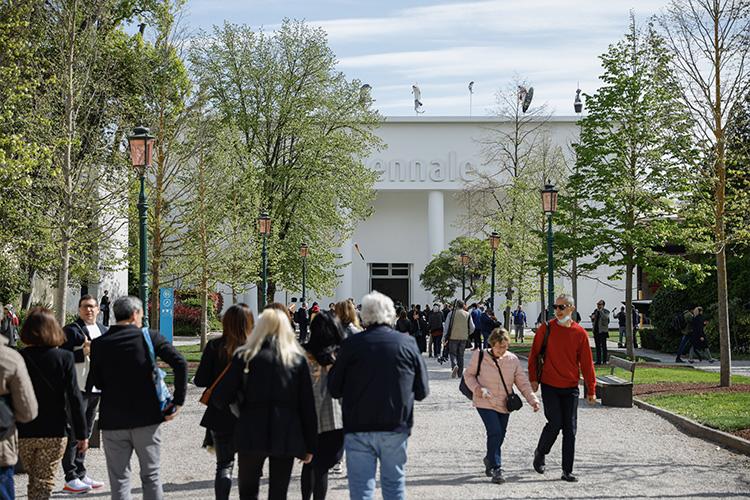
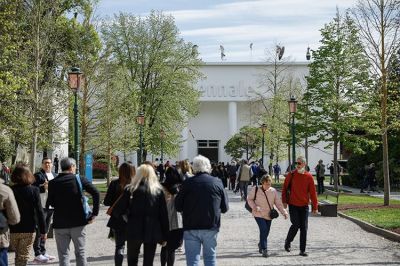
The Giardini, one of the two major sites of the 61st International Art Exhibition of the Venice Biennale 2026. (Credit: Biennale di Venezia 2026)






The 61st International Art Exhibition of La Biennale di Venezia (May 9–Nov. 22, 2026), entitled In Minor Keys, brings to fruition the project of Koyo Kouoh, who passed away prematurely in May 2025, just a few months after her appointment as head of the visual arts department. Kouoh was a Cameroonian and Swiss curator and executive director of Zeitz MOCAA in Cape Town.
Appointed in 2024 to lead the 61st exhibition, she was the first African woman to hold the post. She conceived the project In Minor Keys before passing away on May 10, 2025, leaving behind an edition that was already largely envisioned and structured.
With her family’s consent, the institution chose to move forward with the exhibition as she envisioned it: theoretical framework defined, artists selected, graphic identity set, spaces architecturally planned, and the catalog drafted. More than a tribute, it stands as an act of curatorial fidelity.
Around Kouoh, an international team continued the project: Gabe Beckhurst Feijoo, Marie Hélène Pereira, Siddhartha Mitter, Rory Tsapayi, and Rasha Salti, a Lebanese critic, writer, and curator based between Beirut and Marseille. A specialist in cinema and visual arts, Salti has collaborated with major institutions including MoMA, MACBA, and HKW, and co-designed curatorial projects that explore archives, transnational solidarities, and postcolonial narratives — a field of inquiry that resonates directly with the spirit of In Minor Keys.
Initiated at a key meeting in Dakar in April 2025 at RAW Material Company, the center founded by Kouoh, the process unfolded between Venice and several continents, reflecting her methodology: relational, transnational, and receptive to unforeseen connections.
Biennale president, Pietrangelo Buttafuoco, described the exhibition as “imbued with spirit,” restoring the human perspective in an unbalanced world. For Kouoh, the concept of “sowing seeds” made the exhibition a platform for sharing knowledge and fostering transformation.
A geography of affinities
One hundred and eleven artists — individuals, duos and collectives — are featured in this edition. From Salvador to Dakar, San Juan to Beirut, Paris to Nashville, Kouoh prioritized connections over boundaries. The exhibition is not organized into conventional sections but follows subterranean patterns: “Shrines,” processions, “Schools,” and oases of rest.
The Shrines honor Issa Samb and Beverly Buchanan, artists whose work transforms the object into living energy. Processions, drawing on Afro-Atlantic carnival traditions, encourage participation rather than passive viewing.
The “Schools” propose locally embedded institutions that resist market pressures. Moments of rest become political gestures: opportunities to slow down, listen, and let things unfold. Literary touchstones such as Toni Morrison and Gabriel García Márquez, reflect a desire to move across time and cultivate enchantment amid contemporary cynicism.
These elements were unveiled during the official press conference for the 61st International Art Exhibition, held at Ca' Giustinian, the headquarters of La Biennale di Venezia in Venice. The curatorial team outlined the conceptual framework of In Minor Keys and confirmed the list of 111 invited artists.
In this posthumous edition, charged with strong symbolic resonance, the Lebanese presence is no mere statistical happenstance: six artists connected to Lebanon are featured in In Minor Keys, placing Beirut — and its diasporic dimensions — at the center of the relational geography envisioned by Kouoh. This constellation underscores the strategic significance of the Lebanese scene in contemporary debates on memory, archives, storytelling, and forms of resistance.
Over the years, Joana Hadjithomas and Khalil Joreige have developed a body of work between Beirut and Paris that traces the marks of war, documentary fictions, and the ghosts of the archive. Walid Raad, through his project The Atlas Group, deconstructs with singular conceptual rigor the mechanisms of history-making and the regimes of truth shaping narratives of contemporary Lebanon. Hala Schoukair places sensitive experience at the center of her gaze, exploring pictorial realms where material, color, and vibration become their own language. Raed Yassin investigates Arab popular cultures and sound archives, blurring the line between collective memory and intimate subjectivity.
The participation of Khaled Sabsabi adds a further geopolitical dimension to the Lebanese presence. Initially selected to represent Australia in 2026, the artist was abruptly removed by Creative Australia following political pressure over some of his earlier works. At the heart of the controversy was a 2007 video featuring images of former Hezbollah leader Hassan Nasrallah, which several politicians deemed problematic, sparking a national debate over the limits of artistic freedom and the responsibilities of public institutions.
The decision to withdraw Sabsabi provoked a significant crisis in the Australian cultural sector, attracting international coverage from outlets such as The Guardian and The Art Newspaper. After an independent review and in the face of censorship allegations, the institution reversed course, reinstating the artist in what many interpreted as a gesture affirming the primacy of artistic freedom.
The episode gained even greater symbolic weight when it was confirmed that Sabsabi would exhibit both at the Australian Pavilion and in the central show In Minor Keys at La Biennale di Venezia — a rare arrangement made while Kouoh was still alive.
In a Biennale envisioned as a forum for dialogue and transmission, the notable presence of artists linked to Lebanon is deliberate. It reflects a dynamic artistic scene, scarred yet lucid, that continues to question official narratives and expand our understanding of how we inhabit the world.
Bodies, poetry and thresholds
The performance program places the body at the center, treating it as a site of knowledge and resistance. A procession of poets at the Giardini, inspired by the Poetry Caravan that Kouoh led from Dakar to Timbuktu in 1999, will honor her vision.
The scenography, designed by the South African firm Wolff Architects, explores the threshold as a passage to alternative modes of perception, notably through vast indigo banners suspended at the Giardini and the Arsenale.
National participations will be announced on March 4, followed by the international jury in April. The Golden Lions for lifetime achievement will not be awarded this year, as Kouoh was unable to select the laureates.
To officially represent Lebanon at the 61st Venice Biennale, the cultural authorities selected Nabil Nahas, a major figure in contemporary Lebanese art.
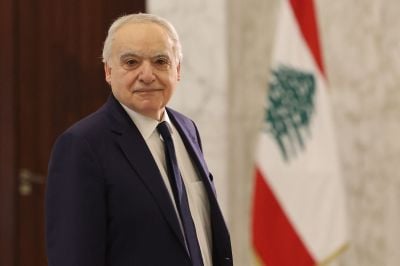
Revealed at a press conference at the National Library with Culture Minister Ghassan Salameh, his project Don’t Get Me Wrong will take the form of a monumental frieze — 26 canvases spanning nearly 45 meters — in the pavilion’s Arsenale space, offering an immersive exploration of identity, time, and our engagement with a fragmented world.
Nahas, whose work for decades has resonated between abstraction, nature, and memory, demonstrates a singular ability to weave a visual language bridging East and West — a choice celebrated as a testament to Lebanon’s creative vitality on the international stage.

 7 p.m. recap: 1 person killed near border with Lebanon; 200 kilos of explosives carried by mules; Riyadh shuts its airspace