





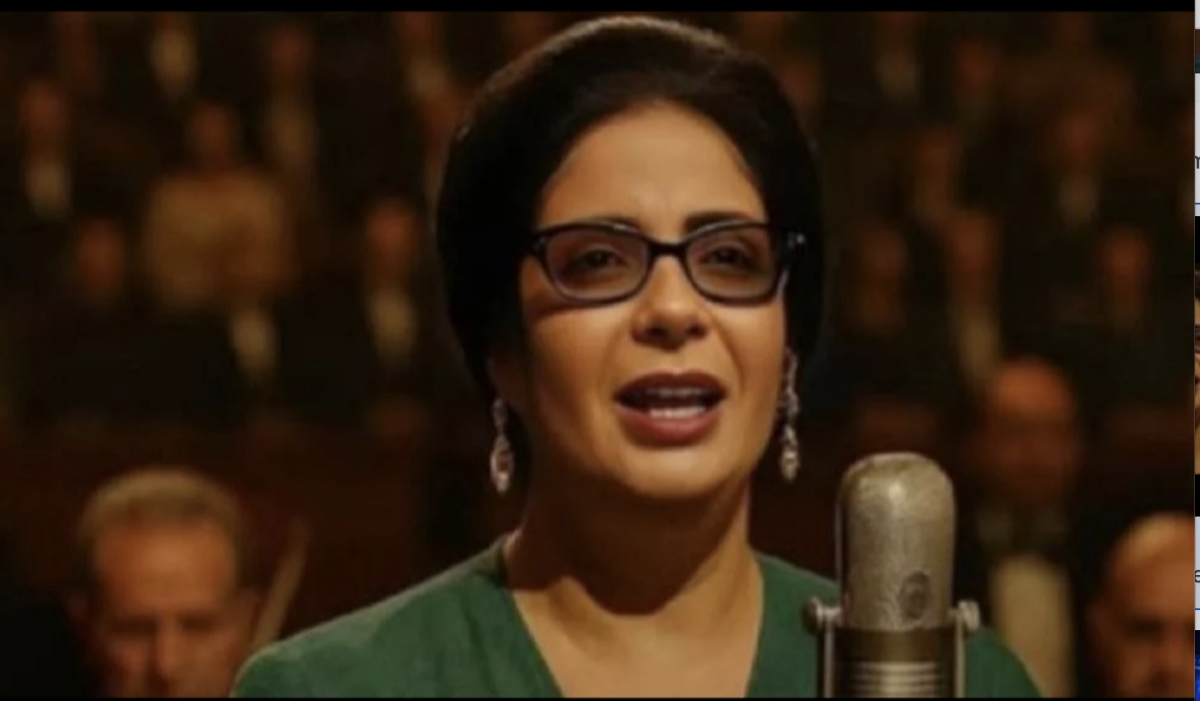
Mona Zaki portrays Umm Kulthum in "El-Sett," lending the legend a restrained intensity and magnetic authority. (Credit: Synergy Films)






After the exhibition “Divas: From Umm Kulthum to Dalida” recently closed at the Sursock Museum after drawing nearly 39,000 visitors, a significant achievement in Lebanon’s cultural scene, the film "El-Sett" captures and extends this fleeting moment of vibrancy in Beirut onto the screen.
Like passing a torch between gallery walls and a darkened cinema, film continues where the museum ends. One concludes a historical mural; the other begins a dynamic story.
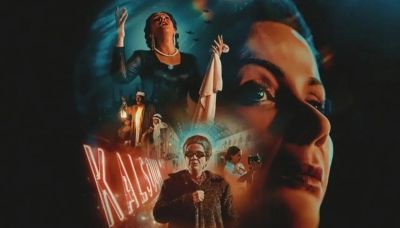
Together, they create a valuable diptych: One part is the filmed biography of Umm Kulthum, and the other is a choral exploration of the great Arab divas, reviving the women who influenced Arab music and cinema in the 20th century.
Born in 1898 in a village in the Nile Delta at the turn of the 20th century, Umm Kulthum started her journey away from the spotlight and the legendary theaters that would eventually define her fame.
As a child, she sang the Quran disguised as a boy alongside her father. From an early age, her voice amazed everyone. But more than her talent, it was her sharp awareness of her destiny that set her apart.
In 1923, in Cairo, she freed herself from her family, surrounded herself with musicians and intellectuals, and transformed her repertoire: A diva was born, but one of an entirely new kind.
This is exactly what "El-Sett" by Marwan Hamed captures with finesse. Well-documented, the film immerses us in Belle Époque Egypt, with its lavish evenings, cosmopolitan charm, refined salons and legendary theaters.

It brings to life a society full of energy, blending tradition and modernity, sophistication and political change.
Above all, it transcends simple celebration of the legend to unveil a woman of extraordinary quality: a strategist and a builder of cultural influence.
'The Star of the East' becomes a power
Umm Kulthum is more than just a voice. She is an institution.
The film presents her as a formidable negotiator: She chose her composers and lyricists, set her own performance fees, controlled her repertoire and shaped her public image with meticulous care.
During a time when women were mostly excluded from decision-making circles, she established her own center of influence. She didn’t just aim to be a star; she aimed to be a force.
For nearly 50 years, her concerts broadcast live on Radio Cairo every first Thursday of the month would halt everything.
Egypt and the Arab world paused to listen as songs, driven by improvisation and her powerful voice, captivated audiences and sent them into a state of euphoria. She became "the Star of the East."
But behind the collective rapture, "El-Sett" highlights a rare and astute political mind.
Without being officially committed, Umm Kulthum realized early on that her voice symbolized national unity. She outlived monarchy, revolution and Nasserism, remaining a central figure throughout.
She understood when to engage with power, when to withdraw and how to position herself as the voice of the nation instead of merely representing a regime.
Her alliance with Gamal Abdel Nasser turned her into an ambassador for pan-Arabism, but — the film insists — she never let herself be subsumed. She stayed sovereign in her role.
The film also uncovers a surprisingly modern take on fame. Umm Kulthum acts as a genuine pioneer of personal "branding": strategic rarity, kept mystery, tightly managed appearances and the sanctification of the monthly concert.
She understood that myth is built just as much as music. The legend was not only sung; it was deliberately created.
A sovereignty without a crown
Yet this power came with a cost. "El-Sett" exposes a type of emotional isolation. She loved but never completely opened herself, married late and rejected any dependence.
It was more than independence: It was the personal toll of power. The diva was also a lonely woman, guarded — and separated — by her own status.
The film even hints at an almost regal figure. The reference to King Farouk creates a symbolic rivalry. While the king would lose his throne, she would never lose hers.
She embodied a different kind of popular, emotional, cultural royalty — a sovereignty without a crown, but with the people’s unwavering loyalty.
Among the film’s most subtle scenes, the one with the handkerchief — advised by Princess Ferial — becomes a defining gesture. Originally a simple social prop, it evolved into a symbol of rank.
Over time, this small detail evolved into a symbolic dividing line: separating the woman from the legend, and marking the difference between intimacy and separation.
Umm Kulthum adopted this aristocratic code and made it her own signature. The handkerchief was no longer just an accessory: It became language, ritual, icon. A form of feminine power, gentle yet absolute.
This may be where Umm Kulthum's paradoxical modernity truly resides: She is ultra-traditional in her aesthetic, radically modern in her management style, conservative in her public image, yet revolutionary in her stance as a woman.
Sovereignty to the very end
The final part of the film elevates the legend to an almost epic level. After the 1967 war, Umm Kulthum went on a major international tour, notably performing at the Olympia, not for her own fame but for a cause: to support wounded soldiers and war victims.
Crowds gathered everywhere — not just to hear the diva, but to join in a collective movement.
The tour raised $8.7 million and 100 kilograms of gold, partly thanks to a spontaneous movement of women offering their jewelry as a show of national solidarity.
Umm Kulthum herself gave all her own jewelry to the cause.
The film thus reveals a sovereign of a different kind: a queen without a throne but with complete moral authority.
She died in 1975. Her funeral became a national event. Massive crowds gathered to honor a woman who was more than just a singer: a voice, a memory and a symbol of the nation.
A major Cairo street now bears her name, as if to eternally mark her presence in both geography and history.
This is how the portrait painted by "El-Sett" concludes: not as merely a diva, but as a woman who knew early on that culture is a form of power — and who, throughout her life, wielded that sovereignty with unmatched intellect, discipline and greatness.

 Evening recap: Netanyahu announces West Bank offensive; 7 killed in Jordan church shooting; tents burned in south Lebanon
 US strike on Iran this weekend? ‘Absolutely,’ says Barrack; ‘I have no idea,’ says Trump