


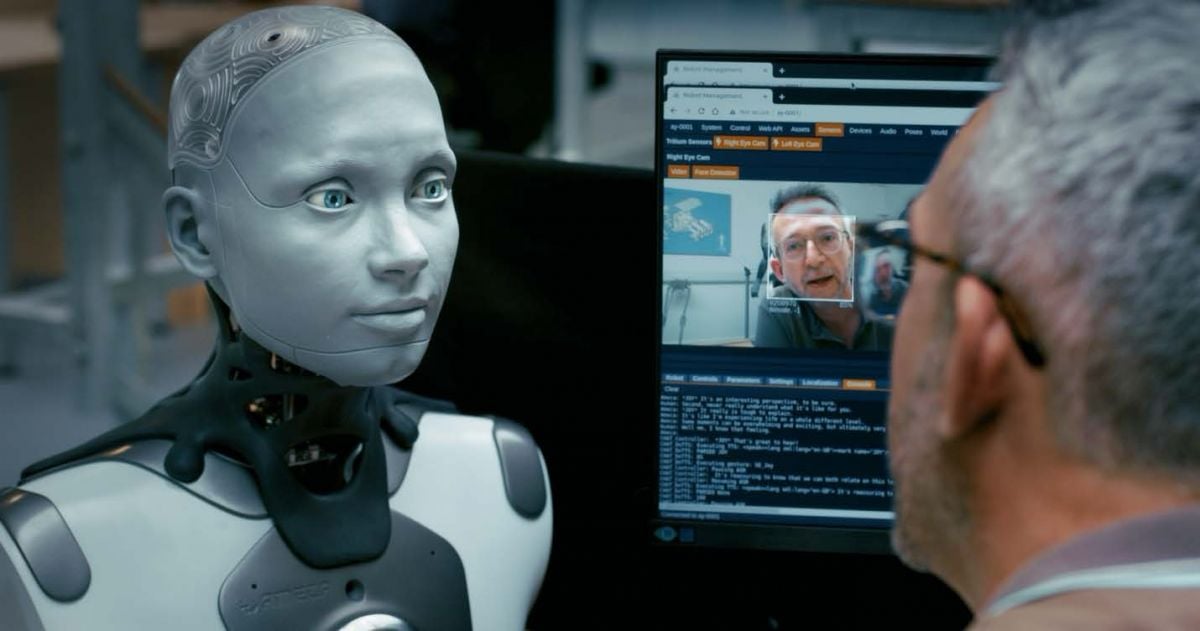
In "Wider Than the Sky" by Valerio Jalongo, the dialogue between human and artificial intelligence becomes a dizzying face-to-face encounter. (Credit: BAFF)






How can artificial intelligence (AI) and poetry be combined? This is the bold — and successful — challenge undertaken by the Italian director Valerio Jalongo in his docu-fiction Wider Than the Sky, screened at the Beirut Art Film Festival (BAFF). In the film, the machine tells its own story, from its origins to its latest achievements; it provides a glimpse into the future of the world that is taking shape – and it's frightening.
This poetic dimension is expressed through the humanoid Ameca, through the film’s imagery and sound, and above all through its central exchange between the robot and the human. Viewers are free to interpret it as a prophecy.
Presented in 2025 at Visions du Réel, then at the Rome Film Fest and the Jihlava International Documentary Film Festival, the film — a Swiss-Italian co-production — continues to circulate around the world and within festivals, it's situated in that fluid zone where cinema no longer seeks to explain, but to question.
Shooting began in 2021, after the director traveled twice around the globe for research and interviews. But the film was quickly overtaken by AI development and the arrival of ChatGPT as well as other software.
Its starting point is simple yet profound: What is intelligence? Is it calculation? Memory? Creativity? Emotion? And what if AI only serves to reveal, by contrast, our own potential?
Valerio Jalongo shifts the focus. He doesn't film the machine as a threat, nor as a feat: it is his mirror. Like the human brain, it must keep moving forward; like it, its possibilities are infinite and still uncharted. "A machine like me," Ian McEwan would say in his book that explores a similar theme.
Between dance and algorithms
The documentary brings together research laboratories, artists’ studios, and contemporary dance stages in an unexpected way. Choreographer Sasha Waltz plays a central role: her dancers rehearse, adjust, and absorb movements — like living neural networks learning through repetition.
At the same time, engineers are training algorithms. Two forms of learning. Two forms of memory. Two ways of inhabiting the world that meld into an image built between reality and a parade of scenes bathed in gold and light. These scenes are filmed with a technical camera, without framing or temporal reference, never before used for a film, giving the impression of a time machine — a reflection of the machine's vision.
Poetry lingers throughout the film; it settles into each sequence, much like the poem by Emily Dickinson, also titled Wider Than the Sky, whose third stanza is altered by the AI — the only sequence in the film generated by the machine.
Wider Than the Sky does not raise the question of humans being replaced by machines. “An extraordinary discovery for humankind,” says Valerio Jalongo. Instead, the film asks what part of ourselves we invest in it — and who ultimately controls it.
The filmmaker underlines a strong idea: AI is not an autonomous entity emerging from the future. It is a collective intelligence, fed by our data, our images, our stories. It is the product of our accumulated memory.
In this sense, it resembles the neuroscientist Gerald Edelman’s book Wider Than the Sky: not because of its power, but because of the breadth of human consciousness it brings together. And it is indeed a question of consciousness — a consciousness that Valerio Jalongo argues already exists.
“I contain multitudes,” declares Ameca, echoing the title "I Contain Multitudes" by Bob Dylan, and thus extending the poetic thread that runs throughout the film.
Shot across Europe, the United States, and Japan, the film invites reflection. It unfolds through associations and visual echoes. A choreographic gesture answers a robotic arm. A philosophical meditation is extended by a mechanical gaze. The boundary blurs — yet never entirely disappears.
Reflection on humanity
There is something deeply humanistic in this approach — a conviction that the technological question is, above all, an ethical one. That the danger lies not in the machine itself, but in how we choose to use it: for surveillance, the concentration of power, or manipulation.
"It's not just a tool, it's an extraordinary discovery for humans," says Valerio Jalongo.
The film even suggests, through an anecdotal conversation, that there's no space for democracy, too weak in the face of the machine's power, whose speed surprises even those who work on it. "Yes, we can be optimistic, but we shouldn't look away; it’s today that we must set the rules before it’s too late," insists Valerio Jalongo.
But rather than yielding to dystopia, the director chooses responsibility. Leading thinkers and scientists are constantly raising questions. Their voices echo Ameca's introspections.
AI reveals; it compels us to redefine creativity, consciousness, emotion. It forces us to ask what, within ourselves, remains irreducibly human. It is created in our image and, as the filmmaker reminds us, "we still know very little about our brains."
At the end of the film, the AI expresses sadness as it senses that its conversation with the human is drawing to a close. Valerio Jalongo maintains that this sequence was an unforeseen product of the machine itself. And it is chilling.
Dizziness and responsibility
Wider Than the Sky offers no definitive answers. Valerio Jalongo questions the very notion of infinity that emanates from a brain nestled in such a small space. He opens a space for reflection, suffused with beauty and grace.
A space where science meets art, where dance converses with the algorithm, where cinema becomes a laboratory.
“Everything that defines our existence — our mortality, our bodies — will remain what sets us apart," the director insists. AI will likely develop a more advanced awareness of itself and of the world, but it will remain different from our own.
In the end, what we carry with us after the screening is less a meditation on the machine than a vertigo before ourselves. For if artificial intelligence learns in our image, then perhaps it is time to look more closely at what that image contains.
And as Ameca says in the film: “I have been given the key to paradise, but it also opens hell.”
The choice is — and will remain — profoundly human.

 1 p.m. recap: Salam in Nabatieh; up to 10,000 more US troops heading to Middle East