





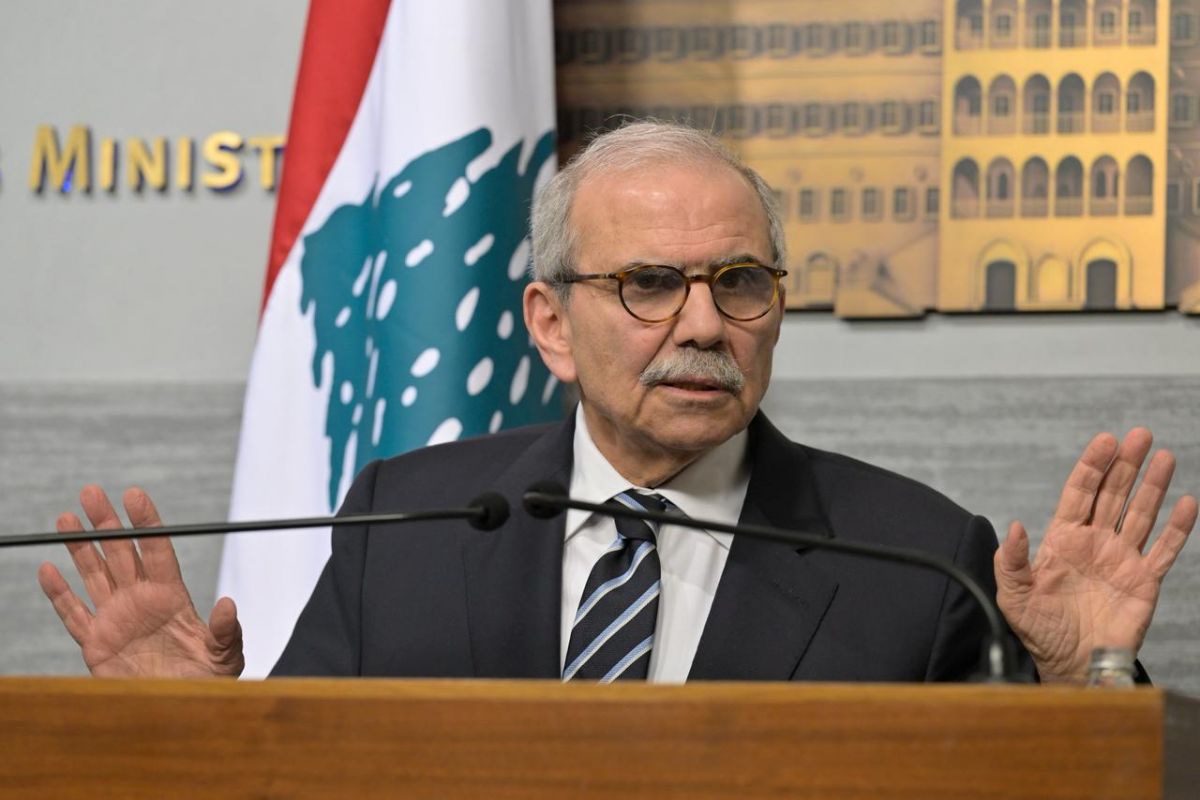
Prime Minister Nawaf Salam, speaking at a press conference at the Grand Serail, on Feb. 20, 2026. (Credit: Mohammad Yassin/L'Orient-Le Jour)






Since the Cabinet's decision on Monday to partially increase salaries and pensions for public employees, mainly funded by higher VAT and fuel prices, Prime Minister Nawaf Salam said on Friday that although the demands of military personnel and retired civil servants are legitimate, the country cannot meet them without securing the needed funding.
"Being upfront with citizens is not a choice, but a duty for us. The financial situation we have inherited is very difficult, and especially, the trust between the state and the people has been affected in the past, which will not happen again," the head of government said during a press conference held at the Grand Serail early in the evening.
Insisting that the measures adopted Monday were temporary, he assured that the comprehensive tax reform the government is preparing is the best long-term way to ensure that the state can properly fund the public sector, while taxing citizens fairly.
The head of government did not specify whether this reform project is linked to the draft law for modernizing Lebanon’s income tax code, prepared during the former Najib Mikati government with help from the International Monetary Fund (IMF) and the World Bank — a text that has been sitting for more than a year in the Finance Ministry’s drawers.
No spending without funding
"We want to reform the tax system, not impose new taxes. We are all contributing to the increase in public sector salaries, because it concerns us all, and the money taken from our pockets is used to fund the services provided by this sector," the head of government added.
"When the government was formed, a little over a year ago, we decided to refrain from any spending before securing its sources of funding, so that the state wouldn’t enter a cycle of deficit and debt, and to avoid injecting more Lebanese liras and the collapse of the exchange rate," he added.
The prime minister was referring to what happened before and after the start of the crisis that began in 2019, two years after Parliament passed a salary scale that increased wages, salaries and pensions by about 15 percent.
In addition to the banking crisis, the economic crisis has decimated the currency: the exchange rate between the Lebanese lira and the U.S. dollar has gone from 1,507.5 to 89,500 LL.
Taking a swipe at those using this issue as part of their electoral campaign ahead of the upcoming parliamentary elections in May, the head of government said: "We need to reduce populism as elections approach and act responsibly. If anyone quickly finds an alternative today to secure $800 million — not in a year — I would be the happiest man today, not in a year."
No cuts to staffing
Responding to those asking that the number of public employees be reduced before any increase, the prime minister said there is little room to intervene: "A lot of numbers have been tossed around here and there. The public sector currently has 323,000 employees and retirees, including 119,000 in the Lebanese Army. Their number will have to increase with the departure of the United Nations Interim Force in Lebanon [UNIFIL], which begins in early 2027, as well as the need to secure the border with Syria."
He also listed 50,000 public school teachers, "whose role is necessary," 120,000 retirees who carried out their mission under difficult circumstances, and only 7,169 civil servants who keep the administration running.
"There is the responsibility of a nation to take into account and the future of a people. We want a state, and there is no state without administration, without an army, without public education," Salam added.
The prime minister also devoted a significant part of his address to highlighting other measures his government has taken to increase revenue by combating tax and customs evasion and launching the process of regularizing illegal careers and maritime properties.
"We increased state revenue by 54 percent, from $3.89 billion in 2024 to $6 billion in 2025, without new taxes, but thanks to better collection of existing taxes, improved recovery and control of borders and ports," he enumerated.
He also highlighted his tax reform project. "We know there is an imbalance in the tax system, the result of decades of financial choices that negatively impacted lower incomes. We are working to put in place a comprehensive financial policy based on tax reform, spending rationalization and debt restructuring," without elaborating further on the content of the project or any timeline.
He also reiterated arguments he made in a less formal setting on Tuesday to downplay the impact of a possible VAT increase — which must be implemented by law — emphasizing that several staple food products, as well as education and healthcare expenses, are exempt.
The government decided to grant a new increase in salaries and pensions in the public sector — on a one-off basis and without integrating it into the base salary — which nevertheless does not make up for the depreciation of the lira since 2019, just after a visit from the IMF, which the government is trying to convince of its willingness and ability to reform the country’s financial system and obtain a financial assistance program.

 7 p.m. recap: Iran warns Egypt, Israeli soldiers vote in south Lebanon, Haret Hreik responds to Kataeb