






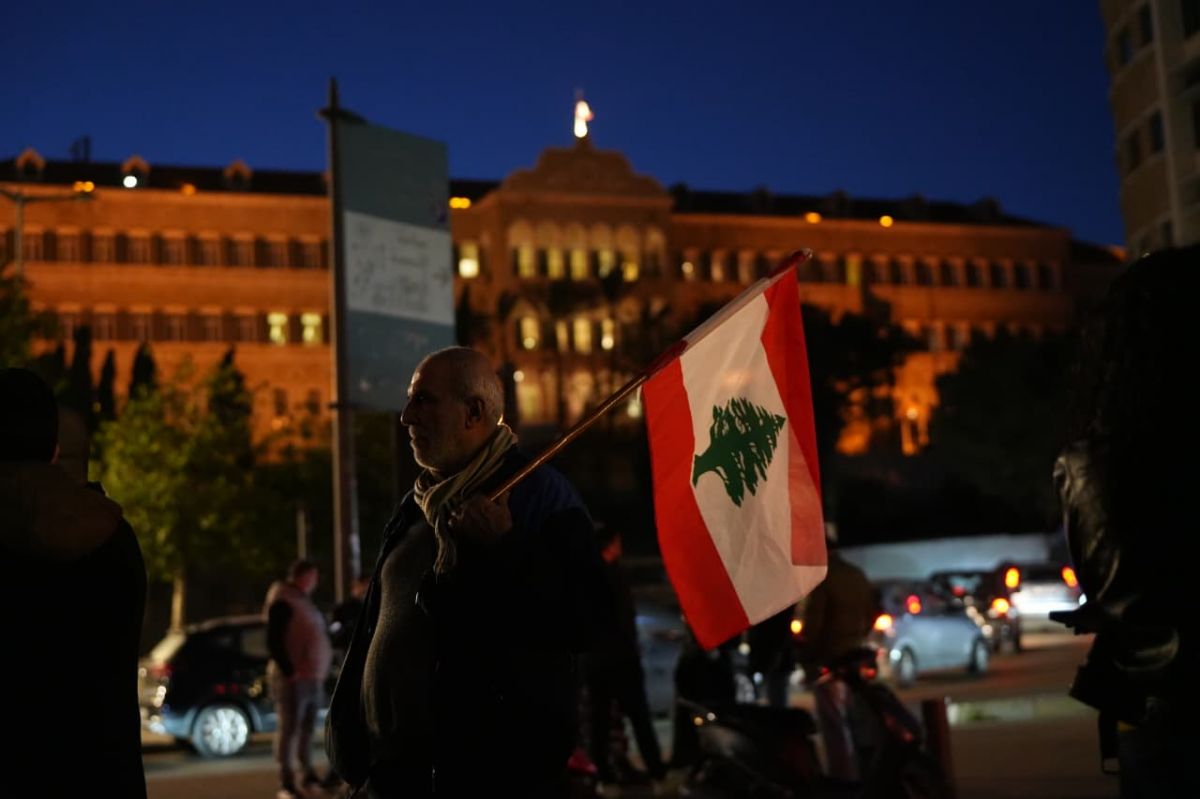
Demonstration at Riad Solh Square, in downtown Beirut, on Feb. 17, 2026. (credit: Mohammad Yassine/ L'Orient-Le Jour)






After a day of scattered protests across the country, a new demonstration was held Tuesday evening in Riad Solh Square, in downtown Beirut.
Launched on social media by the “You Stink” collective, the protest aimed to denounce the government’s decision to raise VAT and fuel prices to finance salary increases for active and retired civil servants, as well as pensions for civil servants and military personnel. The scenes echoed the social anger of 2019, when a popular uprising erupted against the ruling class.
Shortly before the protest began, around a dozen police officers were already deployed at the site, according to our journalist Lyana Alameddine. On the ground, about fifty demonstrators were present, many lamenting the small turnout.
“It’s a matter of timing, just before Ramadan,” said an elderly man. Earlier in the day, the office of Shiite cleric Mohammad Hussein Fadlallah, as well as the Mufti of the Republic, Sheikh Abdellatif Deriane, had both announced that the first day of the fasting month would fall on Wednesday, Feb. 18.
Hayat Wahab Arslane, a civil society activist, told L’Orient-Le Jour that she had come out to protest the new taxes. “We support raising the salaries of soldiers and civil servants, but not having the money taken from citizens’ pockets,” she said.
Maroun Khawleh, president of the Union of Lebanese Workers’ Syndicates, announced that “a meeting will be held to decide on the next steps of the movement.” He called on “all forces that were active during the 2019 uprising to mobilize against these new taxes.” According to him, “these levies take money out of the pockets of the poor, who are left with only one alternative: pay or bring down the government.”
Several protesters voiced concern over the economic impact of the decision. Mohammad Kanj, a 30-year-old political science student, fears “the inflation this measure could trigger, affecting all social categories.” He too had expected a larger crowd, but believes that “Lebanese people remain discouraged by the experience of October 17, 2019, which did not fulfill all their aspirations.” Lina, 49, a restaurant owner close to the communist movement, said she was worried about rising prices while regretting the government’s lack of responsiveness: “It’s important to take a stand; the people are heading toward the abyss.”
Hadi Mounla, a technical engineer, is concerned about the repercussions on his daily car commute. “Lebanese people cannot afford the costs of this decision. I don’t mind paying taxes if only we got something in return.” While insisting that the government should reverse its decision, he believes that “the resignation of Nawaf Salam would change nothing,” although he admits he is disappointed, because he thought the prime minister was “different from the others.”
Around 6:40 p.m., protesters attempted to block the road. A chant — “Down with the rule of thugs!” — failed to catch on. “They’re too polite,” one demonstrator commented.
Around 8:30 p.m., protesters blocked the highway between Saida and Sour, near the village of Adloun, using burning tires, according to our correspondent.
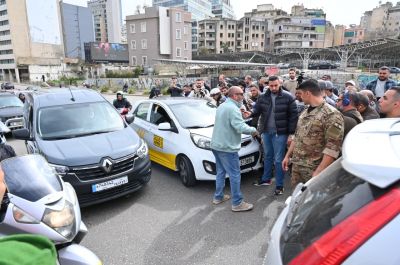
The day was marked by sporadic roadblocks on several major routes in Beirut, Khaldeh, Tripoli, and the Bekaa. About twenty taxi and public transport drivers gathered on the Ring Road in Beirut to denounce a measure they consider unsustainable amid persistent inflation. Soldiers on site quickly reopened the road. “We closed the Ring so we’d be heard! Why is the government digging into our pockets instead of looking elsewhere?” a driver complained.
A scuffle also broke out between soldiers and protesters, during which demonstrators and a photojournalist were pushed and struck by members of the army. “The soldier did this because he doesn’t want us to demand our rights. We are hungry. We’re only asking,” said Mohammad Jammal, 54, from Beirut, showing his reddened wrist. “I have two sons, aged 17 and 19. They’re studying, but I can’t afford to pay for them,” he added.
“Let the soldiers fight the Israelis, not our people,” said another protester from Shebaa. “I get up at 6 a.m. and work until 7 p.m. I make ten dollars a day. With these increases, even that won’t be possible anymore,” he said. “This is the prime minister’s Ramadan gift,” another protester quipped.
Protesters insist the movement is solely aimed at denouncing the rising cost of living and is not comparable to the 2019 popular uprising, which began after the imposition of a tax on WhatsApp. “This isn’t like the thawra. We’re just against this inflation. But if the government doesn’t give us our rights, it should fall,” said another participant. “I’m not against this road closure, but who’s going to listen to them?” said a driver stuck in traffic. “They should close all the roads,” another motorist added. “Let the whole country come to a standstill. This high cost of living is unacceptable.”
