


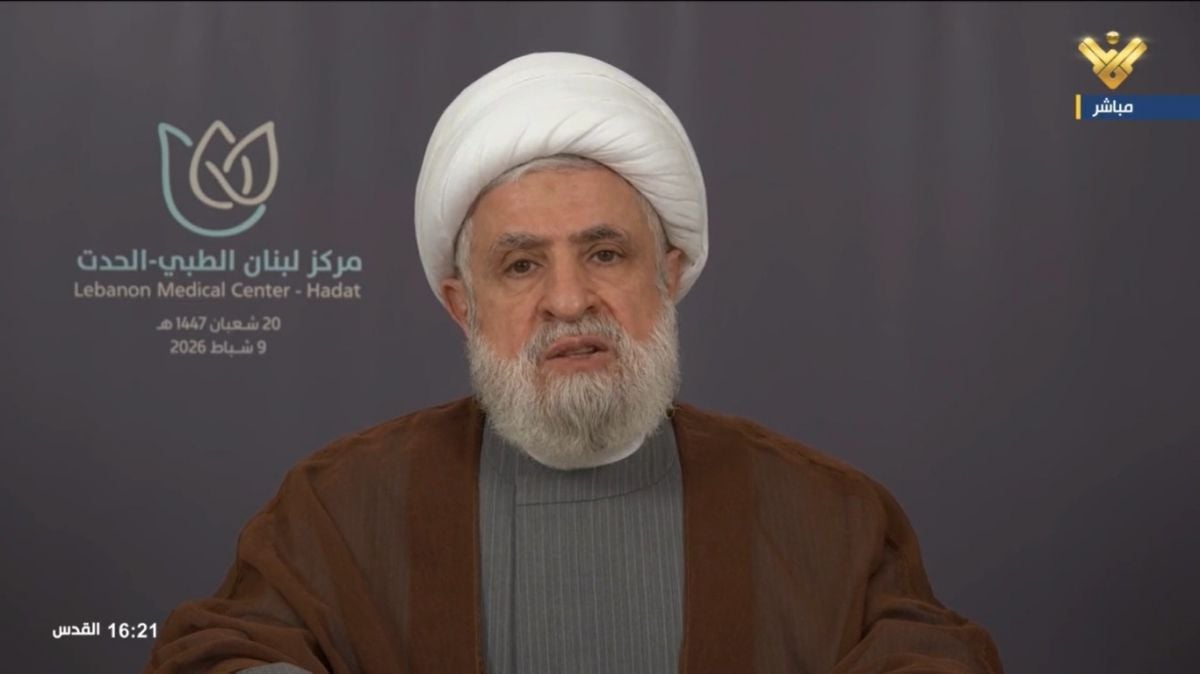
Hezbollah Secretary General, Naim Qassem, during his speech on Feb. 9, 2026. (Credit: Screenshot taken from the live broadcast on al-Manar channel.)






The secretary general of Hezbollah, Naim Qassem, called on Lebanon to reject pressures to disarm the Resistance, as the party refuses to hand over all its arsenal to the Lebanese Army north of the Litani, nearly 15 months after the ceasefire with Israel was agreed upon. This ceasefire is violated daily by Tel Aviv, with a new deadly strike and an abduction on Monday.
Hezbollah and President Joseph Aoun agree on several points, Qassem said, while criticizing attempts "by major powers as well as certain Arab countries" to push the head of state to take measures aimed at creating a rift between him and the party, "that is, between the State at its highest level and the Resistance and its people."
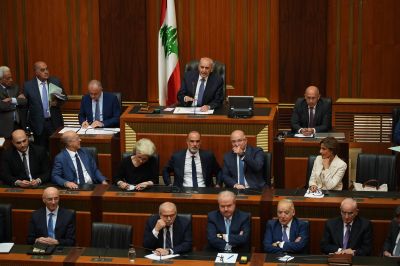
"No one should try to sow discord between us and the president," he warned, adding that the visit by Mohammad Raad, head of the Loyalty to the Resistance parliamentary bloc, to the president last week "was positive and part of an approach of follow-up, coordination, managing disagreements, and meeting challenges." Naim Qassem was speaking during a speech broadcast at the inauguration of the Lebanon Medical Center, a new university hospital in Hadath (Baabda). Health Minister Rakan Nasreddine also spoke at the event.
The Hezbollah leader acknowledged that "there are differences in method on certain issues" between the party and Joseph Aoun, while emphasizing that "from a national perspective, we both want the aggression to stop, we both want Lebanon's liberation, we both reject internal strife, and we both share the will to move the country forward." "Know that this phase is the one that shapes the future: through national unity and cooperation between the state, the army, the government, the people, and the Resistance, we are shaping Lebanon's future," he added.
No rift with Amal
Qassem praised "the recent visit of Prime Minister Nawaf Salam to South Lebanon," considering it "positive and an important step toward the reconstruction of Lebanon." According to him, the most important aspect of this visit is that the head of government affirmed that reconstruction would begin even before the end of Israeli attacks, "which we have always called for." Nawaf Salam made another tour of several regions in south Lebanon this weekend, with scheduled stops in the districts of Sour, Bint Jbeil, and Nabatieh. He was warmly welcomed by the population and pledged to launch the reconstruction of the areas destroyed by Israel.
According to Qassem, Lebanon must "focus on two objectives: first, to end the aggression in all its forms, and second, to emerge from the financial, economic, and social crisis."
The Hezbollah secretary general strongly criticized Israel, accusing it of coveting Lebanon, and arguing that only force can repel Tel Aviv's ambitions. "The enemy was driven out of Lebanon by force, resilience, and the great sacrifices made, which protected the Resistance, its people, and those who supported them, and preserved Lebanon for 42 years," he added.
He explained that the United States has used different means — including political and economic — to try to "subdue" Lebanon, after realizing that Israel could not obtain by force what it wanted, in particular by demanding the disarmament of Hezbollah. In his view, Lebanon must "refuse pressures to disarm the Resistance."
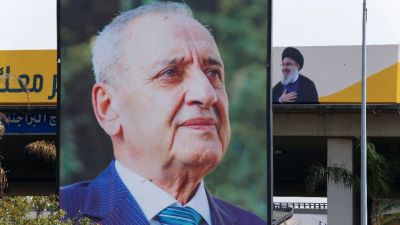
Qassem also denied any rift between Hezbollah and the Amal movement, after recent incidents suggested cracks within the Shiite tandem. "Hezbollah and the Amal movement are one body, share the same vision on major national issues, and act together," he said. He specified that the coordination meeting held in January between the two parties focused on elections, mechanisms of cooperation, speeding up reconstruction, and confronting aggression.
The day after a building collapse in Tripoli, which left 14 dead, Qassem called on the government to pay special attention to the city, describing it as a "historic Lebanese city," and stating that "it is unacceptable for such disasters to occur without concrete measures being taken to address them." "We must stand by the residents of Tripoli, those in Bab al-Tabbaneh and Qobbeh, as well as all those who suffer. This is a national responsibility," he concluded.
