





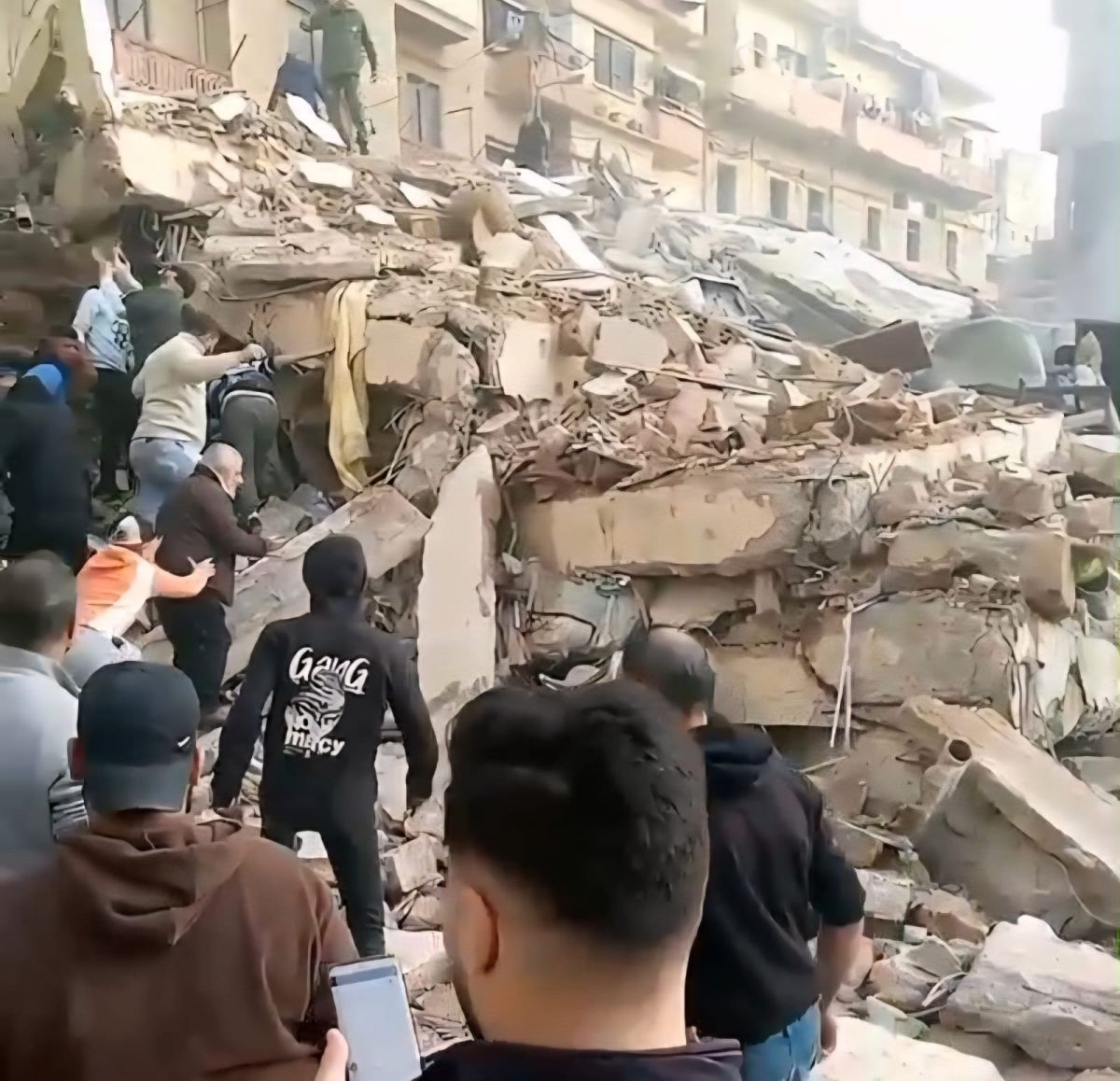
A collapsed building in Tripoli in northern Lebanon on Feb. 8 2026. (Credit: Michel Hallak/L'Orient Today)






After a long night of search and rescue operations in the rubble of a building that collapsed Sunday in Tripoli’s Bab al-Tabbaneh neighborhood, the death toll from the disaster rose to 14, the Civil Defense announced. Its director, Brig. Gen. Imad Khreich, said Monday morning that search operations had officially ended.
Throughout the night, teams from the Civil Defense, the Lebanese Red Cross and the Higher Relief Committee — made up of volunteers from across the country — worked at the scene in search of survivors.
In addition to the 14 fatalities, eight people were pulled alive from the debris and hospitalized. The tragedy adds to a growing string of deadly building collapses in Lebanon’s second-largest city, where years of neglect have left urban planning and infrastructure in dire need of repair.
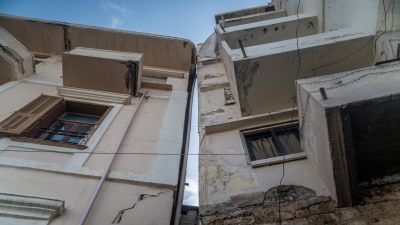
This marks the second fatal building collapse in Tripoli in just a few days, following another deadly incident in the Qobbeh neighborhood in late January. Earlier that same month, two other buildings collapsed in the city without causing casualties. Calls have since intensified to evacuate additional structures deemed at risk or showing visible cracks, though it remains unclear why the Bab al-Tabbaneh building had not been evacuated prior to its collapse. An adjacent building was evacuated on Sunday.
The collapse comes only days after residents of a nearby four-story building in the Dahr al-Maghr neighborhood were evacuated Friday evening due to cracking sounds in the ground-floor foundations. That building stands opposite another structure that collapsed on Jan. 7. According to the municipality’s 2024 census, around 105 occupied buildings in Tripoli are at immediate risk of collapse and require evacuation, though some observers believe the real number is significantly higher.
Anger in Tripoli, municipal chief resigns
According to our correspondent, the disaster sparked widespread anger in Tripoli, with residents denouncing what they describe as chronic state neglect. Protests and motorcycle convoys took place overnight, alongside sit-ins outside the homes of political figures, with demonstrators urging officials to declare a state of emergency and take urgent action to address the city’s crumbling buildings.
Tripoli’s municipal chief, Abdel Hamid Karimeh, announced Sunday evening that he had submitted his resignation to Interior Minister Ahmad Hajjar, describing the city as “disaster-stricken” and saying the municipality lacks the means to confront the risks posed by the large number of structurally compromised buildings.
Separate funerals are being held for each of the victims, according to preliminary notices shared by their families. In Bab al-Tabbaneh, residents fear the collapse of a nearby residential complex; some have moved out and are sleeping in the streets, while others have chosen to remain in their homes.
The tragedy and the public anger it has generated prompted reactions from across the political spectrum. In a post on X, President Joseph Aoun said he was “closely following developments” and called on rescue teams nationwide to assist with relief efforts and to provide shelter for displaced residents.
Speaking Monday morning from Baabda Palace, the president said that “the relevant authorities should have taken the necessary preventive measures to avoid these tragedies and the deaths of innocent people,” including children, and expressed his solidarity with the victims’ families. Information Minister Paul Morcos echoed those remarks, saying the government would not forget the victims.
Health coverage and emergency measures
Prime Minister Nawaf Salam said he had instructed the Higher Relief Committee and the disaster management unit at the Grand Serail to coordinate operations on the ground. He also said he contacted Health Minister Rakan Nasreddine to mobilize all state resources to address the humanitarian consequences of the disaster. Nasreddine later announced that all those injured in Bab al-Tabbaneh would receive full medical coverage from the ministry.
Salam added that the government is ready to provide housing solutions for residents evacuated from at-risk buildings and to allocate funds for immediate reinforcement work, in line with agreements reached during a meeting at the Grand Serail two weeks ago. He stressed that identifying dangerous buildings remains the responsibility of local authorities and urged political actors to refrain from exploiting the tragedy for political gain.
According to our correspondent, no accommodation centers have yet been prepared for displaced residents. However, the Tripoli port authority said in a statement that it was ready to offer solutions for those evacuated.
Parliament Speaker Nabih Berri called for the issue of Tripoli’s unsafe buildings to be treated as a “national priority.” The French Embassy in Lebanon also expressed its solidarity with the victims.

Calls for emergency measures
A religious delegation — including the mufti of Tripoli and the North, Sheikh Mohammad Imam, Maronite Archbishop Youssef Soueif, and Apostolic Nuncio Paolo Borgia — visited the site and called for the creation of a “special council for Tripoli and the North” with the authority to take swift and effective decisions.
Lebanese Forces leader Samir Geagea described the collapse as a “major national catastrophe,” blaming decades of accumulated errors and negligence. Tripoli MP Ashraf Rifi called for a state of emergency to be declared in the city, warning that lawmakers should consider resigning if the situation remains unresolved.
Former Prime Minister Najib Mikati, a native of Tripoli, urged authorities to compel property owners to urgently repair and reinforce unsafe buildings, calling for state intervention where owners lack funding, along with temporary housing for residents during repairs.
The Shiite cleric Ali Fadlallah also called on the state to act swiftly, warning against the political exploitation of the tragedy for personal or electoral gain.
Tripoli, the poorest city in Lebanon, has seen a surge in building collapses this winter amid severe funding shortages, long-standing neglect and deteriorating infrastructure — a crisis that authorities have repeatedly warned could worsen without urgent intervention.
The municipality of Qalamoun, a town located in the district of Tripoli, asked residents of a residential complex housing more than 200 people to evacuate the building in the al-North area after cracks and structural damage were detected in the columns and the concrete infrastructure, the state-run National News Agency (NNA) reported at 1:30 pm.
NNA obtained a copy of the municipality’s written warning formally addressed to the building’s residents.
While a number of residents objected due to the lack of alternative housing, local residents said the building is indeed at risk and that they do not want to witness another building collapsing on its inhabitants, according to NNA.

 2 p.m. recap: Israel accuses Lebanese Army, Israel-Lebanon negotiations in Tampa, Palestinians fleeing Lebanon shipwreck near Greece