






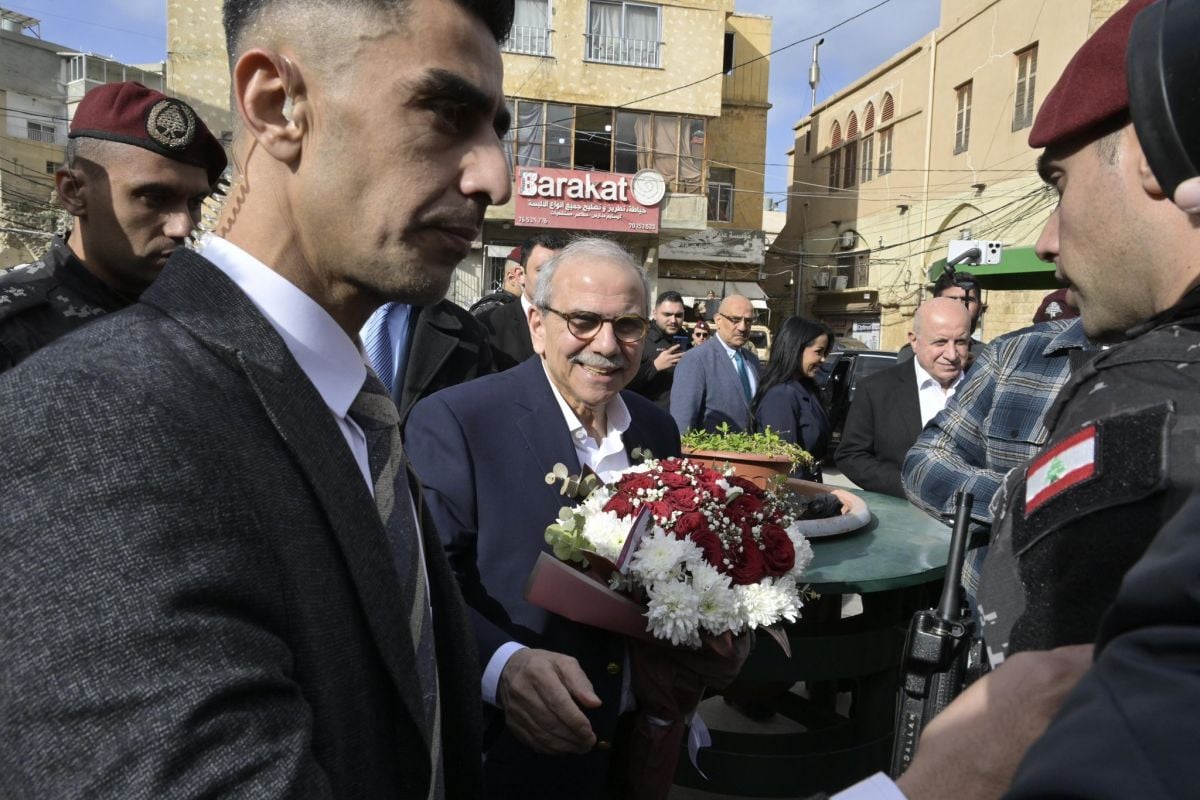
Prime Minister Nawaf Salam during a visit to South Lebanon on 7 February, 2026. (Credit: Salam's account on X)






BEIRUT — Prime Minister Nawaf Salam said Saturday during a visit to southern Lebanon that “reconstruction is a commitment” undertaken by the government, stressing that it is not temporary but one his Cabinet will continue to uphold.
Salam began his tour at the Lebanese Army barracks in the city of Sour. At the municipal building, he met local officials and MPs before heading to Naqoura and then. Salam detailed the financing mobilized for reconstruction: $250 million in World Bank loans, €75 million from the French Development Agency, and €35 million in grants from the European Union, France, and Denmark, aimed at supporting agriculture and local cooperatives.
"Welcome, welcome to the state in our country!" A woman shouted as Prime Minister Nawaf Salam arrived in southern Lebanon. Across the villages he visited, young people waved Lebanese flags, scattered flower petals, and presented colorful bouquets. The crowd cheered, creating an atmosphere of joy and fervor that sharply contrasted with Salam’s first visit a year ago, on Feb. 28, 2025, when skepticism ran high over the new Cabinet’s ability to address the South’s post-war challenges.
"Reconstruction is a non-circumstantial commitment," Salam said on his third visit since taking office. He announced rehabilitation projects for villages damaged in the last war between Israel and Hezbollah, underscoring the government’s pledge to turn promises into action.
"The right of people in the South to security, housing, land, and a dignified life is a national right," he said. "Continued Israeli aggression attacks our sovereignty, civilians’ lives, and the right to live in security. But the presence of the state here today sends a message in the face of this reality."
'Reconstruction and return of services' in southern Lebanon
Salam said the government is acting along three axes: preserving the dignity of the displaced, supporting residents’ return to their villages, and ensuring a better life for all. "We are working on three integrated pathways: humanitarian aid, reconstruction, and economic and social recovery," he said, promising regular visits to monitor project implementation.
From Yaroun, he said that “extending state authority can only be achieved through reconstruction and the restoration of services.” He announced a package of initiatives for the village, including road repairs, the restoration of telecommunications and water networks, the rebuilding of the local school and support for agricultural greenhouses.
In Tayr Harfa (Sour), “which has paid a heavy price,” the prime minister announced similar projects.
In Bint Jbeil, he was welcomed by Hezbollah MP Hassan Fadlallah, who expressed residents’ hope that Salam’s visit would trigger reconstruction efforts. Funds from the World Bank loan will support the district’s road and infrastructure rehabilitation.
Salam continued to Aitaroun (Bint Jbeil), which he called a "symbol."
"I came here because resistance in Aitaroun is not just a slogan. It reflects the determination of men and women who want to return and continue living despite losses. It is the state’s duty to partner in this effort through concrete actions and sustained follow-up," he said. He added that facilitating access to agricultural land, rehabilitating water basins, and repairing networks were essential for the agricultural season to continue.
No distinction between southern villages and Beirut
The prime minister visited predominantly Christian villages, Ain Ebel and Rmeish, also in the Bint Jbeil district. In Ain Ebel, he stressed: "The state is responsible for every village in the South and all its residents, without distinction."
In Rmeish, he reiterated the message: "Like neighboring villages, this area has long suffered from the absence of the state — a state that does not distinguish between the inhabitants of Yaroun, Sour, Rmeish, Ain Ebel or Beirut."
Salam concluded his southern tour in Aita al-Shaab (Bint Jbeil), stating: "We will not wait for the completion of the Israeli withdrawal to prepare infrastructure," while also recalling the follow-up on Lebanese prisoners held in Israel.
Israeli drones flew over several parts of the South during the visit, as violations of the cease-fire reached in November 2024, after more than 13 months of conflict between Hezbollah and Israel, continue.
Israeli drones flew over several southern areas during the visit, highlighting continued cease-fire violations more than 13 months after the conflict.
Salam is scheduled to visit Hasbaya and Marjayoun districts on Sunday, where he will meet MPs and municipal council presidents, and inaugurate a market in Nabatieh. He will be accompanied by ministers Charles Hajj and Fayez Rasamny, the president of the Council for Development and Reconstruction, and the president of the Council for the South.
Salam had previously visited the south in February 2025 and again last October, after Parliament Speaker Nabih Berri criticized the government for neglecting residents. He also faced criticism from Hezbollah, which opposes surrendering its arsenal, while the state maintains a monopoly on arms as a key objective. Reconstruction of the devastated areas, estimated in the billions, depends largely on international funding, which is contingent on effective Hezbollah disarmament — a demand the party north of the Litani River continues to oppose.

 8 p.m. recap: Israel again threatens Beirut’s south suburbs; 2 ships hit near Hormuz; Riyadh football matches canceled