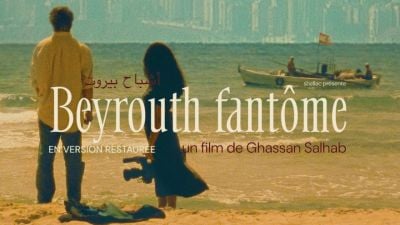
The poster of the film "Beyrouth fantôme" (1999) by Ghassan Salhab, (Credit: screenshot from YouTube)






What remains of cinema when territories disappear, images fragment, and the archives themselves become battlefields?
From Feb. 6 to 14, Metropolis is devoting the second edition of The Second Encounter to this daunting question, at the heart of its Beirut Cinematheque project.
Entitled "After Absence," this edition explores film archives not merely as tools for preservation, but as active sites: of memory, mourning, resistance, and political imagination. In contexts marked by war, exile, and destruction, preserving an image becomes a profoundly committed act.
Over nine days, the festival gathers foundational films, newly restored works, and contemporary creations that engage with archival materials. Screenings, performances, talks, and an exhibition make up a dense program, organized in partnership with the Network of Arab Alternative Screens (NAAS) and with support from the Drosos Foundation.
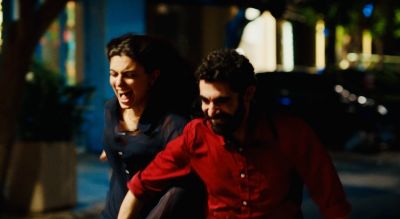
The opening sets the tone: "Beyrouth fantôme" (1999), the first feature film by Ghassan Salhab, is presented in a restored copy. The festival closes with "Mon cœur ne bat que pour elle" (2008) by Mohammad Soueid, extending the dialogue between two filmmakers who have profoundly shaped the Lebanese cinematic scene since the 1990s.
Filming, restoring, surviving
The festival also weaves connections between different geographies of loss. "The Dislocation of Amber" (1975) by Sudanese filmmaker Hussein Shariff, recently restored, is screened alongside "The Walls of Sanaa" (1972) by Pier Paolo Pasolini. The screening is followed by a discussion with members of Cimatheque (Cairo) and the Sudan Film Factory (Khartoum) about the creation and restoration of films in contexts of exile and devastation.
In Lebanon, The Second Encounter partners with UMAM D&R to spotlight the work of pioneering filmmaker Youssef Fahdeh, a little-known but essential figure from the 1950s. Fragments of his film "Fil Dar Ghariba" (1958) come to life during a cine-concert, accompanied by musician Nour Sokhon and conceived by curator Ayman Nahleh, echoing the exhibition "Youssef Fahdeh: A Story from Baalbeck Studios" held at UMAM D&R's Hangar.

In the same spirit of transmission, a case study with the Jocelyn Saab Association and Cinematheque Beirut revisits the restoration of films by Saab and Georges Nasser, revealing the technical, institutional, and political challenges behind preserving cinematic heritage. The session concludes with a screening of "Ghazl el-Banet" (1985), recently restored in Beirut from a print held at the Quebec Cinematheque.
When archives resist
"Found footage" practices occupy a central place in this edition. Major works like "La Zerda ou les chants de l’oubli" by Assia Djebar, as well as recent films by Diana Allen, Mahasen Nasser-Eldin, Ghada Sayegh, Rana Abushkaidem and Mira Jibreen, see filmmakers interrogating colonial and imperial archives, listening to what has been erased, distorted or silenced.
In partnership with the Arab Image Foundation, the festival also presents two films by Sanaz Sohrabi, constructed from British Petroleum’s Middle East archives. These offer incisive reflections on photography, resource extraction, and the visual production of power.
Beyond grand political narratives, The Second Encounter also opens a space for personal archives: family videos, domestic stories, fragmented memories. Films like "Three Promises" by Youssef Srouji, "Karaoke" by Raed Yassin, and "The Video Story" by Vartan Avakian transform these intimate materials into sites of inquiry, revealing other ways of inhabiting history.
Alongside the festival, a closed symposium, "The Multiple Lives of Images," brings together film archive professionals from the Arabic-speaking world for three days. A workshop led by archivist Chantal Partamian, in partnership with the Lebanese Academy of Fine Arts (Alba), extends this reflection to students, focusing on the archives of Nasser.
With "After Absence," The Second Encounter asserts a conviction: in a fractured world, archives are not relics. They are living forces.
Screening program available here.