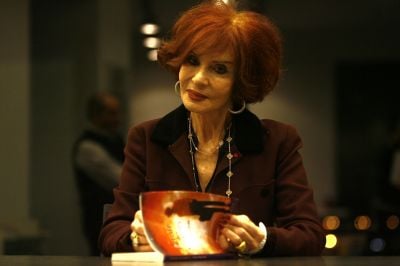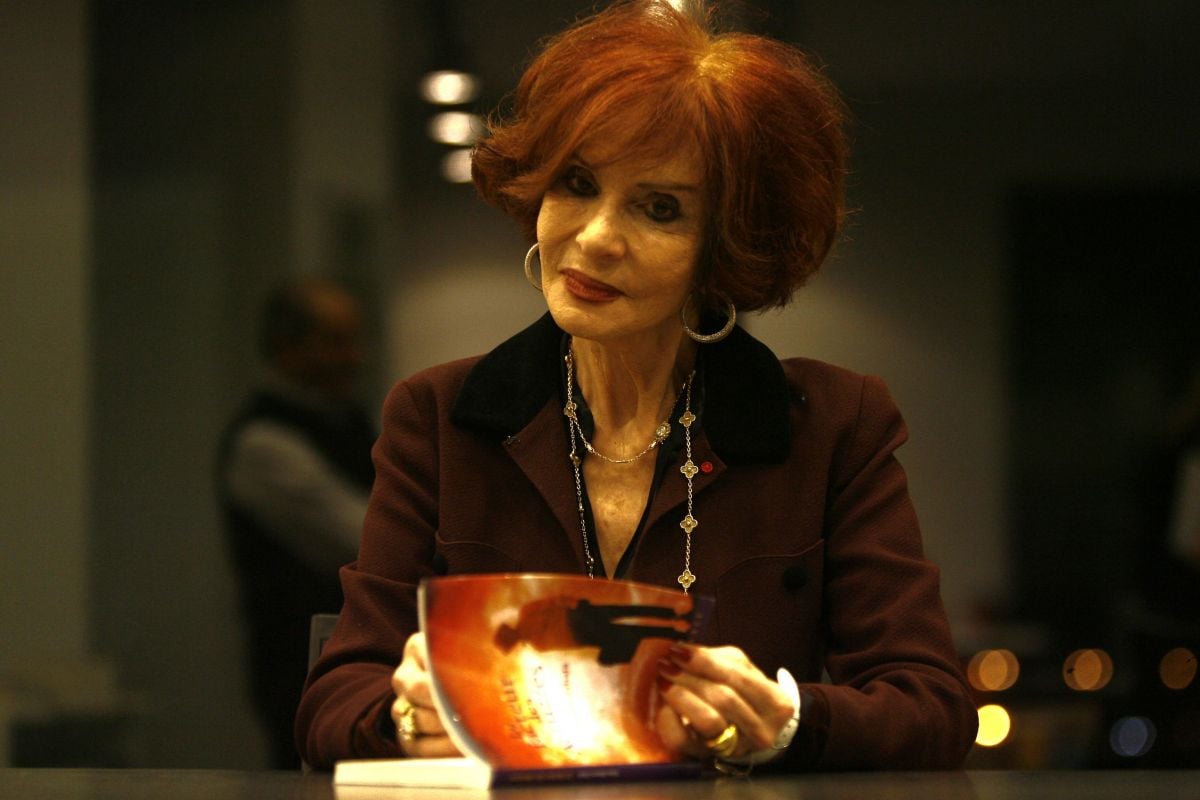
Vénus Khoury-Ghata during a book signing session in Beirut. Photo Marwan Assaf/Archives L’Orient-Le Jour






She said she wrote “from right to left,” a French inhabited by Arabic. This unique writing served as her link, beyond Lebanon, with Bsharri from her childhood — the village of her mother, perched more than 2,000 meters high, in the "north of all norths" of the war-torn country.
Bsharri, which had already been preceded by the pen of Gibran Khalil Gibran, where writing is an act of atavism, perhaps a need to reach out to the world beyond the mountain ridges.
What’s in a name? Venus’ parents — her father a gendarme during the French mandate, her mother a peasant—had lost a baby before she was born. Was giving her this divine name, Venus, a way to invoke the gods — a protective verbal shield and two-syllable safeguard over her?
Venus, goddess of Beauty and Love, would obligate this barefoot goddaughter to live up to her destiny. She who ran through rivers, scraped herself on rocks, and caught snakes with sticks, as she recounted to Ricardo Karam on camera, was crowned beauty queen in Beirut in 1959.

On the arm of her first husband, businessman Joseph Khoury — whose name she kept after an amicable divorce — she shone at high-society soirées, spending entire days preparing for those dizzying events. Evening gowns, jewelry, seduction, attracting attention — all pure joy for this mother of three children: two sons and a daughter, the eldest, Ghassan, born when she was just 20.
So much so that it hardly mattered to her that Joseph Khoury “had his own life” with another woman. Soon she, too, would follow love, in 1972, settling in Paris as poet and writer with researcher Jean Ghata, a scientist specializing in biological rhythms and the body's internal clock.
Their marriage brought a daughter, the writer Yasmine Ghata. For Venus, Parisian life seemed austere — if not dull — compared to the opulence of Beirut’s parties. But soon, war broke out in Lebanon and, she said, she traded her flowing gowns for practical skirt-suits for travel — her career already taking her around the world where her books were translated — but above all for literature, now her main tool of seduction.
A continuation of the brother’s poetry
Venus wrote to be loved — but above all, to heal when life battered her. Her gaze had the power to transport her wherever nostalgia called, wherever she simply desired to go. Jean Ghata died at 52, leaving his young wife torn between widowhood and a country at war.
Mostly, she bore the sufferings of her younger brother, also a gifted poet, “as beautiful as a god,” she said, who went to Paris with dreams, but came back ensnared by heroin.

Her father had him institutionalized in a psychiatric hospital in Lebanon, where he repeatedly tried to escape, before undergoing electroshock therapy that left him in a state of stupor and illusory bliss. “I write to extend his work,” the older sister would say, trying to wash away this immense waste in the gold of her words.
Shielding herself “with a blank page” from the Lebanese war she hadn’t the courage to face, she dived headlong into writing and books, taking advantage of her insomnia to write over and over.
No fewer than forty books, inevitably of varying impact, but the titles alone are masterpieces: "Le fils empaillé" (Belfond, 1980); "Une maison au bord des larmes"; "Le moine", "L’Ottoman et la femme du grand argentier" (both with Actes Sud in 1998 and 2003); "Le facteur des Abruzzes"; "L’adieu à la femme rouge" (Mercure de France, 2012 and 2017); "Ce qui reste des hommes" (Actes Sud, 2021), to name but a few.
She also wrote the biography of Russian poet Osip Mandelstam (Les derniers jours de Mandelstam, Mercure de France, 2016). Moved by the story of this wordsmith who died in a Stalinist gulag for daring to criticize the regime, she thus continued the fight of his wife, who worked to save his writings dictated to her and transcribed onto tiny scrolls, then hidden among friends in unlikely objects.
Venus’s poetry is equally notable. Up to her latest collection, "Qui parle au nom du jasmin," published by Bruno Doucey in 2025, she produced no fewer than 34 hypnotic titles: "Les ombres et leurs cris" (1975); "Un faux pas du soleil" (1982); "Monologue du mort" (1986, Belfond); "Alphabets de sable" (Maeght éditeurs, 2000); "Désarroi des âmes errantes" (Mercure de France, 2024), for example.
As translator of the poet Adonis, she approached his work with the sensitivity of a poet as much as her knowledge of classical Arabic and became, in this role, a genuine bridge between the Arab world and the Francophone sphere.
What winds carried words into our mouths?
The strangeness of her imagination and the uniqueness of her sentences captivated Parisian and French literary circles to the point of crowning her with some fifteen prestigious prizes, including the Grand Prix de la Poésie of the Académie Française" (2009), the Goncourt Prize for Poetry for her entire body of work (2011), the Renaudot Prize for paperback for "La fiancée était à dos d’âne" (Mercure de France, 2015), and official honors such as the Commander of the Légion d’honneur in 2017 and Grand Officer of the National Order of Merit in 2023.
“Where do words come from?” she wrote in "Les mots étaient des loups" (Gallimard), “from what friction of sounds are they born, to what flint did they light their fuse, what winds carried them into our mouths. Their past is the rustling of restrained silences, the trumpeting of matter in fusion, the growling of foul waters.”
She said she wrote her words in French, but “from right to left,” following Arabic calligraphy. As the elder sister of journalist and writer May Menassa, Venus compared languages to painting tools: May wrote Arabic with a brush, she said in essence, and French literature is written with a knife. May’s writing would seem, in French, to be like “lokum” (Turkish delight). In a way, transforming original lokum into garlands of steel was, for fifty years, the grand accomplishment of the woman French and Francophone literature called a “bridge between two shores.”
It was an alchemy she embodied with her own charm and infallible elegance, grateful to her “absents” — and no doubt to her beloved cats — for having dictated her otherworldly words and enigmatic metaphors.
Now she joins her dear departed, who left without ever closing the door. She leaves the living the light baggage of her words which, like the little Japanese flowers Proust spoke of — bits of paper unfurling in a teacup — delicately unfold the turmoil of an entire life stretched between two centuries, two millennia, two languages, two worlds, two countries, and two interwoven stories.
For Venus by Noha Baz
She was the first to answer the call. I had to choose a few people ready to join in this Lebanese flavors project, with all proceeds going to help families devastated by the horror of Aug. 4, 2020, and the hardships of daily crises.
I started with her. At the start of the spring, Avenue Raphael was bursting with life. Regal, Venus — this planet of the heart — opened the door to me with sweet, elegant, feminine eyes.
Her daughter Yasmine, an attentive and discreet blonde angel, confided to me the discomfort her mother had felt that morning. But Venus insisted on going ahead with the meeting, even getting her hair and nails done for the occasion.
That day, Venus told me about Bsharri and the flavors of her youth, her mother’s dishes, borghol banadoura, and a simple, authentic kitchen marked by resignation. Her gaze — where childhood still sparkled — occasionally drifted off into the mists of memory. She searched with precision for measures and recipes, wanting to give me the best of her memory.
Between bites of figs—her favorite fruit, a miracle to find in that season—she would swing from literary to gastronomic tales, playful and upbeat, smilingly weaving anecdotes and memories.
Despite a fractured memory, she adored celebrating life, and her memorable dinners brought together all of Paris. Her eggplant cake, this maqloubeh, a lacy dish to which she gave elegance and life, will remain her signature.
Venus made language a refuge and a crossing. Her words carried exile with gentleness and transformed memory into song.
Between native soil and land of writing, she spent her life sowing poems like sentinels, in which the personal met the universal. Through her pen, the voices of the absent continued to breathe.
Like the goddess whose name she bore so gracefully, her gentleness did not erase the weight of the world but illuminated it with a quiet elegance. Her poetry became an act of love. She birthed words, protected them, then watched them fly. These words recognized her before she summoned them...
Let us always remember that reading Venus is entering a church without walls, where poetry becomes refuge and every sentence a prayer.
Today, she herself has become a cathedral for eternity.