



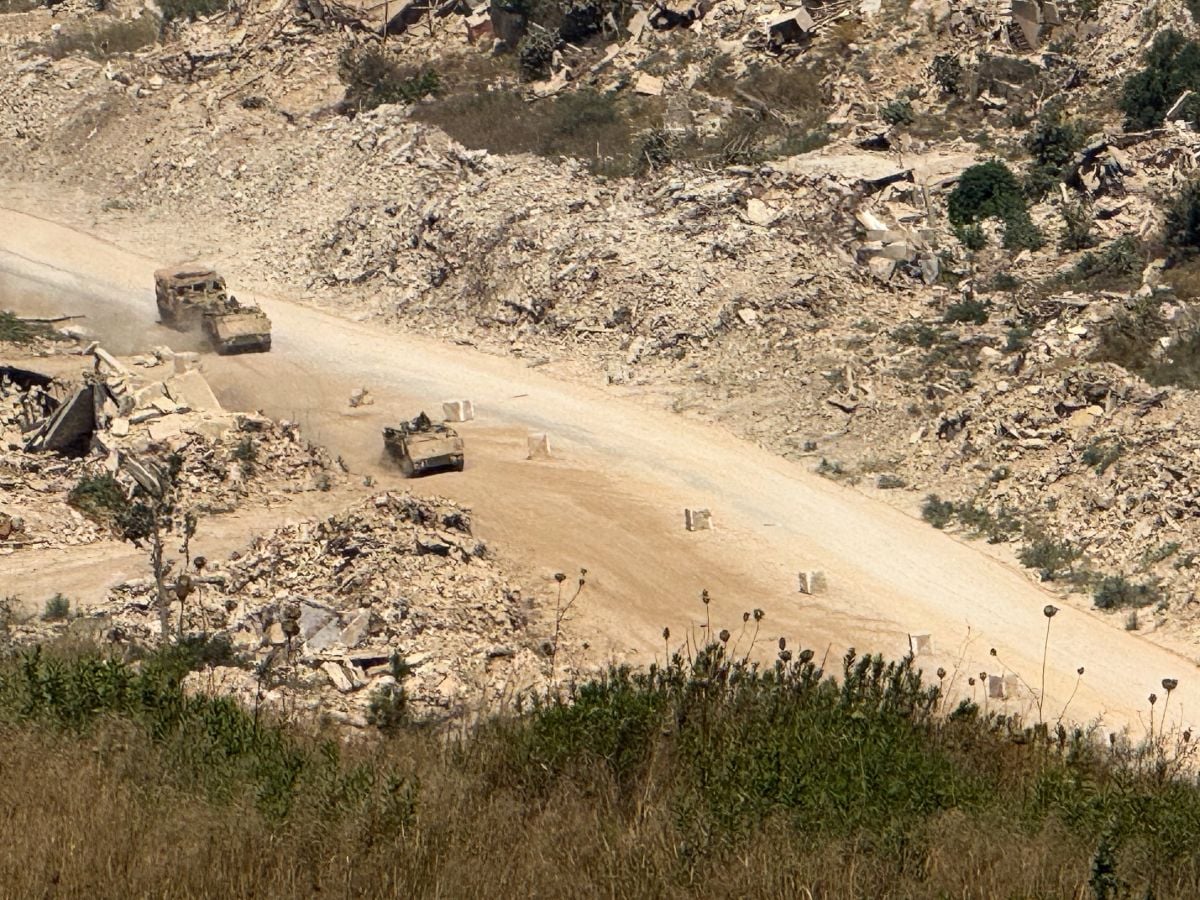
Israeli vehicles on a road in southern Lebanon, seen from Israel, Aug. 6, 2026. (Credit: Avi Ohayon/Reuters)






BEIRUT — As the Israeli army continues its systematic destruction in several villages in southern Lebanon — with attacks "on the rise" over the past two weeks, according to UNIFIL — U.S. Gen. Joseph Clearfield, who heads the U.S.-led ceasefire monitoring mechanism, is once again in Lebanon, where he met with Lebanese Army commander Gen. Rodolph Haykal.
The visit comes as tensions run high in southern Lebanon, where, according to Israeli Channel 12, the Israeli army is preparing for "several days" of fighting against Hezbollah. The group is believed to still have dozens of fighters trapped in tunnels beneath the strategic Ali Taher ridge, which overlooks the entire Nabatieh region.
During his visit to Yarzeh, the head of the "Mechanism" discussed security arrangements related to the framework agreement signed on June 26 between Lebanon and Israel, brokered by Washington, which calls for Hezbollah's disarmament and Israel's withdrawal from "pilot zones" in the South. Implementation of the agreement has stalled, mainly because of tensions on the ground.
Clearfield and Haykal discussed the "difficulties the Lebanese Army is facing in carrying out its missions, particularly due to the continued Israeli attacks, earthworks and demolitions" underway in the South, according to the state-run National News Agency (NNA).
'Significant increase' in Israeli military activity
The Lebanese Army has repeatedly said that ongoing Israeli attacks are preventing it from dismantling Hezbollah's infrastructure, particularly in the "pilot zone" of Zawtar Gharbieh (Nabatieh).
The meeting between the two generals took place as the Israeli army continued numerous operations in several border villages, along with a series of demolitions.
According to the United Nations Interim Force in Lebanon (UNIFIL), a "significant increase" in "Israeli military activity" has been observed in southern Lebanon over the past two weeks. Between Aug. 5 and 16, the U.N. force recorded "an average of 137 projectiles per day, including 208 on Saturday and 185 on Sunday," it said.
Eucalyptus trees uprooted in Marjayoun district
On Monday, in the Marjayoun district, Israeli soldiers set fire to homes in Talouseh, carried out land-leveling operations on the outskirts of Meis al-Jabal, where bulldozers destroyed homes and private property, removed concrete blocks that had been placed on the road linking the town to Shaqra, and uprooted eucalyptus trees with bulldozers.
According to our correspondent in southern Lebanon, an incursion was also reported inside the occupied village of Bani Hayyan, in the Marjayoun district, before Israeli soldiers carried out a major demolition operation there. Israeli forces generally establish positions on the outskirts of occupied villages and enter them to conduct operations, according to our correspondent.
The occupying forces continued their demolition operations, blowing up homes on the outskirts of Braasheet, in the Bint Jbeil district. “The ground shook beneath our feet and we felt tremors in the soil, like an earthquake,” a resident told our correspondent in the South. Shortly beforehand, Israeli soldiers had booby-trapped homes in Beit Yahoun ahead of their destruction.
In the late afternoon, powerful explosions were heard in Zawtar Sharqieh and Mansouri, where two airstrikes targeted the coastal village in the Sour district.
In a video filmed from an Israeli vehicle on a road north of Naqoura, Israeli flags can be seen installed on electricity poles along the coastal road, before the person filming zooms in on the city of Sour in the distance. The footage sparked considerable reaction online over the reasons behind its publication.
Artillery fire also targeted the outskirts of the strategic Wadi Slouki valley. Meanwhile, Haddatha, in the Marjayoun district, was targeted by a stun grenade, while Israeli artillery fire from the village targeted the valley linking it to Haris, in the Bint Jbeil district.
Israeli army drones dropped incendiary munitions on Dohat Kfar Roummane, in the Nabatieh district, as well as the Dabcheh area on the outskirts of Kfar Roummane and the Ali Taher heights in the Nabatieh district.
Reporting contributed by our correspondent in the South, Muntasser Abdallah

