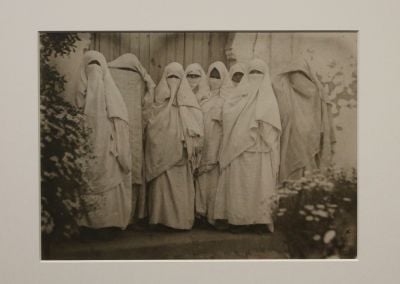
(Credit: Gaëtan Gatian de Clérambault, taken from the artist's website)






In the fall of 2025, large posters scattered across Paris public spaces invited visitors to discover the exhibition "Performer l’invisible," which runs until Jan. 25 at the Musée du Quai Branly – Jacques Chirac.
The project explores the question, 'What can be expected from a colonial archive today?' and charts a path beyond a documentary illusion or the reinterpretation of heritage.
Annabelle Lacour, the museum’s photography collections' curator, invited Iranian-Australian artist Hoda Afshar to delve into a series of photos taken by a French psychiatrist in 1919 in Morocco. A conversation with the artist, at the heart of this installation, helps us understand how The Fold reworks the archive to lay bare the colonial gaze's violence and control.
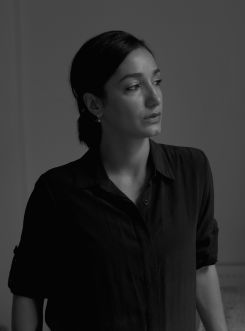
Examining the Western gaze, from past and present
In an Instagram post published on Jan. 12, Afshar reacted to protests unfolding in Tehran and numerous other Iranian cities, violently suppressed by authorities. Two days later, the World Health Organization (WHO) estimated that at least 3,500 protesters had been killed since the mobilizations began.
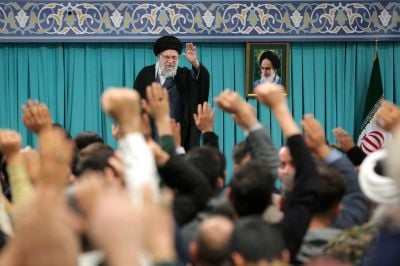
With the same analytical finesse seen in The Fold, Afshar describes the events’ coverage in Europe and the United States as "media manipulation." Once again, it all comes down to 'the gaze.'
Images of Iranian women smoking a cigarette or burning portraits of the ayatollah, which dominated screens in France, are precisely what was expected. Calls from the son of the former Shah of Iran were widely relayed by French and American media, as his proposal offered a ready-made solution to the Iranian political and social crisis, which also aligned with their interests.
In the artist’s words, the Middle East is not "a story of ‘good’ versus ‘evil,’ of East against West"; we must avoid yielding to what is highlighted, praised, or discredited, and instead, pay attention to how narratives aimed at us are shaped.

Should we interpret archives or let them speak for themselves? This is a key political question for contemporary archives, especially when they are related to colonization.
Beginning in the 19th century, photography established an ethnographic tradition in Australia and Algeria, employing similar methods to study and document colonized populations and justify colonial rule.
This is why it is valuable for someone from a formerly colonized territory to study colonial archives. The narratives offer continuity. The emergence of darkrooms reveals how visual codes of identity and hierarchy, which shape us today, were created.

In 2019, while researching colonial portraits and the stereotypical depiction of Algerian women, Afshar unearthed the Gaëtan Gatian de Clérambault archives. Clérambault (1872-1934) followed an unusual path: he trained in fine arts, then medicine, and later became a psychiatrist. He is known for theorizing erotomania, the delusional conviction of being loved.
As Lacan's intellectual mentor, Clérambault focused on decoding subtle body language. After his military service, he was commissioned by General Lyautey to set up a modern psychiatric service in Morocco. In his pursuit of the vanished elegance of ancient drapery, he photographed the haik in Fez, a voluminous cloth worn by men and women throughout the Maghreb.
Afshar’s exhibition does not offer a single interpretation of the presented corpus. Her deliberate refusal to prescribe meaning creates room for a plurality of interpretations, which she describes to L’Orient-Le Jour as “multiple and multidirectional.” She does not attribute ideas to the photographer that he never expressed.
'Exploring the psyche of the voyeur'
Her approach involves both a reversal of the gaze and a disruption of the frame and hierarchies between observer and observed, between 'the seeker' and 'the sought.'
Clérambault, in turn, becomes the object of scrutiny. He is observed, filtered through our projections, hypotheses and imaginations.
The relentless presentation of his work compels the viewer to grasp the figure he once was and the forces at play in his practice. Once the roles are reversed, does the visitor’s gaze acquire a form of authority? Where the camera once held sway, the artist’s work refrains from adopting the photographer’s point of view, instead engaging it with distance, deconstruction and critical analysis.
Even today, photography remains the medium best able to influence us in believing it depicts reality – even as the photographer’s eye manipulates it. This ambiguity blurs our relation to colonial archives and Clérambault’s work.
Seen through a contemporary lens, we are tempted to judge the “Orient” he portrays as the truth, with the risk that we continue to mystify and mythologize this space.

The archive, for Afshar, materializes a one-sided power dynamic — an asymmetry that The Fold seeks to challenge. This approach does not draw on what the images show, but rather on what their construction reveals. "This project isn’t about what the photography shows, but about the colonial gaze and photography itself," she says.
If, as Mounira Khemir* argued in an article on the psychiatrist, colonial photography "didn’t aim to show reality, but to express myths," then Clérambault occupies an in-between space. His work provides both a remarkable testimony of Moroccan draping customs and records colored by expectations.
Far less grotesque and picturesque than common orientalist trends of the time, his photographs laid the foundation for ethnographic work even before the discipline had outlined its methods. Yet they also display a quest for obsessive, layered meanings woven into the cloth itself.
Refusing reparation
Because this project was a commission, it is based on controlled — or at least guided — access to the archives. The artist works with this photographic database, applying an automated cropping process. The files, initially fragmented into thumbnails, are brought into the darkroom and then digitally reworked. This technological encounter gives rise to a "reappropriation."
But from the start, the artist resists the temptation to offer a corrective or redemptive reading. The Fold neither presents the women photographed by Clérambault as witnesses nor seeks to reintegrate them into an archive that, by its very nature, excluded them.
"The women are absent from this archive. They are not there," the artist emphasizes. Any attempt at reparation would therefore be illusory, even counterproductive.

The archive is no longer a source of historical truth, neither about colonization, women’s conditions, nor the life of this enigmatic figure. The artist’s gesture transforms it into a mirror that invites each person to question what they choose to see and reflects our contemporary contradictions, stereotypes, desires and frustrations.

Rather than being nude — a common staging in the explicit eroticization of colonial photography — the women disappear, existing only as vehicles for the scientist’s gaze and interest.
“Clérambault does not photograph draped bodies, but fabrics with presence,” writes Serge Tisseron, author of a book on Clérambault, echoing Walter Freeman, who photographed his patients in the “lobotomobile” before and after treatment with the leucotome (the instrument used for removing white matter).
In this sense, Clérambault’s photographs are part of an economy of the gaze, where the Orient is not so much represented as it is contained within a space for the projection of knowledge and power.
The archive itself is inherently incomplete. Bodies are fragmented, images repeated in series, and individuality is absent. Far from being neutral, the photographic medium cements this asymmetry by granting viewers authority over silenced bodies**.
From this perspective, the women photographed are not subjects, but surfaces for inscription. Their erasure behind the cloth does not block the colonial gaze; it constitutes one of its very conditions. The same applies to the veil, which fascinates the psychiatrist and functions as both relic and catalyst.
From Morocco to Algeria, Iran to France, Afshar reminds us how the veil and the female body have always symbolized national, moral, and emancipatory struggles: "Their bodies symbolize things such as desire, fetishism, obsession. Whatever the intent, it always symbolizes something, but women’s voices are always absent."
Through the western prism of colonialism, the veil acts both as a revelation and a screen, constructing an ongoing tension between desire and anxiety.
The artist recalls both the unveiling campaigns conducted by France in Algeria and the way women were the French colonialists' blind spot during the Algerian War of Independence. The idea that they could hide bombs and take part in the war effort was inconceivable, simply because, by definition, their agency was denied.
Afshar plays every nuance from clinical whites to perverse blackness. Even though Clérambault’s knowledge production had undeniable colonial conditions, the point is not to put him on trial or settle his intentions, but rather to embark on a conscious process of questioning.
The photographer becomes a vehicle for new projections, productive research that prompts us to reflect on a century of gazes at the East and the subjugated. This ever-present fold — that of a piece of fabric — creates a visual abstraction, becoming almost an epistemological obstacle.
These photographs, rather than providing answers, create gray areas and even discomfort. They refuse to give themselves up. They are material to be seen and thought with, and for which Afshar acts as their conduit.
*“Clérambault ethnographe,” Mounira Khemir in Gaëtan Gatian de Clérambault, psychiatrist and photographer, (dir.) Serge Tisseron, Les Empêcheurs de penser en rond collection, 1990.
** https://balises.bpi.fr/decadrage-colonial/ “Photographing the colonies, between reporting and ethnography,” Balises, Le magazine de la Bibliothèque publique d’information (BPI), Paris, November 2022.