


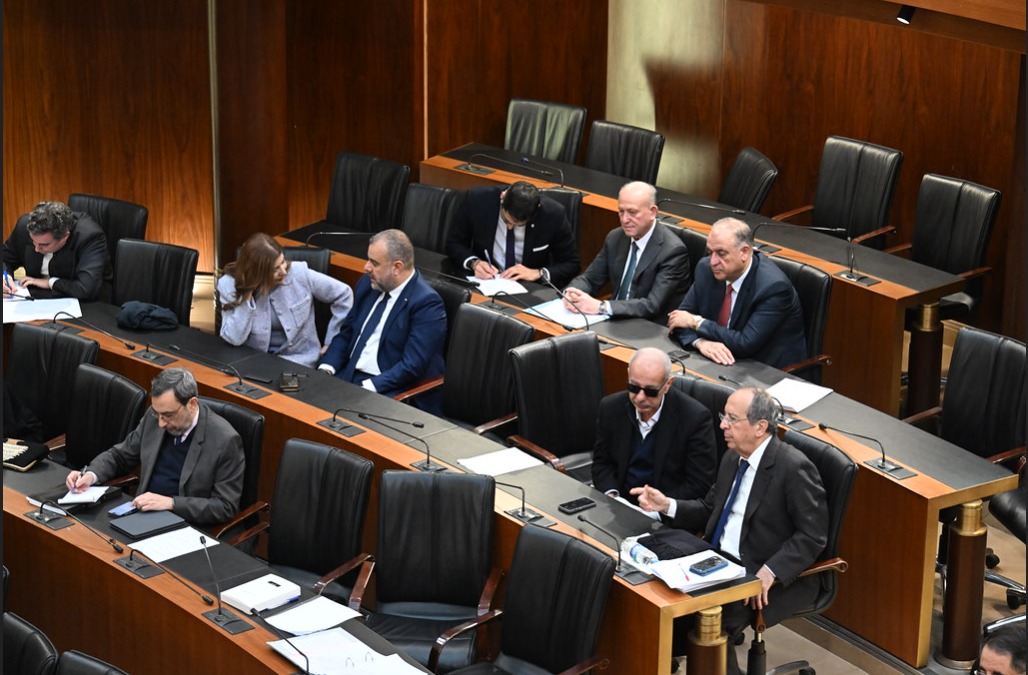
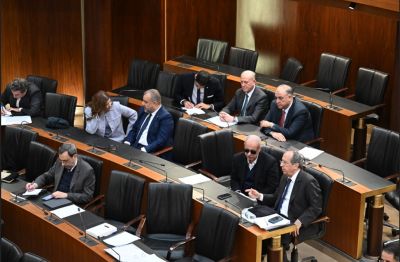
A section of the hemicycle during the parliamentary session on Wednesday, January 28, 2026. Photo from the Lebanese Parliament's Flickr account.






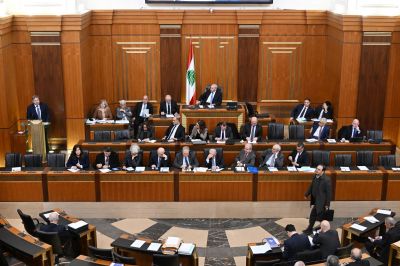
Parliament met Thursday for the third consecutive day as part of the sessions scheduled to vote on the 2026 state budget.
Alongside the recurring criticisms aimed at the draft budget drawn up by the government and revised by the Finance Committee — such as the lack of vision, highlighted notably by Farid Boustany (an ally of the FPM), one of the last MPs to speak Wednesday evening, and by George Atallah and Nada Boustany (FPM) Thursday morning — the session also gave a platform to MPs advocating on issues like the series of collapsing buildings in Tripoli, the revaluation of end-of-service payments for retired civil servants, and reconstruction in southern Lebanon.
More than 60 MPs, or half of the Assembly, were slated to speak over the three days. All scheduled remarks were delivered before the end of Thursday morning’s session, which was held from 10 a.m. to 2 p.m.
Prime Minister Nawaf Salam will open the afternoon session, scheduled to begin at 5 p.m., and respond to MPs’ comments before the examination of the bill begins.
It remains possible that an additional session could be held on Friday to allow Parliament to vote on the budget before Jan. 31. After this deadline, the Cabinet may enact the budget by decree, in the form presented to Parliament.
The draft budget projects expected revenues of $5.97 billion to cover equivalent expenditures, a figure the Finance Committee considers unrealistic. Revenues and expenditures are up 20 percent compared to 2025, according to our calculations.
Tripoli building collapses
Among the first to speak on Thursday, Sunni MP Faisal Karami of Tripoli raised again the issue of the series of collapses of old and poorly maintained residential buildings that have recently hit Lebanon’s second-largest city, calling on the government to act.
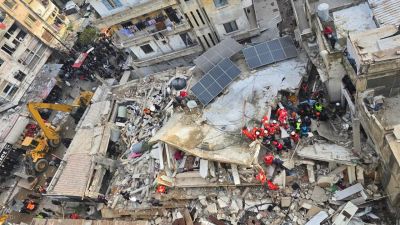
"The current government is not responsible for the disaster in Tripoli, which is the result of years of accumulated negligence. But it is now responsible for any further shortcomings ... and every drop of blood spilled," said the MP, who called for immediate funding to begin reconstruction work.
He praised Salam's expressed commitment to helping victims and supporting a planned urban initiative to build several hundred new housing units to replace those in at-risk buildings.
The Higher Relief Committee estimates that 105 buildings are at risk of collapse in the city, though several local officials believe the number is higher.
Salaries and pensions
Karami also announced he would not vote for any budget law that does not "restore the rights of civil service retirees," whose benefits have not been updated.
The government submitted the draft to Parliament on time, and the Finance Committee studied it, but it does not provide for a general adjustment to pay or public-sector pensions to offset the depreciation of the lira since the crisis began in 2019. However, Berri said the situation “will be resolved.”
On Tuesday, Deputy Speaker Elias Bou Saab said 10 MPs had signed a bill regarding the educational allowances of retired military personnel. Tony Frangieh (Marada) said his party could approve the budget "if the Finance Committee’s changes meet some of the civil servants’ expectations," and Georges Atallah said those demands should be considered.
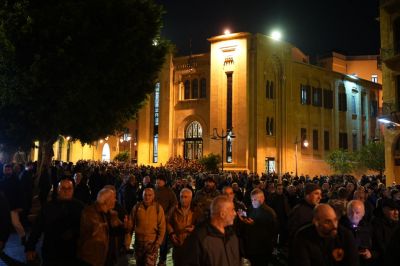
The public sector pay issue was at the center of protests by active and retired civil servants outside Parliament since Tuesday. On Thursday, public school teachers’ unions, particularly those with permanent positions, called for another sit-in at 11 a.m.
According to the state-run National News Agency (NNA), attendance increased compared to Wednesday, which saw fewer protestors than Tuesday. Tensions rose with soldiers stationed outside Parliament after some protestors tried to break through security barriers. After the morning session, Saab met with protestors to assure them their demands would be addressed, as he had on Tuesday.
Salam welcomed a delegation representing public school teaching staff and committed to continuing dialogue and beginning to adjust some pay "before the end of February," if possible, once the budget is passed and its figures confirmed.
Salam met with representatives of public school teachers in secondary, vocational, and elementary education. The delegation indicated that discussions focused on improving salaries in the education sector and that, within the next two weeks, figures will be clarified after the budget review is completed.
South Lebanon and reconstruction
The reconstruction of areas devastated by the war between Hezbollah and Israel — currently paused by a fragile truce in place since November 2024 — was also addressed.
Ghassan Atallah (FPM) called for southern Lebanon residents to be compensated, in the interest of "equality and justice," and also called for the issue of victims of the 1975-1990 civil war, who have not yet been compensated, to be addressed.
Hezbollah MP Ali Fayad, for his part, called for the “Israeli withdrawal” from positions its army still occupies in southern Lebanon, and for an end to Israeli attacks.
He said Lebanon must present a unified position on this issue — even as Hezbollah’s Secretary General Naim Qassem recently said the party could not remain neutral in the event of a U.S. attack on Iran, running counter to the official Lebanese stance.
Speaking at the end of the session, protest MP Mark Daou said, “Voluntary disarmament is needed to achieve national unity.”
Fayad also argued that “the trio of the Justice Minister [Adel Nassar], the Foreign Minister [Joe Rajji], and the Banque du Liban [BDL, central bank] Governor Karim Souhaid is stifling” the Shiite community.
The former two have repeatedly voiced opposition to Hezbollah's arguments for retaining its arms, while the third has tightened, since his appointment nearly a year ago, regulations on non-bank financial institutions, affecting the few remaining financial channels not entirely blocked by U.S. sanctions.
A brief exchange took place between Kataeb MP Elias Hankash and Berri regarding Hezbollah's disarmament. The former called for the Lebanese Army to continue its mission "north of the Litani, where the weapons that killed former Prime Minister Rafik Hariri and March 14 leaders, including Pierre Gemayel and Gebran Tueni, are located." The latter replied that those politicians “were not killed by the weapons of the Resistance,” and that southern Lebanon should also be rid of Israeli arms.
Tax pressure
Among general criticisms of the budget, Frangieh said the project "manages the crisis instead of confronting it," and added that “any budget that does not restore confidence in the banking sector is incomplete” — the latter issue to be addressed in a separate draft law under preparation.
Fayad lamented that budget tax revenues "have increased by 150 percent on salaries and compensation and by 160 percent on the car tax, while revenues from the income tax on profits have dropped by more than half, or 59 percent."
Ghassan Hasbani (LF) was more lenient, saying the budget shows a “modest reformist spirit” in terms of restrained spending and improved revenues, though nonetheless highlighting the lack of structural reforms.
Hankash criticized the projected measures for increasing tax pressure on the private sector, "which pays its taxes," while “the informal economy remains unchecked.” Sunni MP for Dinnieh, Jihad Samad, called for a fairer tax system for the less well-off, with more progressive taxes.
According to the Committee’s report, the bill aligns some taxes that had not yet been updated with the current exchange rate.

 7 p.m. recap: Netanyahu seeks mastermind behind Flydubai incident; Washington sanctions 2 French nationals; Ben Gvir's 'I want to kill you' threat