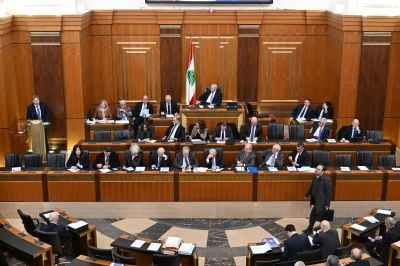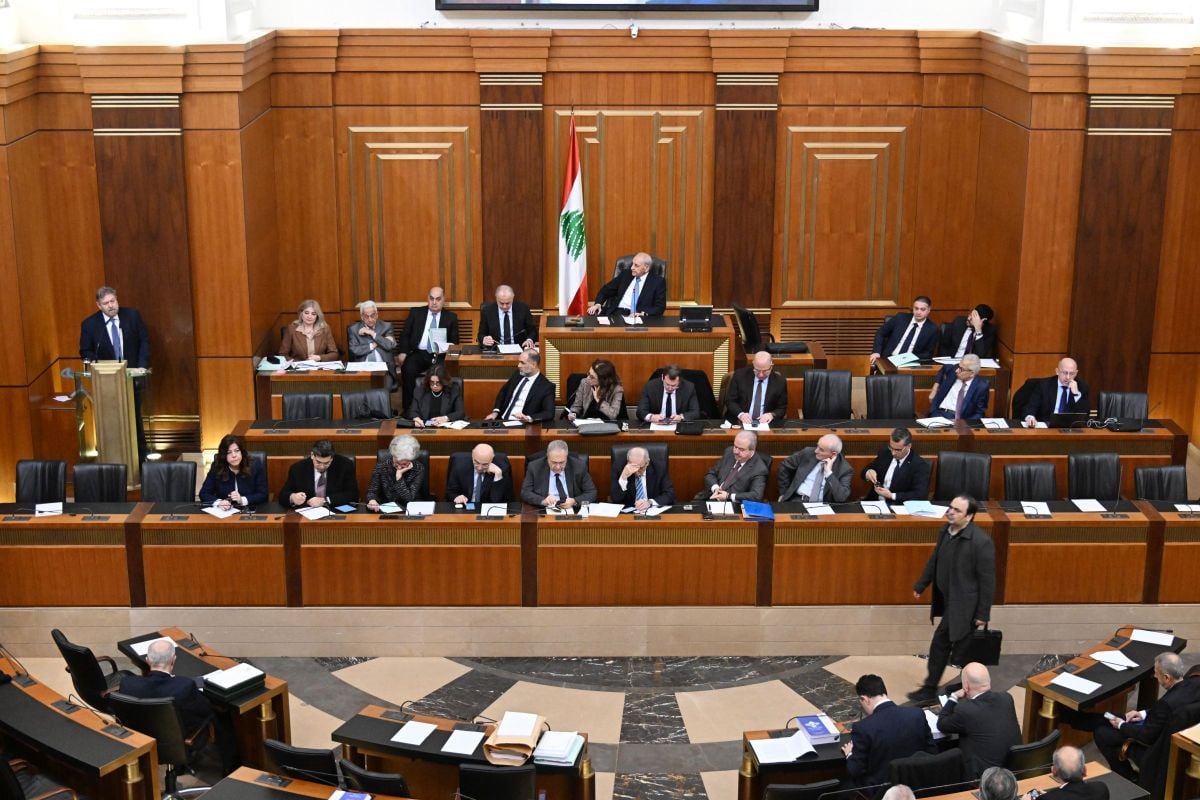
The Lebanese Parliament convened on Tuesday for three days to study the draft budget for 2026. (Credit: NNA)






BEIRUT — A second day of debates and interventions by members of parliament (MPs) opened Wednesday shortly after 11 a.m. in Parliament, as discussions continued over the state budget for the 2026 fiscal year.
Prepared by Nawaf Salam's government and amended by the parliamentary Finance Committee, the bill has been criticized by MPs from the outset.
"Why not increase investment? Quite simply because Lebanon remains in a state of war and no one wants to invest in a country that could erupt at any moment. Until we send the right signals, showing that we are now a sovereign country, there will be no more investment than this, and the budgets will be useless," he insisted.
"Why not increase investments?" he asked, stressing that, "Lebanon remains in a state of war and no one wants to invest in a country that could ignite at any moment. As long as we have not sent the right signals that we are now a sovereign country, there will be no more investments than this, and the budgets will be useless."
Budget 'neither constitutional nor sovereign'
For her part, Representative Cynthia Zarazir (who emerged from the 2019 protest movement) argued the text had "no legitimacy or political backing."
Her colleague, Halime Kaakour, pointed out the "lack of fairness" in the taxes provided for in the bill and, like many of her colleagues, criticized the absence of a law closing the accounts, which should normally go hand in hand with the finance law. She therefore denounced a budget that "is neither constitutional nor sovereign."
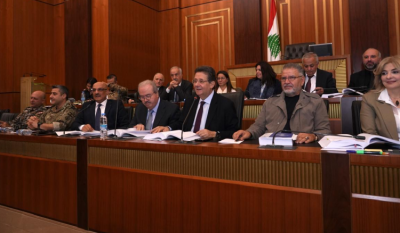
MP Razi al-Hajj (Lebanese Forces) stressed "the need to pay more attention to retirees, as they are the responsibility of the state," calling for 2 percent of budget expenditure to be allocated to pension increases. "We must not accept a budget that does not clearly recognize the extent of the state's debt," he argued, calling for a restructuring of the public sector.
In his intervention, Chouf MP Raji al-Saad also lambasted the draft budget, which he described as resembling that of a "shopkeeper," saying he hoped one day to debate a budget that would actually restore the country.
MP Fouad Makhzoumi criticized the bill for merely "plugging holes" and providing only "temporary solutions" for the public sector, regretting that spending on the army had been reduced to the "bare minimum."
Oussama Saad, secretary-general of the Popular Nasserist Organization and MP for Saida, denounced a text that does not measure up to the current challenges and risks facing Lebanon and "lacks commitments to reconstruction, the return of displaced persons from the south, and fairness for the military and civil servants."
Several members of parliament also raised the controversy surrounding the electoral law and the voting arrangements for expatriates. Independent MP Nehmat Frem from Kesrouan, focused on the electoral law, arguing that the current law, which dates from 2017, is "inapplicable" and suggesting the adoption of new legislation.
The law in force has sparked controversy in recent months over the expat vote; some believe the formula of six independent diaspora MPs should be preserved despite no executive decree regarding this voting method, while others demand that expats be able to vote for all 128 parliamentary seats based on their place of origin in Lebanon.
Adib Abdel Massih has stated that "it is clear that the elections will not take place on the scheduled date" and has therefore announced that he will propose a law "aimed at postponing the elections for one year, so as not to continue lying to the Lebanese people."
North Lebanon MPs make their case
Several MPs from North Lebanon have made demands on behalf of this disadvantaged region. Mohammad Yahya called for the opening of a branch of the Lebanese University in Akkar and the construction of a highway. Ahmad Rustom, for his part, argued for the reopening of Qoleiat Airport, a "national necessity."
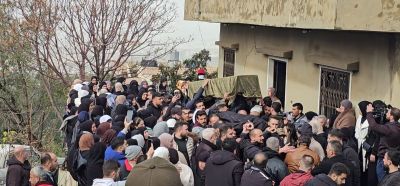
Ihab Matar denounced the "neglect" of the city of Tripoli, where a building collapsed last weekend, killing two people. He said the city had been "impoverished" by the state, as illustrated by the "unfair" budget proposal for the northern city.
Walid Baarini, meanwhile, criticized a law that does not offer "structural solutions to the problems of the Lebanese people."
Some 65 members of parliament are registered to speak, with around 20 having already taken the floor on Tuesday, though the Parliament's leadership is working to reduce the number of speakers in order to vote on the budget by Thursday evening.
The first day focused on comments on the text of the budget, which was often criticized for its lack of ambition in terms of reforms and the ambiguity of some of its articles.

The session was also marked by a debate around the latest speech by Hezbollah’s secretary-general, Naim Qassem, in which he threatened to open a new front in Lebanon if the United States attacks Iran. These remarks sparked verbal clashes between Hezbollah MPs and other lawmakers.
Public workers take to the streets for 3rd day in a row
Tuesday's session was also marked by strong popular mobilization in downtown Beirut, with numerous groups and unions demanding for their rights to be respected as stipulated by law.
The protests were much more subdued on Wednesday, while public school teachers' unions, particularly those representing tenured teachers, called for a new sit-in on Thursday at 11 a.m. in front of Parliament for the third day of budget debates.
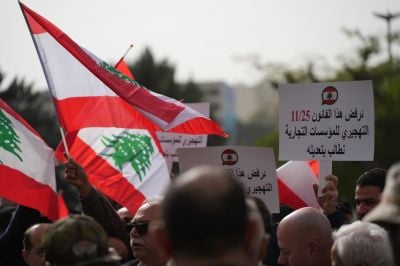
"Our fight will not end with the adoption of the budget. We are prepared to engage in a standoff with the government, and we will not back down until salaries and wages return to their former value," they promised in a statement sent to our correspondent.
They called on their colleagues in the profession "to arrive early to express their anger and demand their rights."
'Hardly any different from previous ones'
The parliamentary session resumed at 6 p.m., with a series of interventions that were largely critical of the draft budget. Beirut MP Ibrahim Mneimneh, who emerged from the Oct. 17, 2019 protest movement, called for “an approach that enshrines the primacy of the rule of law and the role of the state as the guarantor of the protection, well-being, and future of all Lebanese.”
Warning against “suicidal adventures” in dealing with the financial deficit, he questioned the possibility of selling the country’s gold reserves — an option immediately ruled out by Parliament Speaker Nabih Berri, who said it was “out of the question.” According to Mneimneh, “this budget is not reformist, hardly differs from previous ones, continues crisis management, and represents a missed opportunity.”
A similar tone was struck by Jbeil MP Ziad Hawat of the Lebanese Forces, who lamented the absence of “an exceptional budget laying the foundations for a genuine reform process.” “We are returning to the same policies and going in circles,” he said, criticizing the lack of growth, structural reforms, and “the absence of any serious vision to leverage state assets,” despite the existence of laws, particularly on public-private partnerships.
For Free Patriotic Movement (FPM) MP Assaad Dergham, the budget “does not reflect the aspirations of the people.”
Announcing that he would withdraw his confidence from it, he stressed the need to revise salaries, highlighting the collapse of pensions and retirement benefits, and holding the government responsible for the military retirees’ file. Simon Abi Ramia, a dissident FPM MP, denounced the halt in funding for the Janneh dam, calling the decision a “humanitarian crime.”
He also warned against rejecting the budget. “If we do not adopt it, we will return to the provisional twelfths system, a necessity budget,” he recalled, adding that “any budget that does not provide for universal health coverage is a budget against the citizen.”
The Constitution grants an additional month — until the end of January of the budget’s year of execution — if MPs fail to agree on adopting the law before Dec. 31. During this additional period, expenditures and revenues are implemented according to the provisional twelfths rule, meaning in the same manner as in January of the previous year.
For his part, northern MP Melhem Tok (close to the Marada Movement and the Syrian Social Nationalist Party) criticized the adoption of a budget without closing the accounts, seeing this as a violation of the Constitution. “We are still in the era of operating budgets, taxes, and the ease of dipping into citizens’ pockets, rather than an era of economic vision, investment, and production,” he said.
MP Elias Jaradeh of Marjayoun-Hasbaya, who also emerged from the protest movement, first lamented that the government “is content with merely watching Israeli aggressions,” and that “some ministerial positions even seem to align with Israel.” On the budget, he asked, “Where is the fight against waste and the reforms?” “We were hoping for a new start, an economic vision, and the strengthening of all economic infrastructure,” he said.
Sunni MP from Saida Abdel Rahman Bizri, for his part, regretted that the budget does not take into account the needs of populations displaced by Israeli strikes, citing a “lack of social justice” and the absence of any reform-oriented direction. “Nothing changes compared to previous budgets,” he observed.
Sunni MP from the Bekaa, close to the former Future Movement, Bilal Heshaimi, praised Prime Minister Salam’s position on the state’s monopoly over weapons. “There is no economy without stability, no stability without security, and no trust without a strong state and respect for the Constitution,” he concluded.