


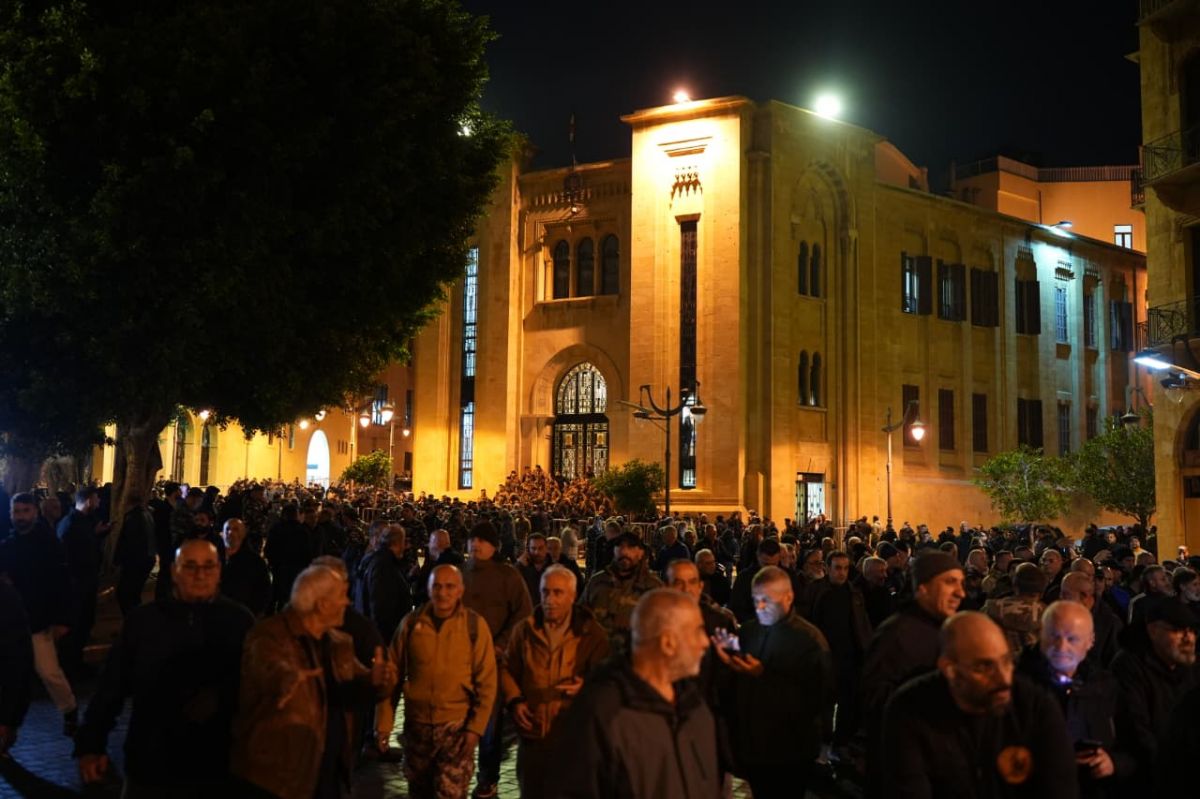
Protesters in front of the Parliament building on Jan. 29, 2026, at Nejmeh Square in Beirut. (Credit: Mohammad Yassin/L'Orient-Le Jour)






Many public sector employees, mainly retired military personnel, demanding an increase in their wages, salaries, and end-of-service benefits, took part in protests Thursday evening in Beirut, as well as in northern and southern Lebanon, following a day marked by demonstrations outside Parliament while MPs were meeting to vote on the draft budget law.
In the evening, dozens of protesters gathered outside Parliament in downtown Beirut. A retired soldier interviewed at the scene clarified that they were not "demanding an immediate 50 percent increase," but rather "seeking a commitment to such a threshold with a gradual timetable," noting that current salaries now represent only a fifth of their pre-crisis value.
Some protesters managed to breach security barriers set up by the armed forces and found themselves crowded in front of Parliament's entrance, according to live broadcast footage.
These breaches remained contained, even as protesters promised to escalate their action if no response was received.
During the session, Interior Minister Ahmad Hajjar and Defense Minister Michel Menassa left Parliament to address the military personnel gathered outside.
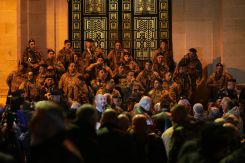
Representing retired military personnel, Roukoz entered Parliament and was joined by a group of soldiers for a meeting in Bou Saab's office.
The two ministers attended the meeting, which was later joined by Prime Minister Nawaf Salam, according to Parliament.
At the end of the discussions, Bou Saab stated that the prime minister was "determined to adopt a fair solution before the end of February and that the atmosphere is positive."
Roukoz, for his part, declared: "We are determined to obtain the 50 percent; nothing else is acceptable."
Shortly after, he clarified that a solution was being prepared and encouraged protesters to leave the area around Parliament.
In Tripoli, retired soldiers occupied al-Nour Square, according to our correspondent in the North.
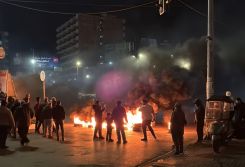
The main Minyeh road was blocked with burning tires, as shown in circulated images.
In Akkar, protesters gathered at Halba's main square. In the south, the Abbasieh road in the Sour district was also blocked with burning tires, according to our correspondent.
In the Bekaa, retired soldiers blocked the roads in Ablah and Taalabaya-Saadnayel in the Zahle district, according to our correspondent.
Since Tuesday morning, alongside the meeting of MPs, public sector employees — both active and retired — have been protesting in front of Parliament.
Tensions rose Thursday when soldiers stationed outside intervened after some protesters, responding to a call by teachers’ unions, attempted to breach the security barriers, according to the state-run National News Agency (NNA).
Following the morning session, which ended at 2 p.m., Bou Saab met with the protesters to assure them their demands would be considered, as he had already done on Tuesday. According to the agency, the number of participants was higher than on Wednesday.
The budget bill, submitted on time by the government to Parliament and reviewed by the Finance Committee, does not provide for a general adjustment of salaries or pensions to offset the depreciation of the Lebanese lira since the start of the socioeconomic crisis in 2019.
During a meeting on Thursday with public school teachers’ unions, the prime minister committed to continuing the dialogue and to begin adjusting part of the salaries "before the end of February," as much as possible, once the budget is passed and its projections are confirmed.
He denied media reports claiming that he had declared the government "had nothing to give to teachers." Another meeting has already been scheduled in two weeks.

 7 p.m. recap: Netanyahu seeks mastermind behind Flydubai incident; Washington sanctions 2 French nationals; Ben Gvir's 'I want to kill you' threat