






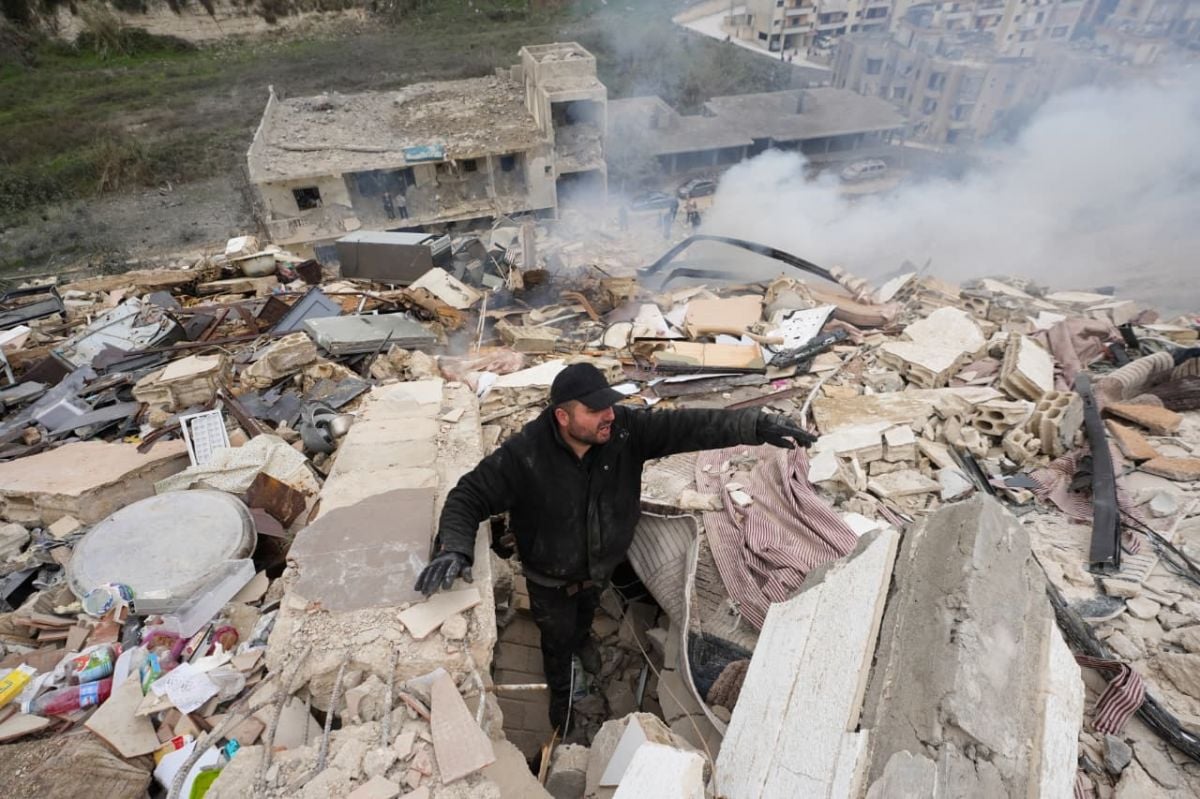
A man stands amid the rubble in Qennarit, in southern Lebanon, the day after Israeli raids targeted several villages, Jan. 22, 2025. (Credit: Mohammad Yassine/ L'Orient-Le Jour)






BEIRUT — In response to the extensive destruction caused by Israeli strikes in South Lebanon on Wednesday night, specifically in the districts of Saida and Nabatieh.
Around 20 people were wounded, including journalists — a wave of condemnations has emerged from political leaders across Lebanon.
Echoing the strong condemnation by President Joseph Aoun, Parliament Speaker and Amal Movement leader Nabih Berri called for "national unity" in the face of Israeli attacks.
Berri stated that "statements of condemnation and protest are no longer sufficient nor effective in protecting Lebanon and the Lebanese people," stressing that "what saves the nation, liberates its land, and protects it against Israeli aggression is national unity, and again, national unity."
Berri also gave instructions to the Civil Defense units under the Islamic Mission Scouts, the Amal Movement Social Services Office, and to the concerned municipalities to "make all their resources available to families whose homes were destroyed and who are now homeless," to provide them with "immediate aid."
He also wished "a swift recovery to the wounded," particularly the journalists, and again called for "the coordination of national efforts to confront the current challenges."
According to our South Lebanon correspondent, citing local residents and municipal sources, more than 50 families reportedly lost their homes in Wednesday night’s Israeli bombings.
At least four journalists were slightly wounded by stone shrapnel from Israeli strikes in Qennarit (Saida district), even though they were stationed 300 meters from the areas listed in an evacuation order, our correspondent reports.

Morcos denounces targeting of journalists
Social Development Minister Haneen Sayed and Information Minister Paul Morcos also condemned the Israeli attacks.
“We strongly condemn the Israeli attacks that targeted the South today, as well as the deep tragedies inflicted on civilians. At the Ministry of Social Development, we stand alongside our fellow citizens of the South and all affected Lebanese, in solidarity and support during these difficult times,” Sayed posted Wednesday evening on X.
Morcos, reminded that “targeting journalists is strictly prohibited,” with their protection in times of war guaranteed under international humanitarian law.
“These journalists were carrying out their professional duties beyond all prior warnings, in densely populated residential areas far from strike sites,” he pointed out.
He contacted several media institution directors, as well as journalists and photojournalists, to check on their well-being after the Israeli bombings. He also tried to reach other journalists present on the ground after the Israeli strike targeting Qennarit, in southern Lebanon.
The minister declared himself “in solidarity with the media sector,” condemning the exposure of journalists to danger while performing their professional duty.
He insisted on “the need to protect them in accordance with international laws and standards, particularly the four Geneva Conventions of 1949 and their 1977 Additional Protocols, which guarantee the freedom of media work and the protection of those in this sector, and do not allow them to be targeted under any pretext.”
Saida MPs condemn
Several MPs from the affected areas also responded, including Abderrahmane Bizri, independent MP from Saida.
He warned of the “grave humanitarian, security, and socio-economic repercussions” of the “continuation of these [Israeli] attacks, especially in densely populated civilian areas,” and called for the “protection of journalists.”
Saida MP Bahia Hariri, in a statement, also slammed Israel for “not respecting any agreement,” after targeting “civilians in their villages and towns, injuring civilians and journalists,” and causing “destruction and damage to civilian infrastructure.”
Former Social Development Minister Hector Hajjar also condemned “the Israeli machine of death and destruction.” Finally, the Jamaa Islamiya in Lebanon — a party represented in Parliament by MP Imad Hout — and the Palestinian Refugee Rights Defense Commission in Lebanon both denounced the Israeli attacks, particularly the one that wounded journalists.
In a different tone, Jaafari Mufti Ahmad Kabalan, who is close to Hezbollah, while criticizing the "brutal and treacherous" Israeli force, also pointed a finger at the Lebanese government for not treating “the South as if it were Beirut or Baabda.”
He then called in his message for the authorities to “fully assume their responsibilities” in South Lebanon.
Former Prime Minister Fouad Siniora, from Saida, expressed his “deep indignation and strong condemnation” in a statement.
He also warned against what he described as Israel’s “malicious intentions” in intensifying its aggression at a time when the government has announced the launch of the second phase of restoring the state’s monopoly on weapons, which notably includes disarming Hezbollah north of the Litani River.
The Syrian Social Nationalist Party said the stae was “responsible” for the situation due to its passivity in the face of Israeli strikes and its “inability to protect” the population.
The Islamic charitable association al-Makassed based in Saida also criticized Israel for injuring journalists in the Qennarit strike, according to a statement relayed by our correspondent in southern Lebanon.
Meanwhile, with the Lebanon cease-fire oversight committee (known as the 'mechanism') temporarily suspended and two meetings scheduled for January postponed, the Israeli army, despite the truce agreed on Nov. 27, 2024, remains in control of at least five positions within Lebanese territory and continues its daily bombardment of South Lebanon and the Bekaa.
Reporting by our regional correspondent, Mountasser Abdallah.

 8 p.m. recap: Israel again threatens Beirut’s south suburbs; 2 ships hit near Hormuz; Riyadh football matches canceled