


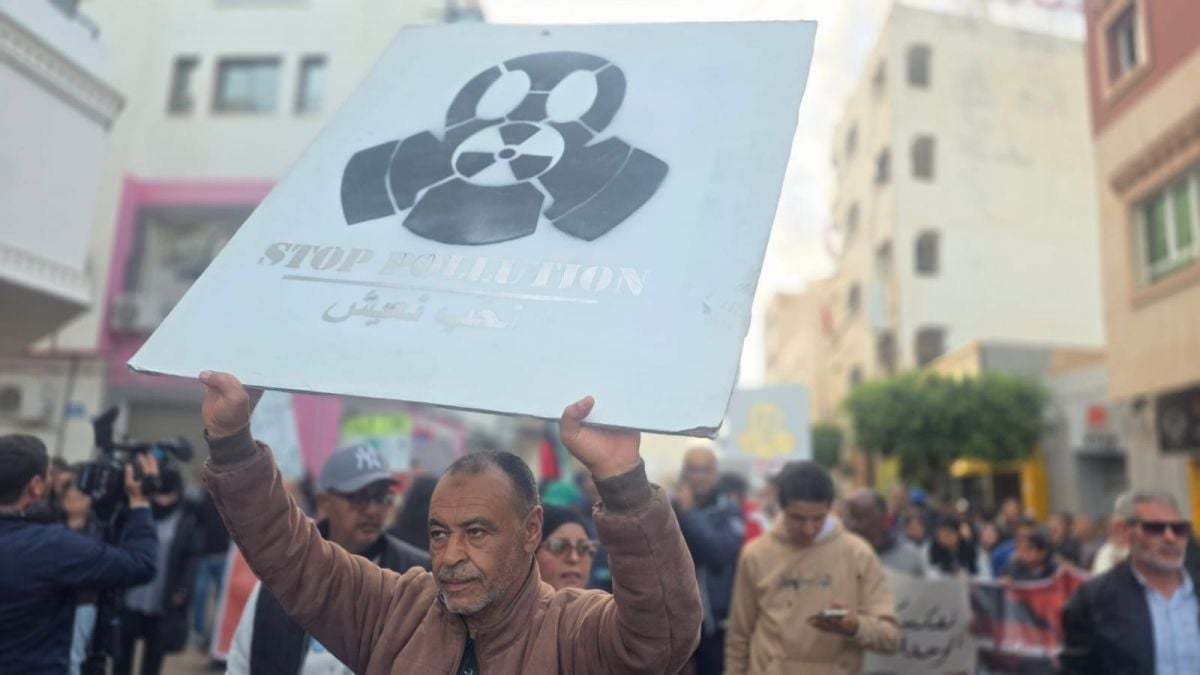
A protester holds an anti-pollution sign during a rally against the consequences of the Tunisian Chemical Group's activities in Gabès, on the Tunisian coast, on Dec. 17, 2025. (Credit: Lilia Blaise/L'Orient-Le Jour)






“Just imagine, 50 years ago, people used to swim here. Now, no one dares to go near the place,” said Salah Ghouma as he looked out over Chott Salem beach in Gabès. On the sand, a stranded turtle lies facing the massive facilities of the Tunisian Chemical Group. “This isn’t the first time. Everything dies here. Sometimes, hundreds of dead fish are washed ashore because of everything the group dumps into the sea,” said the head of the fishermen’s union in this southern Tunisian coastal city. On Tunisia's political context from our archives Tunisia after 15 years of a disillusioned revolution The state-owned company, which processes phosphoric acid into fertilizer, generates phosphogypsum waste containing radionuclides and highly toxic rare-earth elements, a practice that has led to the death of nearly 93 percent of marine...
“Just imagine, 50 years ago, people used to swim here. Now, no one dares to go near the place,” said Salah Ghouma as he looked out over Chott Salem beach in Gabès. On the sand, a stranded turtle lies facing the massive facilities of the Tunisian Chemical Group. “This isn’t the first time. Everything dies here. Sometimes, hundreds of dead fish are washed ashore because of everything the group dumps into the sea,” said the head of the fishermen’s union in this southern Tunisian coastal city. On Tunisia's political context from our archives Tunisia after 15 years of a disillusioned revolution The state-owned company, which processes phosphoric acid into fertilizer, generates phosphogypsum waste containing radionuclides and highly toxic rare-earth elements, a practice that has led to the death of nearly 93 percent of...
 Israeli army carries out demolition at Jabal Amel School in Houla as strikes continue