



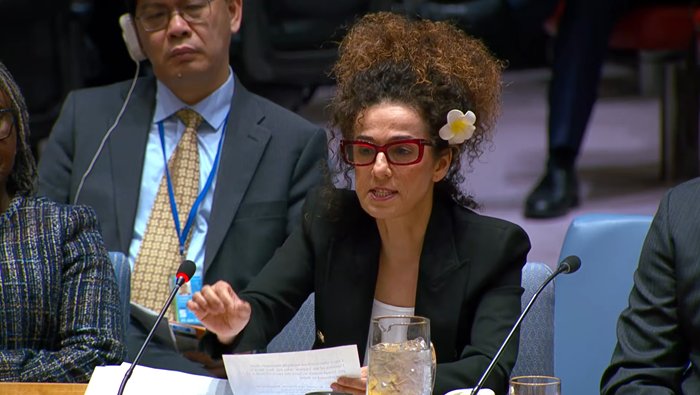
The Iranian activist and journalist Masih Alinejad speaking to the U.N. Security Council, on Jan. 15, 2026. (Screenshot from U.N. WebTV)






In front of the U.N. Security Council (UNSC), convened Thursday evening at the request of the United States, two Iranian journalists called on the international community to “real and concrete action” against the Islamic Republic, describing abuses and repression by the regime against all forms of opposition.
Journalist Masih Alinejad demanded that public funds “stop being stolen and sent to Hamas, Hezbollah and the Houthis,” faulting the United Nations for not responding “with the urgency this moment demands.”
These testimonies, according to Iran’s representative to the U.N., Gholamhossein Darzi, "do not represent his country’s civil society but instead advance the political agendas of the United States and Israel," while the American ambassador, Mike Waltz, stressed that "all options are on the table to stop the slaughter" of protestors.
Alinejad said that millions of Iranians need "real and concrete action" against a regime that does not understand the language of diplomacy, according to the UNSC. She described a total communications blackout with “no Internet, no cell phones and no landlines,” claiming this “total darkness” is meant to destroy evidence of crimes committed against the Iranian people.
She also accused the regime of firing at civilians during demonstrations, citing the use of AK-47s.
Iran’s 'auxiliary forces' in the repression
Activist and journalist Ahmad Batebi recounted the torture he endured during two years of detention in Iran.
Arrested as a student for participating in demonstrations, he had been sentenced to death, held in solitary confinement for two years and subjected to both mental and physical torture, including mock executions, adding: “I can show you my body right now to see the sign of this.”
“You tried to kill me, but you couldn’t […] you cannot kill all the people,” he said to Iran’s delegate. He added that, according to information he claims to have obtained from Iran, the number of people killed since the start of the protests is "the actual number is much, much more" than 12,000, the figure previously reported by opposition media outlet Iran International.
NGOs, for their part, reported a figure of about 3,000 deaths. Batebi also alleged proxy forces were involved in shootings, saying some “cannot even talk Farsi.”
Protests in Iran began in late December to protest the economic situation and the currency's devaluation. As the movement grew, it became heavily suppressed by the regime.
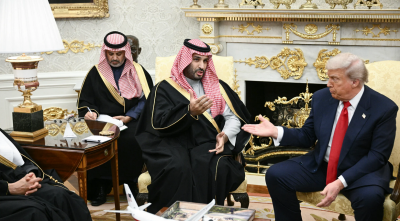
Iran is under pressure by the U.S., which is threatening military action, prompting it to announce it would not carry out summary executions of protesters.
The Iranian delegate's denials
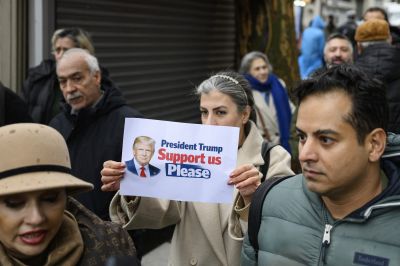
"President Donald J. Trump and the United States of America stand by the brave people of Iran," Waltz said at the meeting, rejecting accusations that the movement was a "foreign plot." He said the U.S. president "is a man of action" and that "no one should know that better than the leadership of the Iranian regime."
For his part, Darzi said that "calm has been re-established" in the country because "people across Iran ignored Mr. Trump’s call for further violence."
Any threat or use of force against Iran, under any pretext, including claims of “protecting protesters” or “supporting the Iranian people,” constitutes a grave and manifest violation of international law and the Charter of the United Nations, he warned.
Iran’s allies, Russia and China, also denounced the U.S.'s "interference." Russian Ambassador Vassily A. Nebenzia criticized "an attempt to justify blatant aggression and interference in the internal affairs of a sovereign state."
His Chinese counterpart accused Washington of "military adventurism."
Priority on diplomacy
On Thursday evening, Trump's envoy for the Middle East, Steve Witkoff, expressed hope during a conference of the Israeli-American Council in Florida that a "diplomatic resolution" would be found in Iran, stressing that Washington favors diplomacy over military action in this affair.
He said that on the Iranian issue, the U.S. wants to focus on four key elements: the nuclear program, enrichment, missiles and regional proxies, including Hezbollah.
Asked about the possibility of a strike against Iran, Witkoff reiterated that he hoped for a diplomatic outcome and said that the Iranian people were "incredibly courageous" to have risen up against the regime.

 7 p.m. recap: Netanyahu seeks mastermind behind Flydubai incident; Washington sanctions 2 French nationals; Ben Gvir's 'I want to kill you' threat