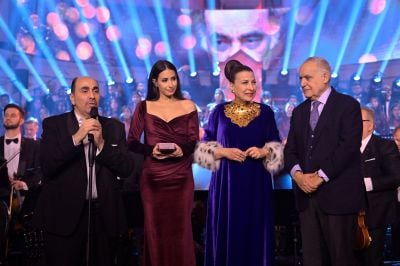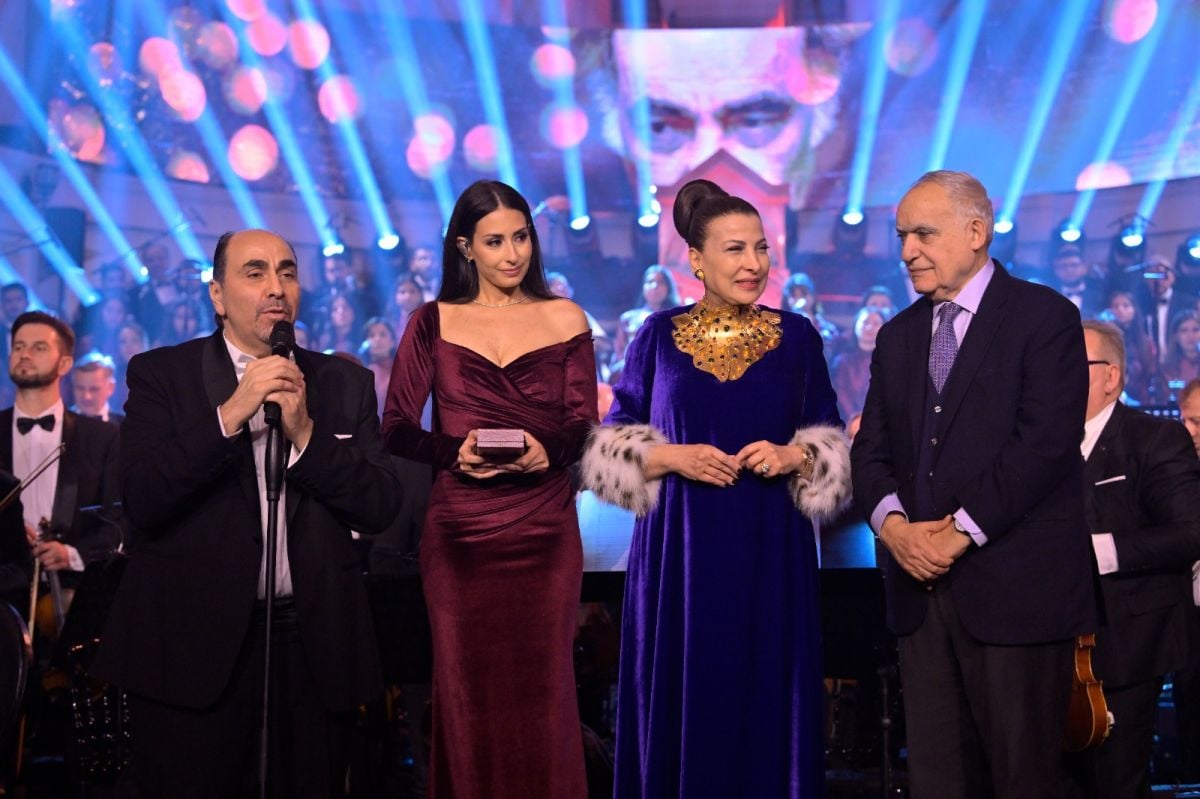
Oussama Rahbani, Hiba Tawaji, Hoda Ibrahim al-Khamis-Kanoo and Minister of Culture Ghassan Salameh gathered to honor Hiba Tawaji and the memory of Mansour Rahbani, at the end of the concert. (Credit: Nabil Ismaïl)






Rain poured over Gemmayzeh as thunder lit the stained-glass windows of the Sacreh-Cœur Church. Inside, a packed, attentive, almost somber audience listened as Mansour Rahbani spoke one final time. Not from the stage, but from the other side.
Through the words of “Ousafer Wahdi Malikan” (“I journey alone as king”), set as an oratorio by Oussama Rahbani, music opened a passage of a poet confronting death head-on, without pathos, transforming farewell into a collective act.
Published in 2007, the book was the last work released during Mansour Rahbani’s lifetime and under his direct supervision. It consists of 34 philosophical poems driven by dramatic force and infused with a cosmic vision that blends awareness of departure, absence, exile and existential questioning. This is threshold poetry, where lucidity never gives way to fear.
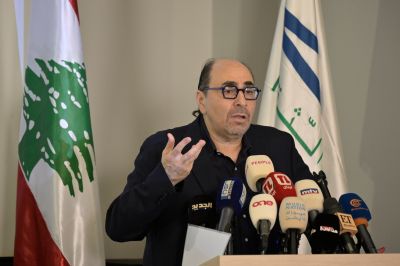
Rendered in modern Arabic and elevated by the crystalline voice of Hiba Tawaji and the deep narration of Jad Rahbani, the oratorio reveals a Mansour Rahbani more solitary than ever, immersed in inner reflection on life and death. At the edge of this passage, it is first to Assi Rahbani, his life partner and creative counterpart, that the poet addresses an open letter.
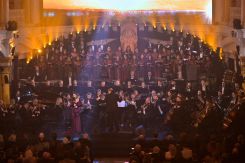
Set to epic melodies carried by the Ukrainian National Symphony Orchestra and the choir of Notre Dame University-Louaizeh, Mansour Rahbani gradually releases his grip on the world. He withdraws, advancing line by line and song by song into the inner night he never ceased to explore.
From solitude, the poet moves toward the multitude. Like a prophet seized by trance, he is accompanied by “all the peoples of the world.” “I am no longer myself; I am my people,” he declares, faithful to a lifelong commitment to the oppressed, the martyrs and the outcast.
Over the course of this extended monologue, personal suffering becomes collective. Lebanon is never far away, nor is Beirut, whose fall he mourns without turning away. “I will die tonight for Beirut, I will be crucified in Hamra, so that Lebanon may become hope and life for the martyrs,” Tawaji chants at a moment of rare intensity, before an audience frozen in reverence.

In the sacred space of the church, the concert takes on the contours of a poetic requiem, suspended between prayer, funeral chant and a cry of love. While the book unfolds from a dense, timeless human experience, the oratorio offers a briefer yet electrically charged immersion into this whirlwind of thought. For just over an hour, Mansour Rahbani is summoned — resurrected by music — until a final parting arrives, sealed by his ultimate celestial cry: “I journey alone as king.”
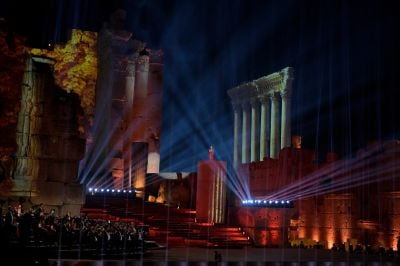
A deep legacy
Through this musical reinterpretation, Oussama Rahbani does more than set a text to music. He extends its breath, claims its inheritance and pays the founding father the truest tribute of continuity.
At the close of the concert, which brought together figures from culture, media and politics, Culture Minister Ghassan Salameh, representing President Joseph Aoun, presented Tawaji with the National Order of the Cedar.
The artist was also honored by Hoda Ibrahim al-Khamis-Kanoo, founder of the Abu Dhabi Music and Arts Foundation and initiator of the Abu Dhabi Classical Music Festival, which co-produced the concert.
“In his centennial year, Mansour Rahbani remains deeply embedded in our minds,” she said. “He has left a legacy that enriched our lives, our souls and our dreams. His work expressed our joys, our anxieties and our collective memory. He opened for us gardens of beauty and spaces of imagination, where poetry and song meet the truth of reality.”
“His creative journey was always guided by a compass of values, elevation and belonging,” she added, as the Abu Dhabi Classical Music Festival Prize for 2026 was awarded posthumously to Mansour Rahbani, recognizing an exceptional contribution to music and poetry, an inheritance destined to carry into the next century.