






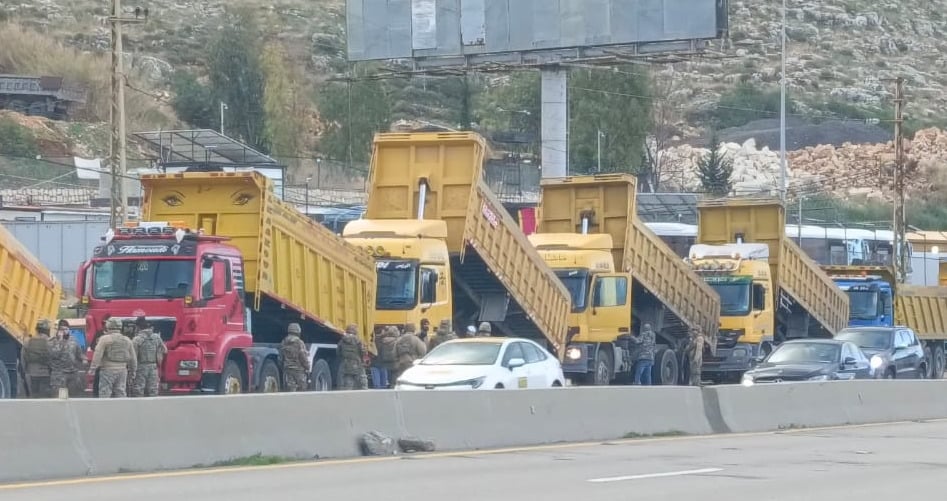
Truck drivers holding a sit-in on a section of the coastal highway near Jiyeh, on Jan. 14, 2026. (Credit: Photo provided by our correspondent Mountasser Abdallah)






BEIRUT — Truck drivers held a sit-in for several hours in the morning on the coastal highway near Jiyeh (Chouf), without blocking traffic, to protest the “extremely harsh professional conditions” facing workers in the sector.
Starting at 6 a.m., the partial roadblock was lifted around 9 a.m., according to the state-run National News Agency (NNA), under the supervision of the army and Internal Security Forces.
Unions and organizations in the land transport sector were later received at 10:30 a.m. by Bechara Asmar, president of the General Confederation of Lebanese Workers.
The representatives then released a statement addressing Prime Minister Nawaf Salam, noting that “the agreement reached with him, in the presence of several concerned ministers, has not yet been implemented,” even though it “places no financial burden on the Treasury” and aims to “reduce chaos and strengthen social stability.”
According to them, the land transport sector remains “undermined by the accumulation of crises, rising operating costs, lack of public support, and the failure to enforce existing laws.”
They stressed the need to “unite efforts and organize ranks” to defend their rights and “preserve the dignity of workers” in a sector described as an “essential pillar of the national economy.”
The unions called for the “transport plan that has been stalled in parliament since 2011” to be discussed and amended if necessary, so it can be implemented and put the sector “on the path to genuine reform.”
They also emphasized the “need to define the place of the legal public land transport sector” in any recovery plan, considering that ignoring it would be an “unacceptable marginalization.”
Finally, the truck drivers denounced the “complacency of the authorities” in the face of traffic code violations, especially by private cars operating as taxis, fake license plates, foreign drivers, as well as the proliferation of tuk-tuks and passenger motorcycles, arguing that this laxity represents “a direct threat to the stability of the sector” and “a flagrant violation of the law.”
