





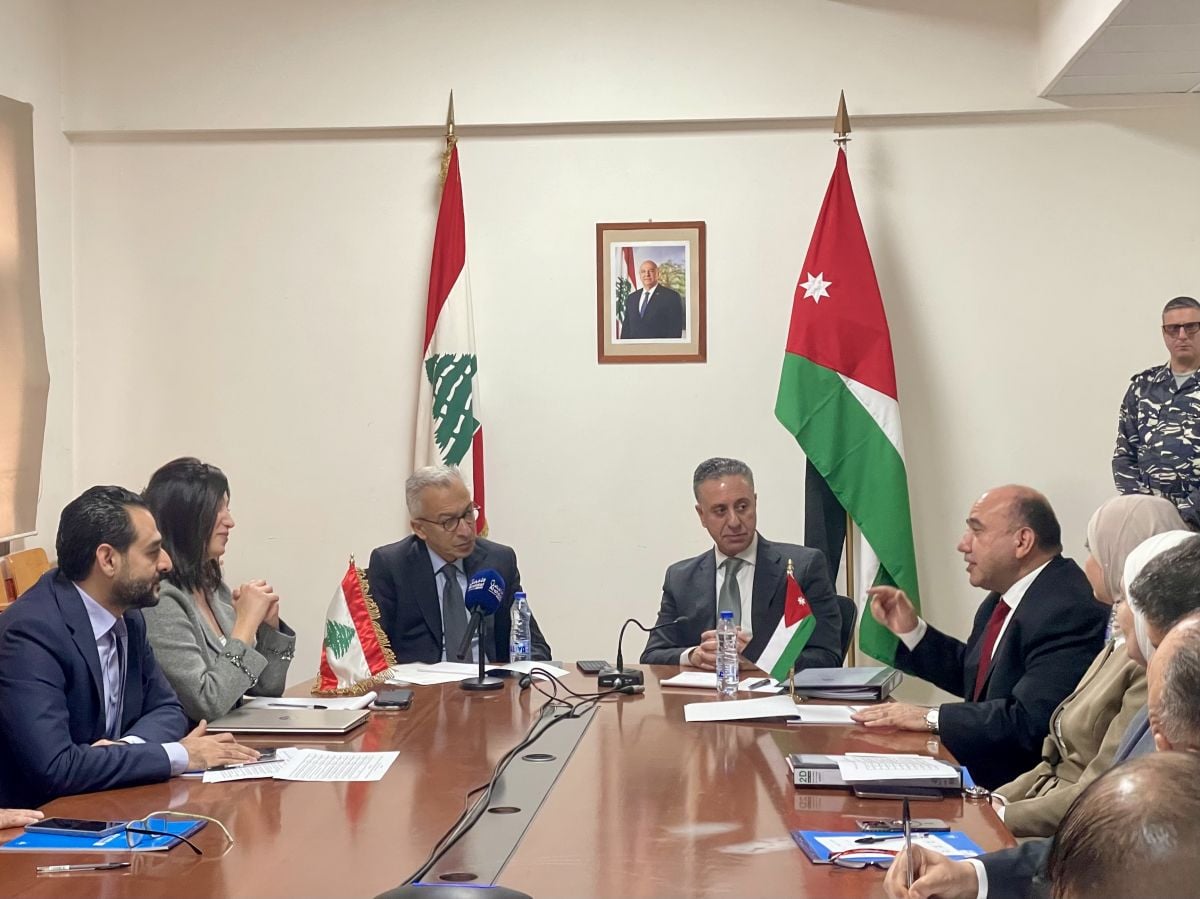
Economy minister Amer Bisat (3rd to the left), and Jordanian Minister of Industry, Trade, and Supply Yarub Al-Qudah (to his left) during the meeting of theJordanian-Lebanese Joint Higher Committee, at the Economy Ministry in Beirut, on Jan. 13, 2025. (Credit: Stephanie Bechara)






BEIRUT — Economy and Trade Minister Amer Bsat announced Tuesday that Lebanon and Jordan will sign 20 economic agreements, memoranda of understanding (MOUs), and protocols during a meeting of the Jordanian-Lebanese Joint Higher Committee, held in the presence of Jordanian Minister of Industry, Trade, and Supply Yarub Al-Qudah.
The agreements and programs are expected to be signed on Jan. 14, when the High Committee convenes under the chairmanship of Prime Minister Nawaf Salam and his Jordanian counterpart, Jaafar Hassan. They span cooperation across at least 14 ministries on both the Lebanese and Jordanian sides.
The protocols cover a wide range of sectors, notably industrial cooperation, consumer protection, the exchange of tax expertise, and the promotion and protection of investment.

They also include coordination on social security between Jordan’s Social Security Corporation and Lebanon’s National Social Security Fund, as well as cooperation in digital transformation and information technology, civil service and civil defense, electricity and natural gas, renewable energy, the environment, tourism, media, infrastructure — including roads, bridges, buildings, housing and public tenders — and rail transport, among other areas.
Jordan, a ‘strategic economic partner’
Six years after Lebanon’s economic collapse, and as the country seeks to restore “financial and economic stability and stimulate investment,” Jordan’s geographical proximity and long-standing position make it a “strategic economic partner,” Bsat said.
Bilateral trade between the two countries amounts to around $200 million annually, the minister noted, with Jordanian exports forming “a key pillar” of the Lebanese market, while Lebanese food and agricultural products maintain a strong presence in Jordan.
The agreements with Amman open up “promising opportunities for cooperation through joint projects and enhanced private-sector partnerships in both countries,” the economy minister said.

“This will be achieved through the implementation of signed agreements and closer coordination to apply Arab summit and Economic and Social Council decisions — particularly those related to Arab rules of origin, the liberalization of trade in services and the Arab Customs Union,” he added.
Arab Rules of Origin (ARO) are the legal criteria used to determine whether a product is considered “of Arab origin », qualifying it for duty-free or preferential treatment within the Greater Arab Free Trade Area (GAFTA).
The two sides also reaffirmed their commitment to accelerating the implementation of the 2002 Free Trade Area Agreement and to activating the “Rapid Intervention Unit,” a joint GAFTA administrative mechanism designed to resolve trade disputes and remove barriers.
In the tax and customs fields, emphasis was placed on exchanging expertise, enhancing customs interconnection, activating the 2010 Administrative Cooperation Agreement, and drawing on “Jordan’s advanced experience in customs modernization,” alongside the adopting international best practices to combat smuggling and facilitate trade.

 Evening recap: Netanyahu announces West Bank offensive; 7 killed in Jordan church shooting; tents burned in south Lebanon
 US strike on Iran this weekend? ‘Absolutely,’ says Barrack; ‘I have no idea,’ says Trump