


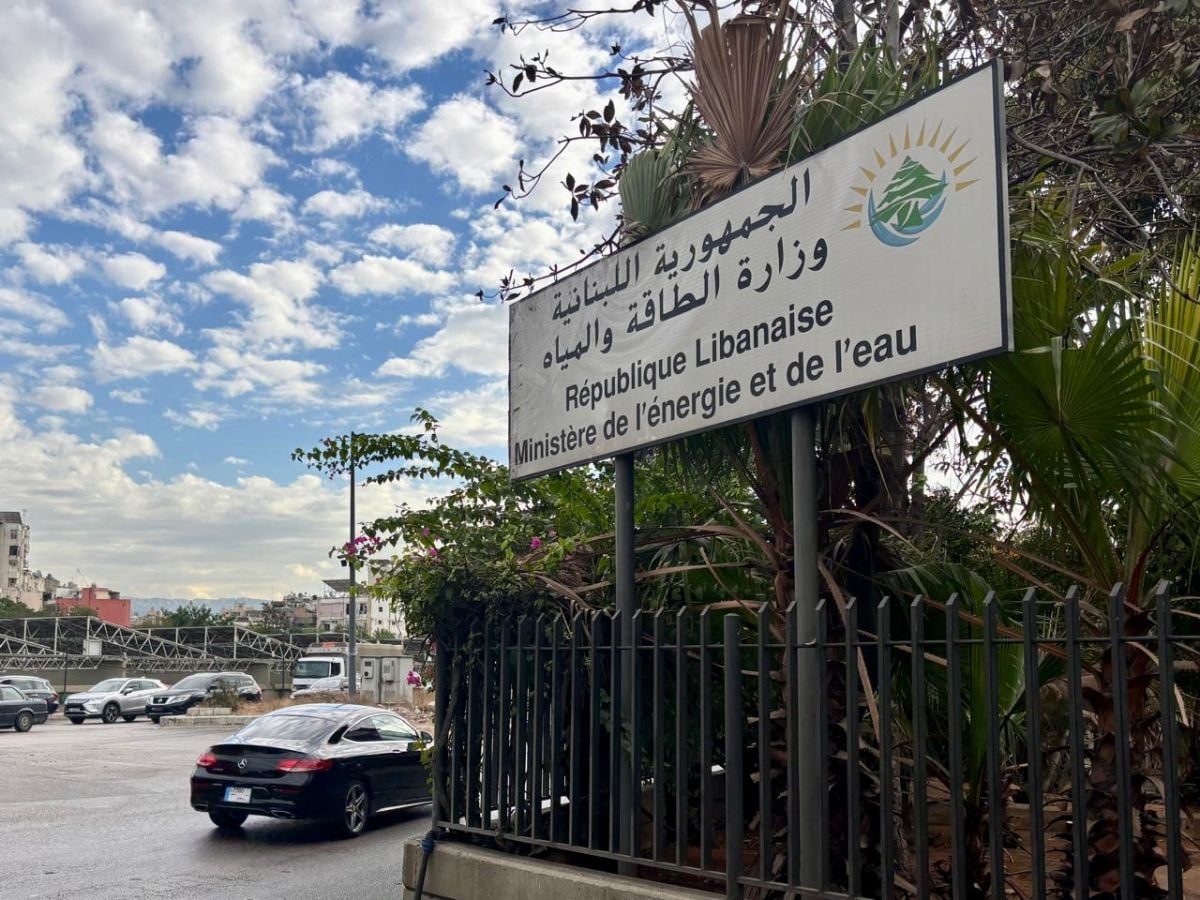
The entrance of the Energy and Water Ministry on the outskirts of Beirut, Oct. 8, 2025. (Credit: Philippe Hage-Boutros/L'Orient-Le Jour)






Energy and Water Minister Joe Saddi told L’Orient-Le Jour on Monday that Lebanon had not yet rehabilitated the facilities needed to receive Egyptian gas, but had identified the work that needs to be done, to be ready as soon as possible.
The official was responding to a report published the same day by the news site Asharq, which cited an anonymous source claiming that Egypt had started sending gas to Lebanon
"I can’t comment on that statement, but I can tell you where we are two weeks after the protocol was signed between Lebanon and Egypt, in Beirut, which will allow Lebanon in the future to procure Egyptian gas," said Saddi.
"There was recently a technical mission facilitated by Jordan, during which experts visited the field to inspect the state of the pipelines linking Lebanon [specifically Tripoli, in the north] to Syria. The experts provided us with a report on the work that needs to be started as well as a cost estimate," the minister explained to L’Orient-Le Jour, without disclosing any amounts.

He added that a similar mission had been dispatched to Syria for the same reasons, but that he did not have any additional information on the outcome.
"Then, a delegation from the Energy Ministry traveled to Egypt a week ago with this report to take part in an initial meeting intended to review the file, estimate the time needed to rehabilitate facilities, and assess Lebanon’s gas needs," Saddi continued.
"Things can move fairly quickly, but all facilities must be operational beforehand, from Aqaba in Jordan, where Egypt will deliver its LNG to Tripoli, passing through Syria," the minister summarized.
On Monday, Asharq announced that Egypt had already begun "injecting about 50 million cubic feet of natural gas per day to Lebanon, via Syria and the Arab Gas Pipeline, while also supplying 50 million cubic feet per day to Syria since the end of last week."
Citing an anonymous Egyptian official, the site added that "Egypt had reached an agreement with Syria and Lebanon to receive shipments of liquefied natural gas [LNG] on behalf of both countries via the regasification vessel chartered by Cairo, currently docked at the port of Aqaba, Jordan. About 100 million cubic feet of gas per day will be injected to both countries during the winter months."
At the end of December, Beirut and Cairo signed a memorandum of understanding aimed at meeting Lebanon’s natural gas needs for electricity production. The contracts, including the quantities involved, the sale price, and payment terms, were to be finalized in the coming weeks, while the imported gas would initially be used to fuel the Deir Ammar power plant in North Lebanon, with some production units already running on gas.
Egypt also signed two similar protocols with Syria a week ago, to supply it with gas via regasification vessels or through transport networks, but provided no details on the volumes involved.
The fact that Egypt is committing to export gas to two countries while importing part of its own supply is raising questions, especially since Cairo finalized a 35 billion dollar agreement with Israel at the end of December, providing for the delivery to Egypt of about 130 billion cubic meters (bcm) of gas by 2040.

 1 p.m. recap: Salam in Nabatieh; up to 10,000 more US troops heading to Middle East