






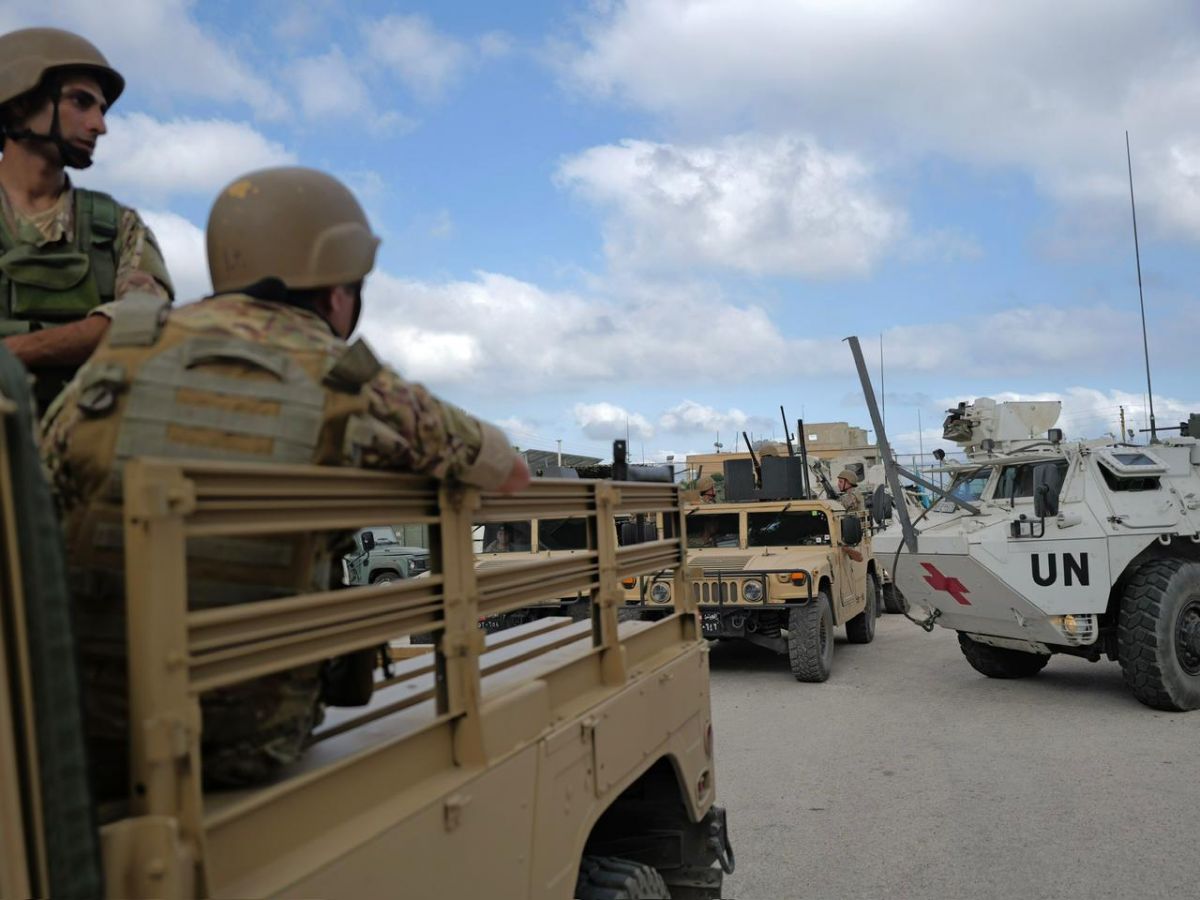
Lebanese soldiers and French UNIFIL troops on July 8, 2025, at a Lebanese Army base in the Sour region, southern Lebanon. (Credit: Matthieu Karam/L’Orient-Le Jour)






The Lebanese Army, which announced Thursday morning the end of the first phase of its plan to reclaim the state's monopoly on arms, is expected to present the next stage of its plan in February, aimed at disarming militias, and especially Hezbollah, north of the Litani.
The announcement was made by Lebanese Information Minister Paul Morcos following a Cabinet meeting during which Army Commander Rodolph Haykal presented the monthly status of the "Shield of the Nation" plan, which led to the dismantling of the party’s arsenal south of the Litani.
Shortly before the meeting at the Baabda Presidential Palace, the army had declared that its plan had "entered an advanced stage" and that the "objectives of the first phase" had been met, an achievement welcomed by Lebanese authorities, though it did not lead to a calming of tensions with Israel, as Israeli Prime Minister Benjamin Netanyahu said the disarmament efforts were "far from sufficient."

After the Cabinet meeting, Morcos said, "The Cabinet took note of the presentation made by the Army command regarding disarmament, and praised the efforts of the military institution."
The troops must continue to implement this plan "in all its phases, as quickly as possible" and must, in this context, develop their disarmament program north of the Litani, which will be submitted to the government in February.
Israel and the United States reproach the Lebanese authorities for not dismantling Hezbollah's arsenal quickly enough.
In recent days, the Israeli army has increased pressure on southern Lebanon and the Bekaa with numerous targeted strikes, bombardments launched with or without prior evacuation orders, and the demolition of several buildings along the border strip.
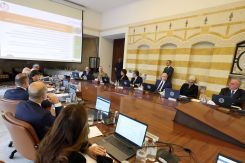
Morcos also praised the government for its "accomplishments" of recent months, as President Joseph Aoun will celebrate tomorrow, Jan. 9, the first anniversary of his term at the head of the state.
In the morning, the army published a lengthy statement, which did not mention Hezbollah by name, and in which it emphasized that it would carry out a "general and thorough assessment of the first phase of the 'Shield of the Nation' plan," on the basis of which it will determine "the direction of the next phases."
'Advanced stage' of the disarmament plan
The army reiterated its "total commitment to assume and exercise the exclusive responsibility for maintaining security and stability in Lebanon, and in particular in the area south of the Litani River."
Since the cease-fire of November 2024, the army has begun deploying in this zone, which was previously mostly under Hezbollah’s control.
This commitment is aimed, in particular, at "preventing any use of this area as a launching point for military action, as part of the state's decision to extend its authority by its own forces across the entire national territory," the army added.
In this context, it affirmed that the plan to reclaim state monopoly on weapons had "entered an advanced stage, after effectively and concretely achieving the objectives of the first phase on the ground," with the dismantling in recent months of the party’s military infrastructure south of the Litani and the retrieval of weapons from Palestinian Liberation Organization factions in the Palestinian refugee camps.
While these processes have taken place smoothly so far, Hezbollah nevertheless refuses to hand over its weapons north of the river.
As for Hamas, it is also unwilling to abandon its arsenal, citing the continuation of Israeli attacks against Lebanon.
In an 'irreversible' manner
The army further emphasized that its operations will continue south of the Litani "until completion of the handling of unexploded munitions, tunnels, and requests," via the monitoring committee for the truce's implementation, and measures against suspicious sites.
Over the past month, the Lebanese Army has repeatedly deployed in various villages to search homes, inside which no weapons have been found.
The aim of these measures is to "strengthen control and prevent armed groups from rebuilding their capabilities irreversibly."
Regarding cooperation with the "Mechanism," the monitoring committee, the army estimated that it "contributes to strengthening stability" in the region.
The troops also raised several points that are hindering the procedures to reclaim the monopoly on weapons, notably "the continuation of Israeli attacks, the occupation of several points inside Lebanese territory, as well as the establishment of buffer zones limiting access to certain regions."
"Added to this is the delay in the delivery of military equipment promised to the troops, a factor that directly impacts the pace of mission execution," it continued.
An international conference to support the army is scheduled for February.
Finally, the army praised the "constructive cooperation of southern citizens, whose commitment and concern for security and stability have been a determining factor in the success of the first phase," as well as the "exceptional efforts" of military personnel.