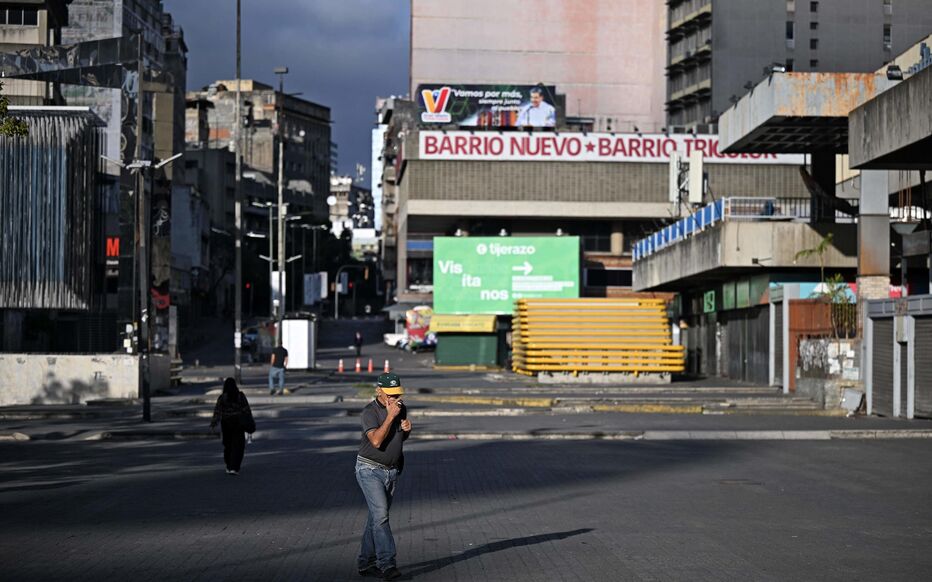
People walk along a street in Caracas on Jan. 4, 2026, a day after Venezuela's president, Nicolas Maduro, was abducted in a U.S. operation. (Credit: Federico Parra/AFP)






“We exchange a few words in Arabic, but it’s still dangerous. Everything is being watched,” said Raghida Neaimeh, born and raised in Venezuela and also a Lebanese citizen, who moved to Lebanon in 1998. For the past 72 hours, she has been glued to the news coming out of her birthplace.
From Lebanon, she has been trying to piece together what is happening in Venezuela through her family, who still live there. They barely dare to speak about the situation. On social media groups, they receive warnings: “Be careful what you say.”
“I don’t particularly like the United States, but if we can get something better than Maduro, I’m not saying no!” says Raghida, a mother. Her brother, Ziad, an executive in the Vente Venezuela party of opposition leader and Nobel laureate Maria Corina Machado, has been detained by the regime for a year.

“If my brother is released, I want him to come to Lebanon,” the woman in her 60s shares.
As ousted President Nicolas Maduro prepares to appear in a New York court, two days after being abducted in Caracas during a shock U.S. military operation, accounts from the Lebanese diaspora living in the country starkly contrast with the scenes of celebration displayed by many Venezuelans in exile.
“I felt like I was in Beirut”: Most of the diaspora in Venezuela contacted by L’Orient-Le Jour declined to speak, while the few who agreed avoided “political” questions, preferring to recount the events of those hours when the country was plunged into chaos.
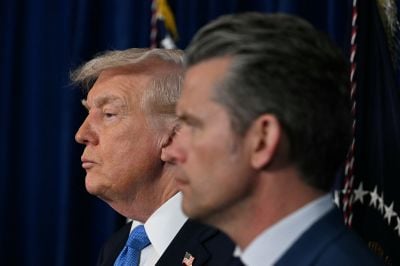
The Lebanese diaspora had been expecting U.S. airstrikes after threats from U.S. President Donald Trump. But “this operation shocked everyone,” says Layal*, who settled in Venezuela with her husband 24 years ago.
The bombings that targeted the capital and its surrounding areas on Friday night remain etched in the memory of this 44-year-old mother: “The houses shook."
Armando Murad was jolted awake by the strikes. “After that, I could hear the planes in the sky. I felt like I was in Beirut,” he recounts. “Even now, we’re still in shock: We’re not used to this here,” he sighs, before expressing his astonishment at the kidnapping of Maduro.
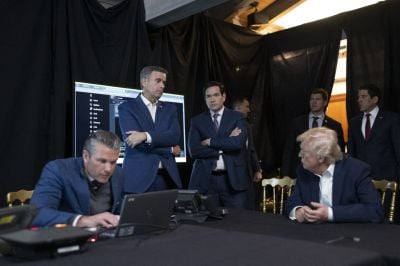
“It was like something out of a Hollywood movie,” says this local representative of the Lebanese Cultural Union in the World (ULCM), who has lived in Venezuela for 35 years and strives to maintain ties with their homeland for the many emigrants who have settled, sometimes for generations, in this South American country.
For over a century and a half, Venezuela has welcomed several successive waves of migrants from Lebanon, Syria, and Armenia.
And for Armando, leaving was out of the question: “We were more stunned than scared,” he says, indicating that he hadn’t considered returning to his wife and children, who live in Lebanon.
He’s not alone: Of the approximately 300,000 Venezuelan nationals registered by the Lebanese ambassador, Nisrine Boukaram, none contacted the emergency hotline established by the Foreign Affairs Ministry after the American operation, she states. “We received only two calls today [Monday, Jan. 5]: Two people who wanted to grant power of attorney.”
The day before, however, the capital still had the air of a ghost town, according to residents. Some neighborhoods remained plunged into darkness or cut off from the world due to the lack of internet access. Only pharmacies and supermarkets were open.
“And they were closing earlier than usual,” says Diana Ghostine, a journalist who moved to Venezuela less than four months ago to live with her husband. On Sunday, the situation “improved,” she says. “There might not be as much activity, but that’s normal; people don’t understand what’s happening.”
Issa’s family continues to watch the demonstrations in the capital from their balcony. “They don’t know if it’s anti- or pro-Maduro. Everything is confusing,” reports this Lebanese-Venezuelan man.
He lives abroad, but his family, who settled there in the 1950s, still resides in Venezuela. Some of his relatives are still without electricity and internet.
The young man doesn’t want to give any more details about his identity, fearing repercussions for his family. “We’ll see.”
While some say they see a glimmer of hope for their adopted country, uncertainty reigns for the vast majority. “We thought the system was going to change. Elections must be organized very quickly,” laments Raghida, while Venezuelan Vice President Delcy Rodriguez has been appointed to serve as interim president.
After demanding the release of the man she called “the only president of Venezuela,” and then being directly threatened by Trump with paying a “higher” price than Maduro, the new leader yesterday expressed her willingness to cooperate with the United States within the framework of “balanced and respectful relations… based on sovereign equality and non-interference.”
“We don’t know what awaits us. First, the United States talked to us about drugs; now they’re talking about oil,” sighs Armando. “The government had its problems, but when has the United States ever actually intervened in a country and made it better? May God have mercy on Maduro,” says Dania, who lives in Caracas and whose family is originally from the southern suburbs of Beirut.
“I’m still glad to know he’s gone. The future can hardly be worse than what we experienced under his rule,” adds Manal Abu Jokh, who has lived in Venezuela for 25 years but came to Lebanon for medical treatment.
Venezuelan public health services are considered too dilapidated, and private clinics too expensive. “We’ve been suffering a lot for several years now, due to record inflation and the lack of jobs. But I would have preferred him to be overthrown by the people or at the ballot box,” she says, in a mix of Arabic and Spanish.
Manal is eager to return to Caracas, where her two sons, aged 24 and 20, have stayed: “I’m waiting for flights to resume from Turkey.” Issa, for his part, doesn’t expect the “Chavez regime,” which dates back to the late 1990s, to be “uprooted” anytime soon.
“It’s going to take a long time,” he says, having not set foot in his native country for over 10 years because of the insecurity. “We have a slogan: Free Venezuela. I really hope that will be the case.”
*First name has been changed.
This article was translated from L'Orient-Le Jour.