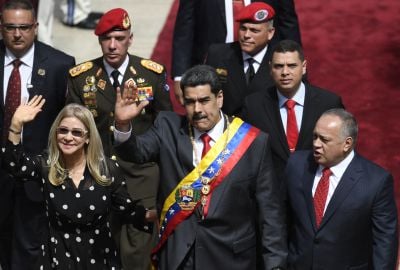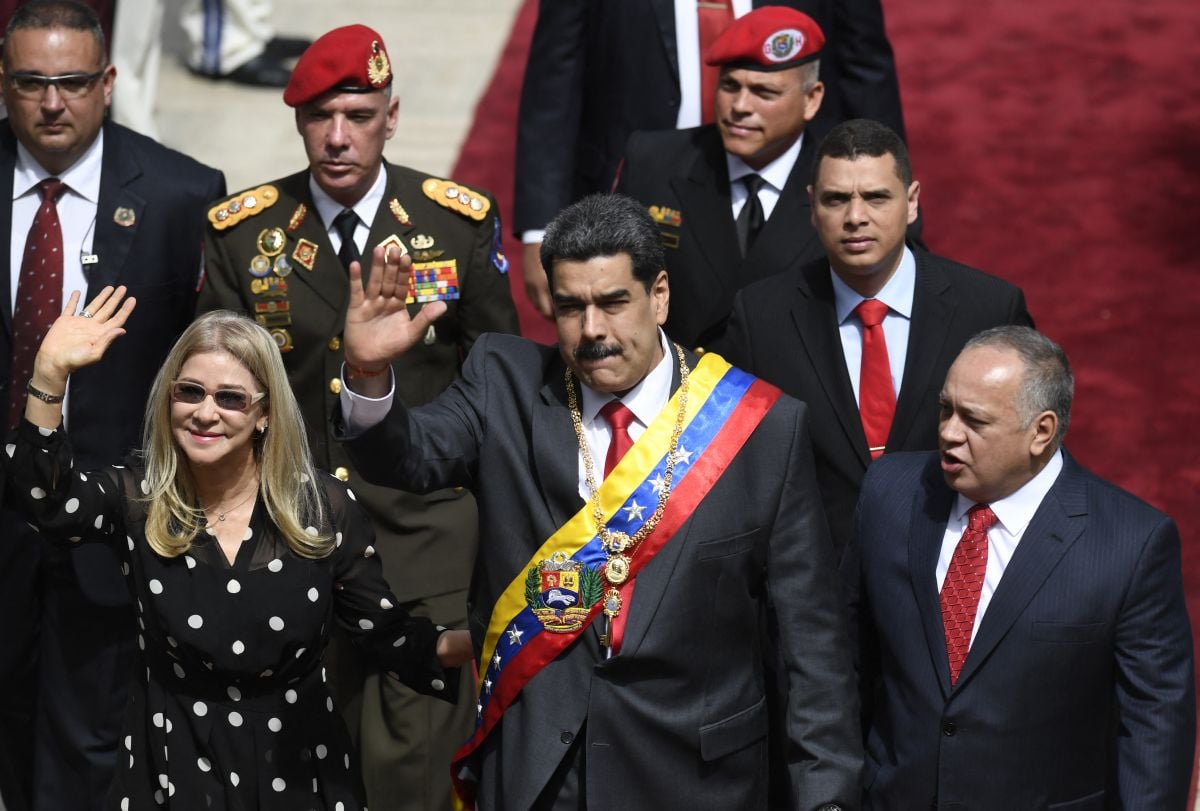
Venezuelan President Nicolas Maduro and his wife, First Lady Cilia Flores, on Jan. 14, 2020 in Caracas. (Credit: Federico Parra/AFP)






Following Saturday morning's sweeping military attack by the United States on Venezuela, during which President Nicolas Maduro and his wife were abducted by U.S. special forces, diplomatic reactions from around the world began pouring in. Yet the tone of official statements varied greatly depending on each country's relationship with Washington.
An ally of Maduro's regime, Russia was one of the first nations to condemn the surprise operation by the U.S. military, calling for the "immediate release" of the Venezuelan leader, who, at the time, was being held on a U.S. ship en route to New York to face trial. "The United States has committed an act of armed aggression against Venezuela. This is deeply worrying and must be condemned," said the Russian foreign ministry in a statement. "The pretexts used to justify such actions are indefensible. Ideological hostility has triumphed over business pragmatism," it added.
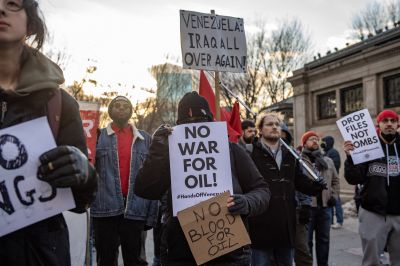
Meanwhile, U.N. Secretary General Antonio Guterres expressed concern "that international law has not been respected" with regard to Maduro's capture. He called the operation a "dangerous precedent."
Pope Leo XIV said Sunday that "the well-being of the dear Venezuelan people must prevail over all other considerations," and called for "the sovereignty of the country to be ensured," after the Angelus prayer in St. Peter's Square in Rome.
Crossing an 'unacceptable line'
In South and Central America, and especially in Venezuela's neighboring countries, Washington's attack revived memories of U.S. interventionism in the region, notably the 1973 coup in Chile that overthrew President Salvador Allende to install General Pinochet. "As Chile's government, we express our deep concern and condemn the U.S. military actions in Venezuela and call for a peaceful solution to the severe crisis facing the country," Chilean President Gabriel Boric wrote on X.
Similar language was used by Venezuela's neighbors, including Brazil, led by leftist President Luiz Inacio Lula da Silva, who called it the crossing of "an unacceptable line." "This action recalls the worst episodes of interference in Latin America and the Caribbean, and threatens to undermine the region as a zone of peace. Attacking countries in flagrant violation of international law is the first step toward a world of violence, chaos and instability, where might makes right instead of multilateralism," he said.
The same is true in Colombia, which announced it would deploy its army along the border with Venezuela. "Colombia reaffirms its unconditional commitment to the principles enshrined in the United Nations Charter, notably respect for the sovereignty and territorial integrity of states. In this regard, the Colombian government rejects any unilateral military action that could worsen the situation or endanger the civilian population," President Gustavo Petro denounced.
In Cuba, another historic foe of Washington in the Caribbean, President Miguel Díaz-Canel Bermúdez called the U.S. operation "state terrorism" against the Venezuelan people. "Cuba denounces and urgently demands a reaction from the international community in the face of the U.S.'s criminal attack on Venezuela. Our zone of peace is brutally assaulted. State terrorism against the courageous Venezuelan people and against our America," he wrote on X.
Reactions from the Arab World and Israel
Other countries, however, refrained from commenting on the U.S. strikes against Caracas, whose human toll has yet to be communicated by Venezuelan authorities. From Lebanon to the Gulf countries, including Syria and Egypt, there were no official statements as many of these states seek to maintain good relations with the U.S. administration.
In Lebanon, only Hezbollah and other parties close to the pro-Iran axis condemned the "terrorist aggression" and "U.S. brutality" against Venezuela. "This attack is further confirmation of the policy of domination, arrogance and plundering carried out by the American administration without restraint, and demonstrates its disregard for international stability and security, while consolidating the law of the jungle," said Hezbollah.
Another U.S. adversary, Hamas, denounced "an act of aggression that is part of the ongoing unjust U.S. policies and interventions hiding imperialist ambitions."
In Iran, which was targeted by U.S. strikes in June 2025 during the "12-Day War" with Israel and was recently threatened again by Donald Trump, President Massoud Pezeshkian and Foreign Minister Abbas Araghchi remained silent. Only the Supreme Leader Ayatollah Ali Khamenei made remarks that offered a potential implication to the event, in a local context marked by widespread anti-regime protests and worsening economic conditions. "What matters is that when the enemy arrogantly tries to impose something on the country, the authorities, the government, and the nation, we must stand firm and offer our chests in resistance. We will not yield to the enemy,” he declared.
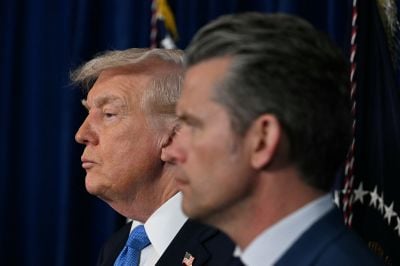
For his part, Israeli Prime Minister Benjamin Netanyahu, who had met with his ally Trump last week in Florida, said that Israel supports the "determined" U.S. action in Venezuela. "In Latin America ... several countries are coming back into the U.S. orbit and ... renewing their ties with the State of Israel. We are pleased, we congratulate President Trump ... and also salute the U.S. armed forces who carried out a perfect operation," he added, according to AFP.
Measured condemnations in Europe
In Europe, reactions were also measured, as in the statement by European Commission President Ursula von der Leyen. "We stand with the Venezuelan people and support a democratic and peaceful transition," she said, without mentioning the U.S. strikes in Caracas or Nicolas Maduro's abduction.
"The EU is closely monitoring the situation in Venezuela. In all circumstances, the principles of international law and the United Nations Charter must be respected. We call for restraint," added EU foreign policy chief Kaja Kallas.
Several European leaders did react, including Spanish Prime Minister Pedro Sanchez, who called for "de-escalation," after his foreign minister said he was prepared to mediate to achieve a "peaceful and negotiated solution to the current crisis."
His British counterpart, Keir Starmer, avoided condemning the act. When pressed by a reporter, he simply reiterated that "all countries must respect international law," assuring that the United Kingdom had "not participated in this operation." "I would like to speak with President Trump, but for now, I think we need to establish the facts," he said in a brief statement on British television.
In France, the Foreign Ministry published the first official response around 5 p.m. (Beirut time) Saturday, via a statement from Foreign Minister Jean-Noel Barrot. "The military operation that led to the capture of Nicolas Maduro runs counter to the non-use of force principle that underpins international law. France recalls that no lasting political solution can be imposed from the outside and that sovereign peoples alone decide their future," he wrote, while estimating that Maduro "seized power from the Venezuelan people by depriving them of their fundamental freedoms."
French President Emmanuel Macron praised the end of "Maduro's dictatorship" and called for a "democratic transition," without mentioning the U.S. attack in his statement, provoking outrage among the French left.
China and North Korea express outrage
Beijing said it was "deeply shocked" by the U.S. military strikes against Venezuela and the capture of President Maduro, denouncing what it called Washington's "hegemonic behavior." "China is deeply shocked and firmly condemns the flagrant use of force by the United States against a sovereign state and their action against its president," the Chinese foreign ministry said Saturday in a statement. On Sunday, this ministry called on the United States to "immediately release" Maduro and his wife and "stop seeking to overthrow the Venezuelan government," in a separate statement.
North Korea called Maduro's capture Sunday a "grave infringement on sovereignty," according to state media. It also "strongly condemned the hegemonic act committed by the United States in Venezuela," calling it "another example that confirms yet again the rogue and brutal nature of the United States," according to a ministry spokesman in a statement carried by official KCNA news agency.