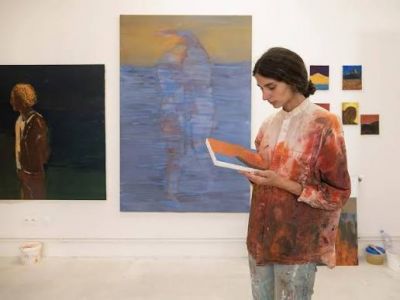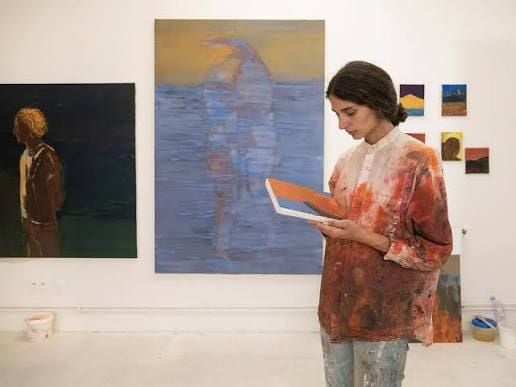
Christine Safa in front of her canvases at Galerie Lelong in Paris. Photo Galerie Lelong






Amid the frantic pace of Paris, Galerie Lelong, tucked at the corner of Rue de Teheran, recently hosted Christine Safa’s “I Have Two Homes,” an exhibition that unfolded like a slow, unhurried sigh. Its Mediterranean breath warmed Paris’ biting winter, offering visitors a cocoon of idleness and intimacy.
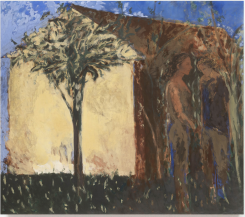
The show reads as a sensual caress. On canvases where paint becomes both sculptural and architectural, facades of houses and mountain flanks rise from the surface like primitive cave reliefs — organic, tactile, alive.
From this material world emerges Safa’s own delicate silhouette, enveloped in a dreamlike softness she commands with quiet assurance.
Exile and nostalgia as inheritance
“Imagined country, real country,” this is how Safa describes Lebanon in a text written in Beirut and included in the catalogue of her previous solo exhibition at Galerie Lelong in 2023.
Her paintings layer mental images softened by the languor of dreams, where mountains, coastlines and blazing horizons of a very real Lebanon intersect. Out of this alchemy of dream and reality emerges a carefree country, sometimes insolent, defiantly alive despite war and political and economic instability.
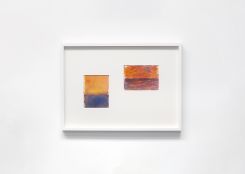
From Horizon rouge, mer bleu cobalt to Mer noire, montagne bleue, ciel rouge, an idle atmosphere settles in, tinged with a Bonjour tristesse melancholy worthy of Françoise Sagan.
Aware of the violence endured by thousands of Lebanese, Safa initially, while studying at the Beaux-Arts in Paris, attempted a more overtly committed painting style, which she now describes as that of a “warrior child.” Over time, she accepted that her bond with Lebanon is above all poetic.
“I didn’t feel like I belonged,” she says, “because I couldn’t claim to have lived what my cousins and friends who grew up in Lebanon experienced. I eventually accepted that there is still poetry in Lebanon, and that is what affects me most. Being born in France, as part of the first generation of immigrant children, is in itself a sufficiently political condition. My work constantly questions this nostalgic relationship to the ‘elsewhere’ that is Lebanon, a feeling I believe many Lebanese share.”
Born in the Paris suburbs, Safa says she has always lived in-between, between France and Lebanon, an interworld that now materializes on her canvases. “Lebanon gave me certain subjects,” she explains, “the horizon, the suns, the moon, the sea. As I more serenely accepted my life in France and my identity questions eased, houses began appearing in my imagination. I never thought I would paint them, as I’m not especially drawn to architecture.”
On the white canvas, forms surface first as memories: a horizon line over the sea, facades of suburban Parisian houses. Recalling the genesis of Un matin (le silence, la maison), Safa describes an impulse rooted in a lexicon of primitive forms — “square,” “house,” “tree,” “figure” — nourished by Italian painting and the perspectives of the Trecento and Quattrocento, from Giotto to Fra Angelico. The earthy palette bears this influence.
Layer by layer, dream and reality accumulate, turning the canvas into a palimpsest of nostalgic memory, that of an heir to exile, recalling summers in the Lebanese mountains, when an entire family conspired to offer her “the best of moments.”
“My grandparents welcomed me like a queen,” she recalls.
Poetry also irrigates Safa’s preparatory work. Etel Adnan, in particular, helped her reconcile this aesthetic, poetic relationship with Lebanon.
If a poem were to accompany Safa’s horizons, it might be Adnan’s: “You are half virgin and / half fire / your absence radiates its / light / and summer pursues you.”
A child’s gaze
Safa’s gaze remains foreign to adult anxieties, even as it belongs to a woman who fully inhabits and accepts the sweetness of her Parisian daily life. She has built a harmonious cocoon in her suburban home with her husband Nathan, a recurring, almost angelic presence in her work, while preserving what Henri Bergson described in Le Rire as childhood’s lingering perfume.
Safa unfolds her imagination like a child daydreaming at a car window, envisioning the promises of adulthood. And the adult, in return, draws from childhood innocence what is most sensual and precious in the present.
“I have incredible childhood memories,” she says, her smile lit with gratitude and gentle nostalgia.