






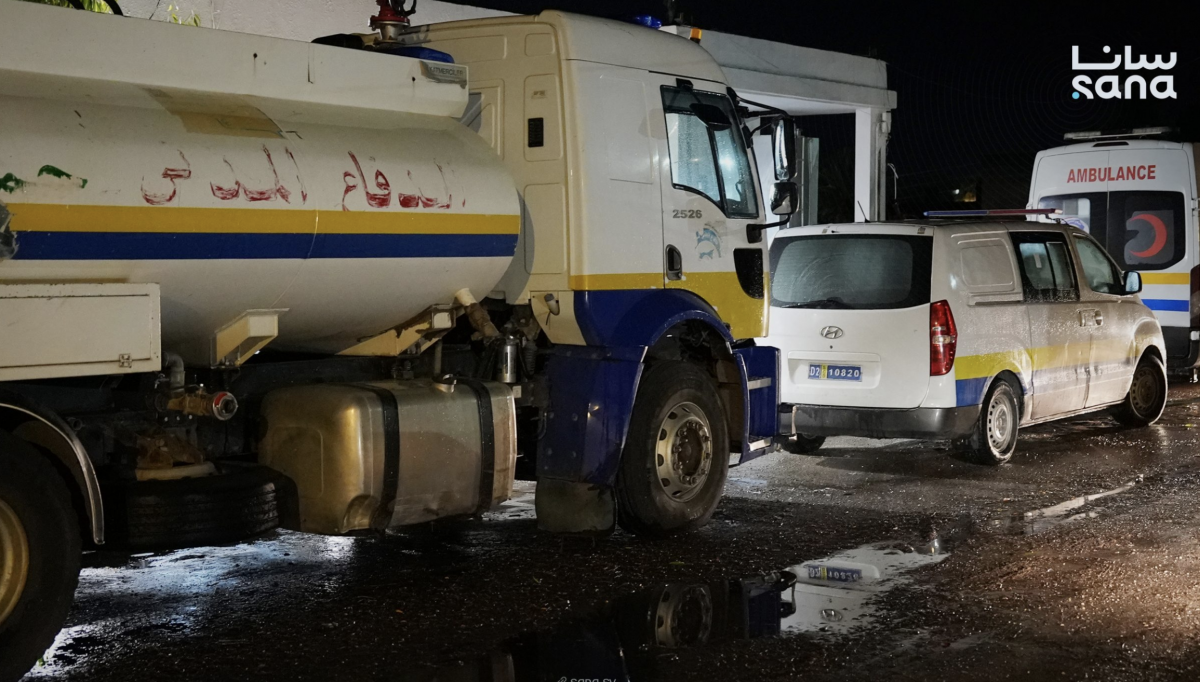
Civil defense vehicles from Tell Khalakh, located in the Homs region, were deployed following the drowning of people who attempted to cross the Lebanese-Syrian border via the Nahr al-Kabir river, on the night of Saturday, Dec. 27, to Sunday, Dec. 28, 2025. (Credit: SANA)






At least four people drowned overnight from Saturday to Sunday in the Nahr al-Kabir, while attempting to illegally cross the river at the Lebanese-Syrian border in the Homs region (West), according to the Syrian Civil Defense as reported by state-run news agency SANA.
Search operations rescued three people — two women and a young man — from a group of 11, according to the Civil Defense chief in Tell Khalakh.
Four members of the group managed to return to Lebanese territory, he added. No information has yet been released about other groups that may have tried to cross the border.
Searches were halted due to "the rising water level and the strength of the current," as well as "the presence of mines left behind by the old regime along its banks."
Anti-personnel mines had been placed along the Lebanese-Syrian border by the Assad regime, in front of Lebanese villages — especially after the start of Syria’s civil war in 2011 — in an effort to control border crossings.
When the Nahr al-Kabir river overflows, landmines are often washed to the Lebanese side. Syria shares a 375-kilometer border with Lebanon, with no official demarcation in many areas, making it porous.
Search operations continued on both sides of the border Sunday morning, according to our correspondent in northern Lebanon.
'Return of Syrians through official crossing points'
The Lebanese Army, meanwhile, denied forcing people to turn back by crossing the riverbed, contrary to reports on "some news websites," according to a statement released by the military Sunday.
"Army command clarifies that the military units did not intervene in the relevant area, as they had received no information about any attempted illegal crossing in this sector. It notes that these units are conducting searches to locate people carried away by the waters, in coordination with Syrian authorities."
The army also stated that it "facilitates the voluntary return of Syrians to Syrian territory through official border crossings, ensuring their safety and guaranteeing that they arrive securely on the Syrian side, in coordination with the relevant Syrian authorities."
In the past year, more than a quarter of Syrian refugees in Lebanon have returned to Syria, the highest return rate in the region.
The head of the judicial police in the Tell Khalakh area told SANA agency that he received a report at 11:30 p.m. Saturday, "regarding the drowning of people attempting to cross the border by illegal routes."
A security force arrived on site, and "Civil Defense teams and members of the 52nd brigade managed to rescue" three people, who were transferred to the Tell Khalakh National Hospital. Survivors recounted "the rising waters and the force of the current," as well as "heavy rain," according to testimonies collected by the Syrian agency.
Stormy and windy weather hit the region on Saturday. Near the border with Syria in Akkar, northern Lebanon, residents of the villages of Dreib and Kawashira were surprised by giant hailstones and had to seek shelter, our correspondent reported.
